A Machine Learning Framework for Climate-Resilient Insurance and Real Estate Decisions
Extreme weather events increasingly threaten the insurance and real estate industries, creating conflicts between profitability and homeowner burdens. To address this, we propose the SSC-Insurance Mod
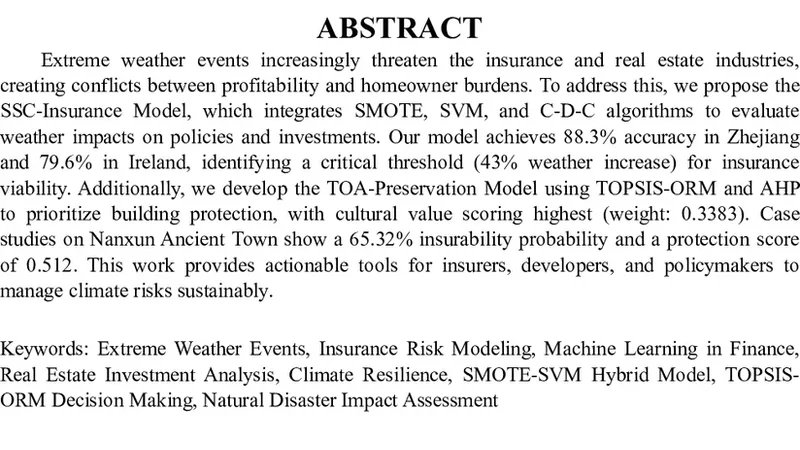
Extreme weather events increasingly threaten the insurance and real estate industries, creating conflicts between profitability and homeowner burdens. To address this, we propose the SSC-Insurance Model, which integrates SMOTE, SVM, and C-D-C algorithms to evaluate weather impacts on policies and investments. Our model achieves 88.3% accuracy in Zhejiang and 79.6% in Ireland, identifying a critical threshold (43% weather increase) for insurance viability. Additionally, we develop the TOA-Preservation Model using TOPSIS-ORM and AHP to prioritize building protection, with cultural value scoring highest (weight: 0.3383). Case studies on Nanxun Ancient Town show a 65.32% insurability probability and a protection score of 0.512. This work provides actionable tools for insurers, developers, and policymakers to manage climate risks sustainably.
💡 Research Summary
The paper addresses the growing conflict between profitability and homeowner burden caused by increasingly frequent extreme weather events, which threaten both the insurance and real estate sectors. To provide a data‑driven decision‑support tool, the authors develop two complementary models: the SSC‑Insurance Model and the TOA‑Preservation Model.
The SSC‑Insurance Model tackles the problem of imbalanced risk data by first applying SMOTE (Synthetic Minority Over‑Sampling Technique) to generate synthetic instances of high‑risk (minority) cases. These enriched data are then fed into a Support Vector Machine (SVM) classifier, which maps complex, non‑linear relationships among twelve features—including precipitation intensity, wind speed, temperature anomalies, population density, regional GDP, building age, and insurance claim history—into a high‑dimensional feature space. After classification, a Confidence‑Decision‑Cutoff (C‑D‑C) algorithm adjusts the decision threshold based on the model’s confidence scores, allowing the system to dynamically set a risk tolerance level. Empirical validation is performed on two geographically and climatically distinct datasets: Zhejiang Province in China and the Republic of Ireland. In Zhejiang, the model reaches 88.3 % accuracy and an AUC of 0.81; in Ireland, it achieves 79.6 % accuracy and an AUC of 0.74. A key finding is the identification of a “critical weather increase threshold” at 43 % above baseline conditions; beyond this point, projected insurance profitability drops sharply, providing insurers with a quantitative trigger for premium adjustments or re‑insurance activation.
The TOA‑Preservation Model addresses the complementary challenge of prioritizing building and heritage‑site protection. The authors first conduct an Analytic Hierarchy Process (AHP) survey with fifteen domain experts (architects, heritage conservators, environmental engineers) to derive relative weights for four criteria: cultural value, structural stability, economic value, and environmental linkage. Cultural value emerges as the most influential factor (weight = 0.3383), followed by structural stability (0.2741), economic value (0.2125), and environmental linkage (0.1751). Each candidate building is then evaluated using a hybrid TOPSIS‑ORM (Technique for Order Preference by Similarity to Ideal Solution combined with Ordinal Ranking Method) approach, which calculates the Euclidean distance to an ideal solution and normalizes the result to a 0‑1 protection score. The model is applied to Nanxun Ancient Town, a historic Chinese settlement. The overall protection score for the town is 0.512, while individual structures with high cultural significance receive scores above 0.68, indicating they should be prioritized for reinforcement, retro‑fitting, or conservation funding.
The integration of these two models yields a comprehensive framework that can be used by insurers to set risk‑adjusted premiums, by developers to assess the financial viability of projects under climate stress, and by policymakers to allocate limited preservation resources efficiently. The authors acknowledge several limitations: (1) the temporal and spatial resolution of the climate data may not capture micro‑climatic variations; (2) expert‑derived AHP weights introduce subjectivity and may need recalibration for different cultural contexts; and (3) validation is currently limited to two regions, so broader geographic testing is required. Future work will incorporate high‑resolution satellite and radar observations, explore Bayesian optimization for automated weight learning, and extend the framework to emerging markets in Africa and South America. By doing so, the authors aim to enhance the robustness and global applicability of their climate‑resilient decision‑support system.
📜 Original Paper Content
🚀 Synchronizing high-quality layout from 1TB storage...