Curvature-Enhanced Inertia in Curved Spacetimes: An ADM-Based Formalism with Multipole Connections
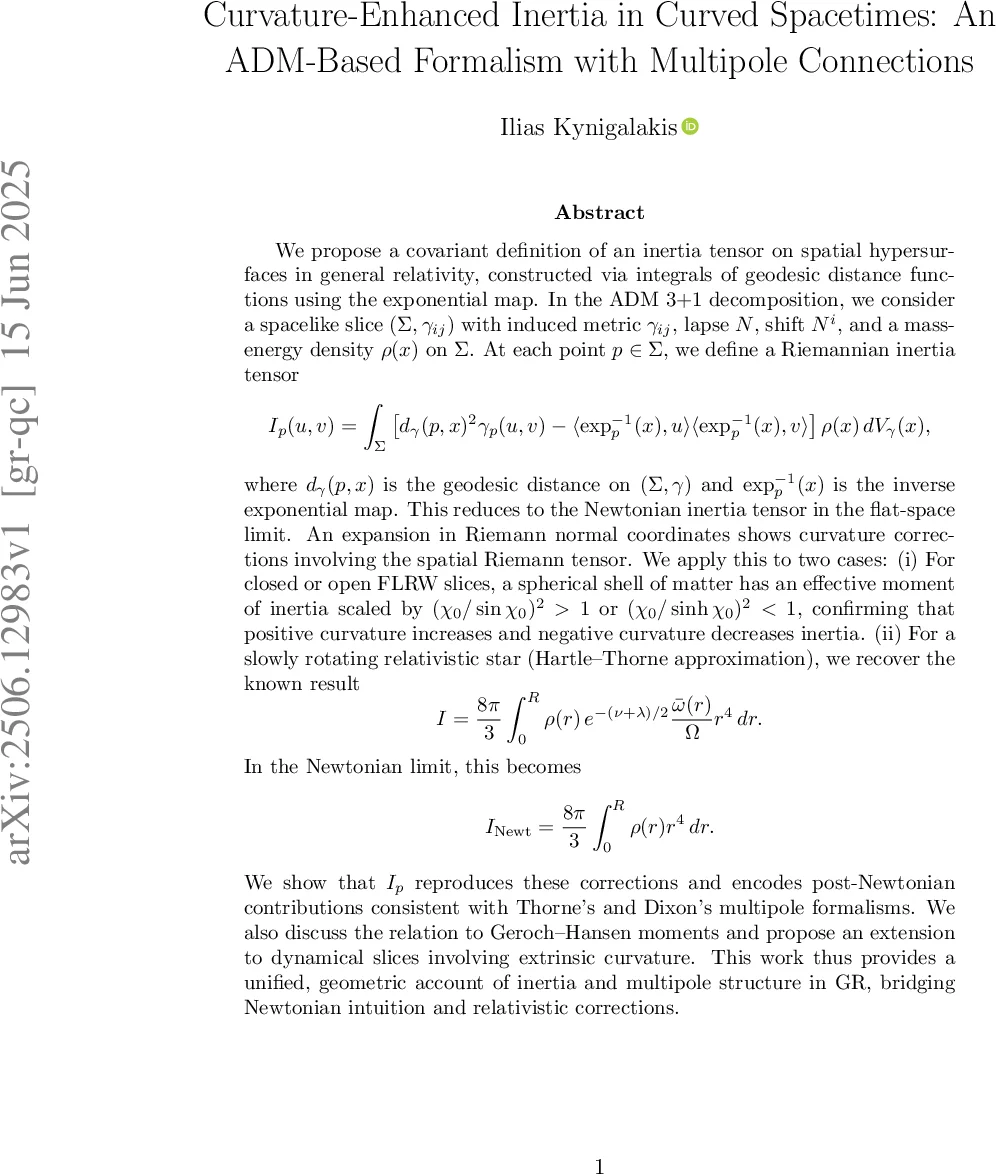
We propose a covariant definition of an inertia tensor on spatial hypersurfaces in general relativity, constructed via integrals of geodesic distance functions using the exponential map. In the ADM 3+1 decomposition, we consider a spacelike slice (Sigma, gamma_ij) with induced metric gamma_ij, lapse N, shift N^i, and a mass-energy density rho(x) on Sigma. At each point p in Sigma, we define a Riemannian inertia tensor I_p(u,v) as an integral over Sigma involving geodesic distances and the exponential map. This reduces to the Newtonian inertia tensor in the flat-space limit. An expansion in Riemann normal coordinates shows curvature corrections involving the spatial Riemann tensor. We apply this to two cases: (i) for closed or open FLRW slices, a spherical shell of matter has an effective moment of inertia scaled by (chi_0 / sin(chi_0))^2 > 1 or (chi_0 / sinh(chi_0))^2 < 1, confirming that positive curvature increases and negative curvature decreases inertia; and (ii) for a slowly rotating relativistic star (Hartle–Thorne approximation), we recover the known result: I = (8 pi / 3) integral from 0 to R of rho(r) exp(-(nu + lambda)/2) [omega_bar(r)/Omega] r^4 dr. In the Newtonian limit, this becomes I_Newt = (8 pi / 3) integral from 0 to R of rho(r) r^4 dr. We show that I_p reproduces these corrections and encodes post-Newtonian contributions consistent with Thorne’s and Dixon’s multipole formalisms. We also discuss the relation to Geroch–Hansen moments and propose an extension to dynamical slices involving extrinsic curvature. This work thus provides a unified, geometric account of inertia and multipole structure in general relativity, bridging Newtonian intuition and relativistic corrections.
💡 Research Summary
The paper introduces a fully covariant definition of an inertia tensor on spatial hypersurfaces within the 3 + 1 ADM formulation of general relativity. Starting from a spacelike slice Σ with induced metric γ_{ij}, lapse N, shift N^{i} and mass‑energy density ρ(x)=T_{μν}n^{μ}n^{ν}, the authors define at each point p∈Σ a (0,2) tensor
I_{p}(u,v)=∫_{Σ}\Big
Comments & Academic Discussion
Loading comments...
Leave a Comment