Differential transcendence and walks on self-similar graphs
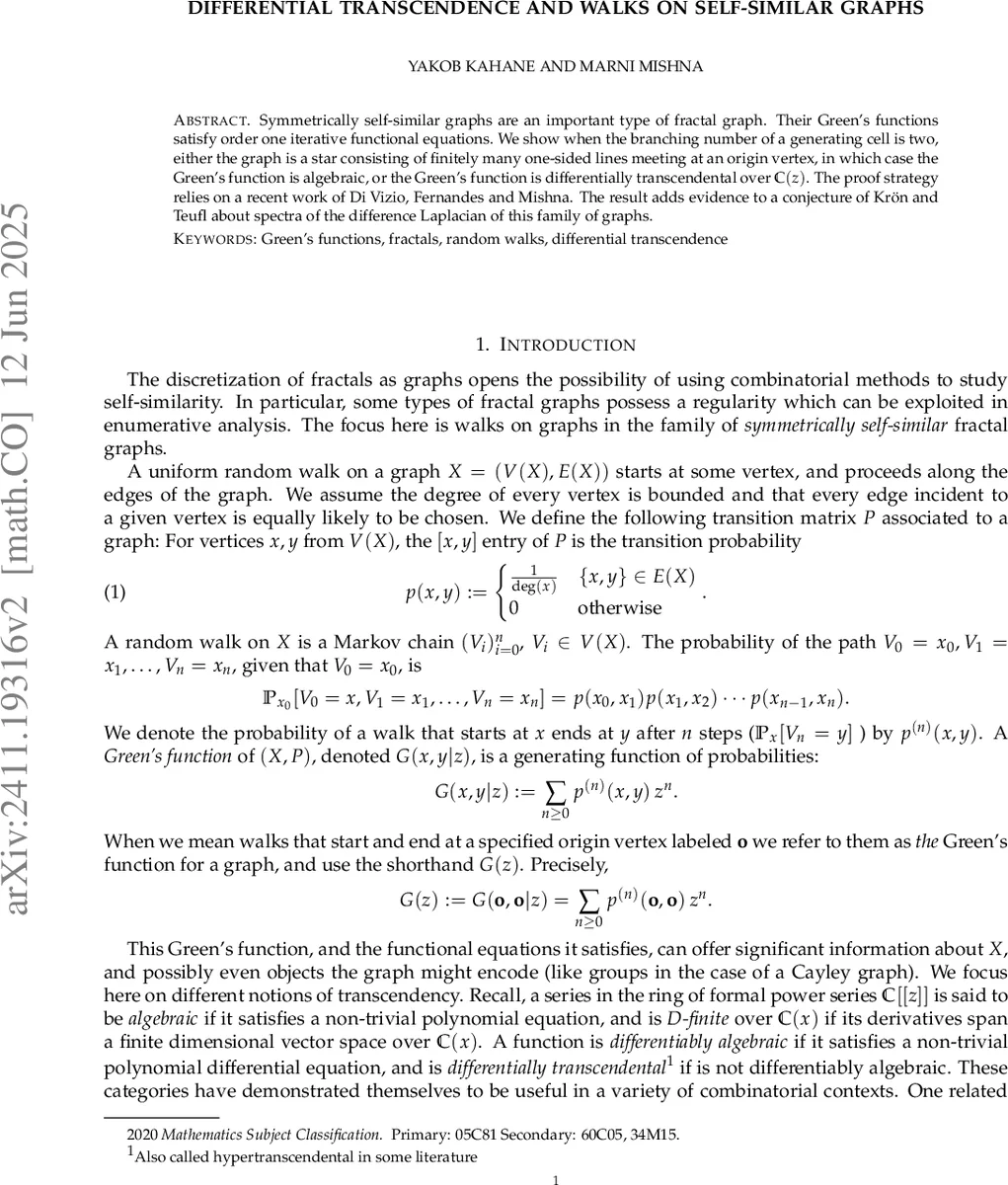
Symmetrically self-similar graphs are an important type of fractal graph. Their Green functions satisfy order one iterative functional equations. We show when the branching number of a generating cell is two, either the graph is a star consisting of finitely many one-sided lines meeting at an origin vertex, in which case the Green function is algebraic, or the Green function is differentially transcendental over $\mathbb{C}(z)$. The proof strategy relies on a recent work of Di Vizio, Fernandes and Mishna. The result adds evidence to a conjecture of Krön and Teufl about the spectrum of this family of graphs.
💡 Research Summary
The paper investigates the analytic nature of the Green’s function associated with a class of fractal‑like infinite graphs known as symmetrically self‑similar graphs. These graphs are built by repeatedly inflating a finite “cell” graph; each cell has a set of boundary (or extremal) vertices, and the whole infinite graph is obtained by gluing copies of the cell together in a highly symmetric way. The number of boundary vertices of a cell is called the branching number θ. The authors focus on the case θ = 2, i.e., cells with exactly two extremal vertices.
A random walk on such a graph is defined in the usual way: from any vertex the walk chooses uniformly among incident edges. The Green’s function G(x,y|z) is the generating function of the n‑step transition probabilities p⁽ⁿ⁾(x,y). When x = y = o (the unique origin vertex, if it exists) we write simply G(z). For finite graphs the Green’s function is a rational function, because it can be expressed as a matrix inverse (I−zT)⁻¹ where T is the transition matrix. The authors recall standard results on the dominant singularity of such rational functions, which will later be used to analyse the infinite self‑similar case.
Krön and Teufl (2010) showed that for any symmetrically self‑similar graph the global Green’s function satisfies a first‑order iterative functional equation of the form
G(z) = f(z)·G(d(z)) (1)
where f(z) and d(z) are rational functions derived from the cell’s transition probabilities. The function d(z) is the “transition function” (probability that a walk starting at one boundary vertex first hits the other boundary vertex after n steps) and f(z) is the “return function” (probability of returning to the starting boundary vertex without hitting the other). Both are explicitly computable from the cell’s adjacency matrix.
The central question is whether G(z) is algebraic (i.e., satisfies a polynomial equation over ℂ(z)) or, more generally, differentially algebraic (satisfies a polynomial differential equation). A function that is not differentially algebraic is called differentially transcendental. Recent work by Di Vizio, Fernandes, and Mishna (2022) proved a powerful dichotomy for equations of the type (1): if f and d are non‑trivial rational functions and d has a fixed point other than 0, then any solution G(z) that is differentially algebraic must actually be rational. Consequently, any non‑rational solution is automatically differentially transcendental.
The authors apply this dichotomy to the θ = 2 case. They first analyse the special situation where the infinite graph is a “star”: finitely many one‑sided infinite rays meet at the origin. In this configuration the cell consists of a single edge, so f(z) and d(z) reduce to simple rational functions (essentially constants or linear terms). Equation (1) collapses to G(z)=c·G(z), forcing G(z) to be a rational function; indeed the Green’s function can be written explicitly as a finite sum of geometric series, and therefore it is algebraic.
If the graph is not a star, the cell contains more than a single edge; consequently f(z) and d(z) are genuine rational functions with non‑trivial numerators and denominators. In particular, d(z) has a fixed point λ≠0 (coming from the spectral radius of the cell’s transition matrix) and f(z) is not identically zero. These properties satisfy the hypotheses of the Di Vizio–Fernandes–Mishna theorem. Hence any solution G(z) of (1) that is not rational must be differentially transcendental. The authors then show that, for a non‑star graph, G(z) cannot be rational: the singularity structure inherited from the cell’s dominant eigenvalue yields a non‑algebraic Puiseux expansion incompatible with rationality. Therefore G(z) is differentially transcendental over ℂ(z).
The main theorem (Theorem 12 in the paper) thus states: for any symmetrically self‑similar graph with bounded geometry and branching number θ = 2, either the graph is a star (in which case G(z) is algebraic) or G(z) is differentially transcendental.
Beyond the pure function‑theoretic classification, the result has implications for spectral theory. Malozemov and Teplyaev (2004) proved that the spectrum of the discrete Laplacian on a self‑similar graph consists of the Julia set of a rational map together with possibly isolated eigenvalues. Krön and Teufl conjectured that the Julia set is an interval exactly when the graph is a star, and a Cantor set otherwise. Since differential transcendence of G(z) signals a highly non‑regular singularity pattern (typical of Julia sets with fractal structure), the authors’ classification provides new evidence supporting this conjecture: non‑star graphs yield differentially transcendental Green’s functions, consistent with a Cantor‑type spectrum.
The paper concludes by discussing possible extensions. The proof relies on detailed knowledge of the singularities of the cell’s Green’s function; the authors suggest that with a finer analysis the same argument could be carried out for branching numbers θ > 2. They also note that certain infinite Cayley graphs, though fractal‑like, have algebraic Green’s functions because their functional equations reduce to trivial cases; this contrast highlights the delicate balance between symmetry, branching, and analytic complexity.
In summary, the work establishes a clear dichotomy for the analytic nature of Green’s functions on a broad family of fractal graphs, linking combinatorial structure (star vs. non‑star) to deep properties in differential algebra and spectral theory. The methodology blends combinatorial graph theory, random walk analysis, and recent advances in the Galois theory of functional equations, opening avenues for further exploration of transcendence phenomena in discrete fractal systems.
Comments & Academic Discussion
Loading comments...
Leave a Comment