Lecture Notes in Loop Quantum Gravity. LN3: Boundary equations for Ashtekar-Barbero-Immirzi model
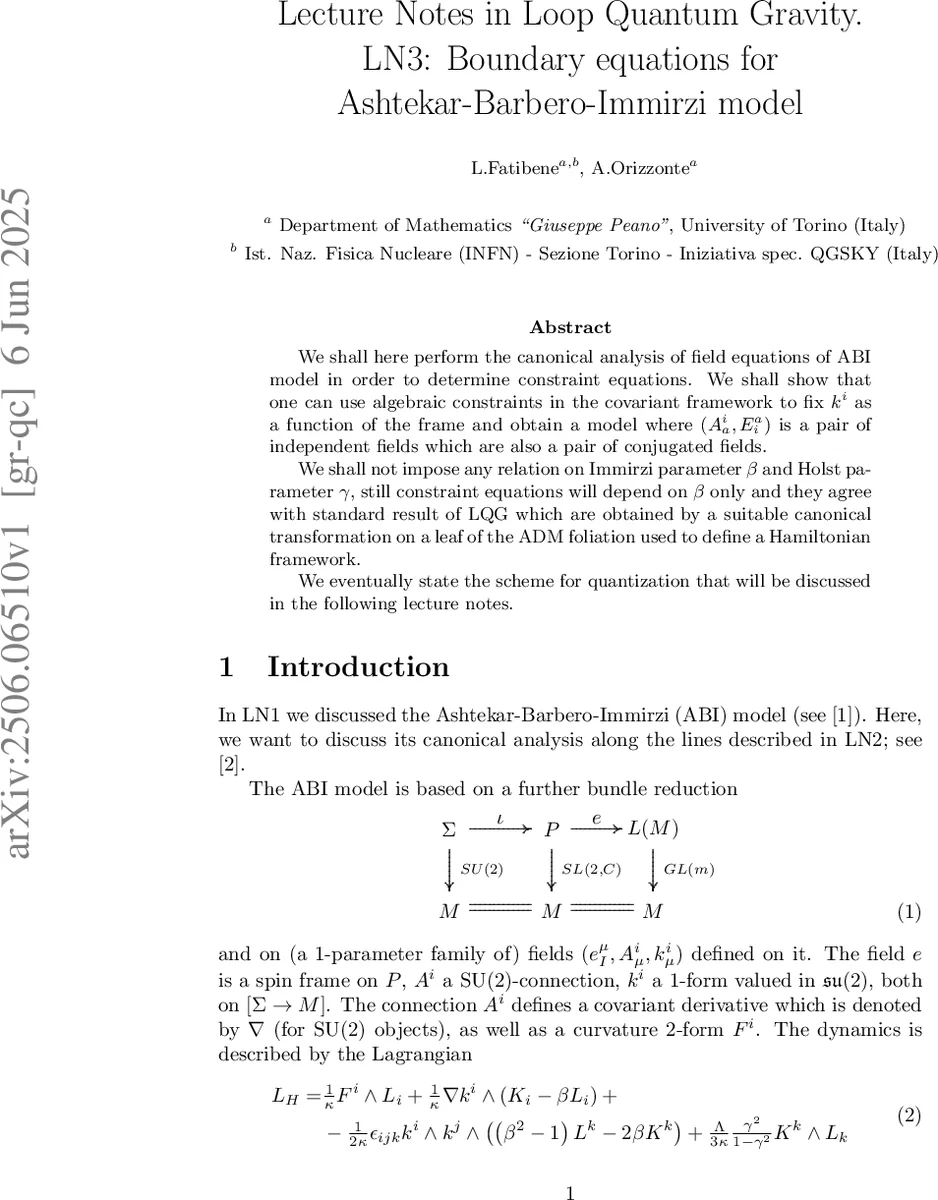
We shall here perform the canonical analysis of field equations of ABI model in order to determine constraint equations. We shall show that one can use algebraic constraints in the covariant framework to fix $k^i$ as a function of the frame and obtain a model where $(A^i_a, E_i^a)$ is a pair of independent fields which are also a pair of conjugated fields. We shall not impose any relation on Immirzi parameter $β$ and Holst parameter $γ$, still constraint equations will depend on $β$ only and they agree with standard result of LQG which are obtained by a suitable canonical transformation on a leaf of the ADM foliation used to define a Hamiltonian framework. We eventually state the scheme for quantization that will be discussed in the following lecture notes.
💡 Research Summary
This lecture note, the third in the “Lecture Notes in Loop Quantum Gravity” series, presents a thorough canonical analysis of the Ashtekar‑Barbero‑Immirzi (ABI) model, focusing on the derivation of its constraint equations and the identification of the true phase‑space variables. The starting point is a first‑order Lagrangian that depends on three fields defined on a principal bundle over spacetime: a spin frame (e^{I}{\mu}), an (SU(2)) connection (A^{i}{\mu}), and an auxiliary su(2)‑valued one‑form (k^{i}_{\mu}). Two dimensionless parameters appear: the Immirzi parameter (\beta) (which governs the reductive splitting of the Lorentz algebra) and the Holst parameter (\gamma) (which multiplies the Holst term). Unlike many treatments that set (\gamma=\beta), the author deliberately keeps them distinct in order to trace their influence throughout the analysis.
A 3 + 1 decomposition is performed by introducing an “evolution bubble” ((\bar D,\zeta,i)) and a spatial manifold (S) that foliates the bubble. An adapted tetrad ((e^{0},e^{i})) is chosen so that (e^{0}) is transverse (the lapse‑shift normal) and (e^{i}) are tangent to the leaves. The spatial triad (\epsilon^{i}{a}) is densitized to the electric field (E^{a}{i}=\star\epsilon^{a}_{i}), which will later serve as the momentum conjugate to the connection. The lapse function (N) and shift vector (\beta^{a}) are introduced as gauge parameters that encode the choice of foliation.
The canonical momenta associated with the first‑order fields are computed explicitly. The expressions reveal a non‑trivial dependence on both (\beta) and (\gamma); however, after imposing the algebraic constraints that arise from the torsion‑free condition of the spin connection (\tilde\Gamma^{IJ}{\mu}), the auxiliary field (k^{i}{\mu}) is shown to be completely determined by the triad, lapse, and shift. In other words, the only independent configuration variables that survive are the spatial connection (A^{i}{a}) and its conjugate electric field (E^{a}{i}).
The field equations split into two groups: algebraic constraints and differential (evolution) equations. The algebraic sector fixes (k^{i}) and the normal component of the connection, eliminating 12 variables. The remaining differential sector yields three sets of first‑class constraints:
- Gauss constraint (D_{a}E^{a}_{i}=0), expressing the internal (SU(2)) gauge invariance.
- Momentum (diffeomorphism) constraint (F^{i}{ab}E^{b}{i}=0), encoding invariance under spatial diffeomorphisms.
- Hamiltonian (scalar) constraint (\epsilon_{ijk}F^{k}{ab}+2(\beta^{2}+1)k^{i}{a}k^{j}{b}+\frac{\Lambda}{3}\epsilon{ijk}\epsilon_{abc}E^{c}_{k}=0).
Crucially, after substituting the algebraic solution for (k^{i}_{a}), the Hamiltonian constraint depends only on the Immirzi parameter (\beta); the Holst parameter (\gamma) drops out entirely. This matches the standard Loop Quantum Gravity (LQG) result, where the Immirzi parameter is the only free parameter entering the quantum theory, but here the independence from (\gamma) is demonstrated explicitly from the classical action.
Counting degrees of freedom confirms consistency: starting from 40 original field equations, 12 algebraic constraints remove 12 variables, 3 boost‑type gauge choices adapt the tetrad, leaving 18 dynamical variables ((A^{i}{a},E^{a}{i})). Of the remaining equations, 7 are first‑class constraints (3 Gauss, 3 momentum, 1 Hamiltonian) and 12 are genuine evolution equations. The evolution equations reproduce the familiar extrinsic curvature evolution (\dot{\chi}{ab}=3R{ab}+\chi\chi_{ab}-2\chi_{ac}\chi^{c}{}{b}-\Lambda\gamma{ab}), confirming that the canonical formulation reproduces standard General Relativity dynamics on the spatial slice.
Finally, the note outlines a quantization scheme that follows the conventional LQG program: the pair ((A^{i}{a},E^{a}{i})) is promoted to holonomy and flux operators, spin‑network states provide a basis, and the three constraints are represented as operators on the kinematical Hilbert space. The author emphasizes that because the analysis kept (\beta) and (\gamma) distinct, the resulting quantum theory will inherit only the (\beta) dependence, offering a clean justification for the usual practice of setting (\gamma=\beta) at the quantum level.
In summary, the paper delivers a meticulous canonical derivation of the ABI model’s constraint structure, clarifies the role of the Immirzi and Holst parameters, and sets the stage for a straightforward loop‑quantization of the model in subsequent lecture notes.
Comments & Academic Discussion
Loading comments...
Leave a Comment