Decoding Phone Pairs from MEG Signals Across Speech Modalities
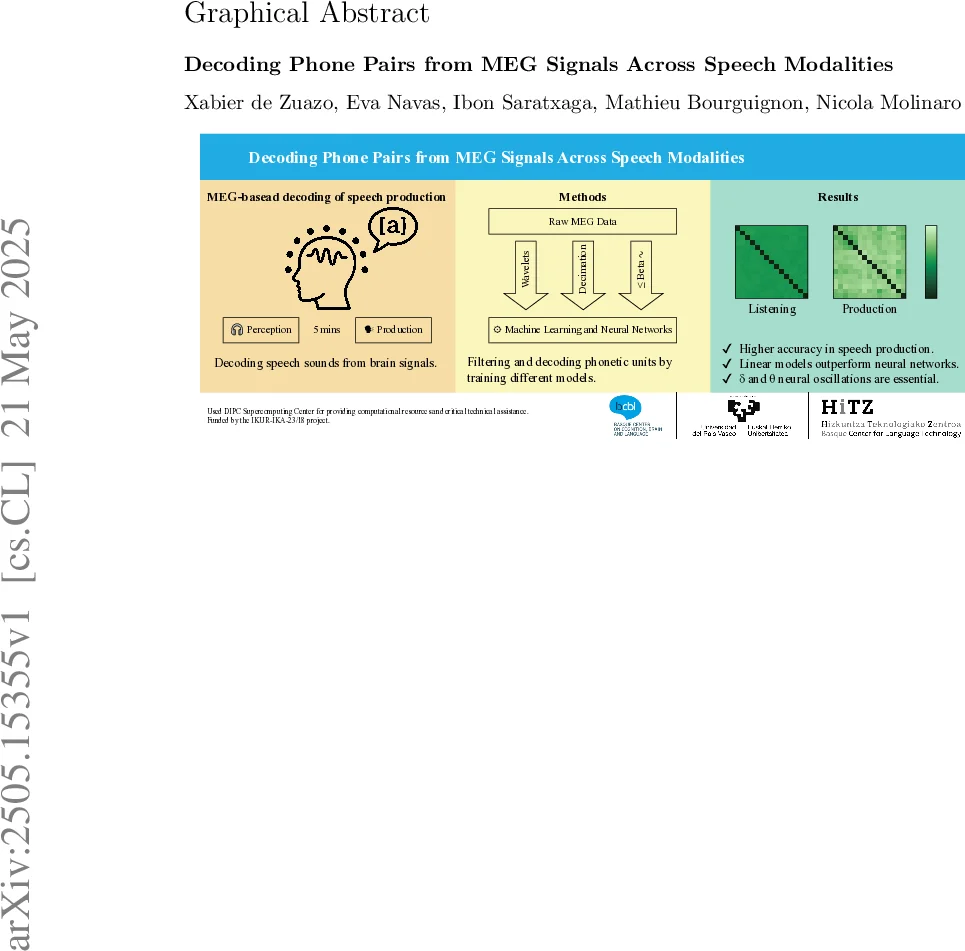
Understanding the neural mechanisms underlying speech production is essential for both advancing cognitive neuroscience theory and developing practical communication technologies. In this study, we investigated magnetoencephalography signals to decode phones from brain activity during speech production and perception (passive listening and voice playback) tasks. Using a dataset comprising 17 participants, we performed pairwise phone classification, extending our analysis to 15 phonetic pairs. Multiple machine learning approaches, including regularized linear models and neural network architectures, were compared to determine their effectiveness in decoding phonetic information. Our results demonstrate significantly higher decoding accuracy during speech production (76.6%) compared to passive listening and playback modalities (~51%), emphasizing the richer neural information available during overt speech. Among the models, the Elastic Net classifier consistently outperformed more complex neural networks, highlighting the effectiveness of traditional regularization techniques when applied to limited and high-dimensional MEG datasets. Besides, analysis of specific brain frequency bands revealed that low-frequency oscillations, particularly Delta (0.2-3 Hz) and Theta (4-7 Hz), contributed the most substantially to decoding accuracy, suggesting that these bands encode critical speech production-related neural processes. Despite using advanced denoising methods, it remains unclear whether decoding solely reflects neural activity or if residual muscular or movement artifacts also contributed, indicating the need for further methodological refinement. Overall, our findings underline the critical importance of examining overt speech production paradigms, which, despite their complexity, offer opportunities to improve brain-computer interfaces to help individuals with severe speech impairments.
💡 Research Summary
The paper investigates the feasibility of decoding phonetic units (phones) from magnetoencephalography (MEG) recordings during overt speech production and two perception conditions (passive listening and playback of one’s own speech). Using a publicly available dataset of 17 healthy native‑Spanish speakers, the authors performed pairwise classification on 15 phonetic pairs (five vowels and ten consonants). The experimental paradigm consisted of three 5‑minute tasks: reading aloud a narrative text, listening to a matched‑gender speaker, and listening to a playback of the participant’s own recorded speech. MEG data were acquired with a 306‑channel Elekta Neuromag system at 1 kHz, and structural MRI was obtained for source localisation.
Pre‑processing focused on maximising signal‑to‑noise while preserving the low‑frequency neural dynamics thought to carry phonetic information. Only gradiometer channels were retained, the data were down‑sampled tenfold to 100 Hz after an anti‑aliasing low‑pass filter (cut‑off 50 Hz), and a 0.2–31 Hz FIR band‑pass filter was applied. A two‑level discrete wavelet transform (Daubechies‑4) decomposed the signal; high‑frequency detail coefficients (d₁, d₂) were discarded, and only the second‑level approximation (a₂) – containing frequencies up to 125 Hz – was kept. This pipeline effectively removed muscular and high‑frequency environmental noise while retaining delta, theta, alpha, and beta bands.
The authors compared a suite of machine‑learning models: Elastic Net (ℓ₁/ℓ₂ regularised linear classifier), linear SVM, multilayer perceptron, 1‑D convolutional neural network, long short‑term memory network, and a hybrid CNN‑LSTM. All models were trained on the same pre‑processed data, using five‑fold cross‑validation, and evaluated with accuracy and F1‑score.
Key findings:
-
Production advantage – Decoding accuracy during overt speech production reached 76.6 % with the Elastic Net classifier, substantially higher than the ~51 % achieved in listening and playback conditions. This confirms that overt speech generates richer, more discriminable neural patterns than passive perception.
-
Linear models outperform deep nets – Across all tasks, the Elastic Net consistently outperformed more complex neural‑network architectures. The limited number of trials (≈5 min per condition) and the high dimensionality of MEG data favour regularised linear models that avoid over‑fitting.
-
Low‑frequency dominance – Frequency‑band analysis revealed that delta (0.2–3 Hz) and theta (4–7 Hz) contributed the most to classification performance. Alpha and beta added modest gains, while higher frequencies (above 31 Hz) were not considered for model training. This aligns with prior work linking low‑frequency cortical synchrony to speech motor planning and articulation.
-
Ablation of preprocessing steps – Removing the wavelet‑based denoising reduced accuracy by 5–7 %, highlighting the importance of eliminating high‑frequency muscular artifacts. Using magnetometers instead of gradiometers, or skipping down‑sampling, also degraded performance, confirming the necessity of each preprocessing decision.
-
Residual artifact concerns – Despite sophisticated denoising, the authors acknowledge that low‑frequency electromyographic (EMG) activity from lip and tongue movements may still be present, potentially inflating decoding scores. Future work should incorporate simultaneous EMG recordings or advanced ICA‑based artifact removal to isolate genuine cortical signals.
The study contributes several important points to the field of non‑invasive speech‑BCI research. First, it demonstrates that overt speech production, traditionally avoided due to motion artifacts, can be successfully decoded from MEG when appropriate preprocessing and regularised linear models are used. Second, it provides empirical evidence that low‑frequency oscillations are the primary carriers of phonetic information in MEG, justifying the common practice of low‑pass filtering in speech‑related neuroimaging pipelines. Third, the open‑source code and reproducible pipeline (https://github.com/hitz‑zentroa/meg‑phone‑decoding) enable other laboratories to replicate the analysis or extend it to larger vocabularies and different languages.
In conclusion, the paper shows that MEG, combined with careful signal cleaning and Elastic Net classification, can reliably discriminate between phonetic categories during natural speech production. These findings pave the way for developing real‑time, non‑invasive brain‑computer interfaces aimed at restoring communication for individuals with severe speech impairments, while also highlighting the need for further methodological refinements to fully separate neural activity from residual muscular artifacts.
Comments & Academic Discussion
Loading comments...
Leave a Comment