Multiplexed holographic molecular binding assays with internal calibration standards
Holographic molecular binding assays detect macromolecules binding to colloidal probe beads by monitoring nanometer-scale changes in the beads’ diameters with holographic microscopy. Measured changes are interpreted with Maxwell Garnett effective-medium theory to infer the surface coverage of analyte molecules and therefore to measure the analyte concentration in solution. The precision and accuracy of those measurements can be degraded by run-to-run instrumental variations, which introduce systematic errors in the holographic characterization measurements. We detect and mitigate these errors by introducing a class of inert reference beads whose polymer brush coating resists macromolecular binding. The holographically measured diameter and refractive index of those beads serve as internal standards for THC measurements. To characterize the reference beads, we introduce a general all-optical method to measure the grafting density of the polymer brush that combines holographic characterization of the bead diameter with a refractometry measurement of the polymer’s specific volume. The latter technique shows the specific volume of poly(ethylene oxide) to be 1.308(4) cubic nanometers per kilodalton. We use this suite of techniques to demonstrate a multiplexed immunoassay for immunoglobulin G (IgG) whose success validates the effective-medium analysis of holographic characterization measurements. Internal negative controls provided by the reference beads are validated by negative control measurements on alcohol dehydrogenase (ADH), which has a similar molecular weight to IgG but does not bind to the probe beads’ binding sites.
💡 Research Summary
This paper presents a comprehensive solution to improve the accuracy and reproducibility of holographic molecular binding assays that rely on Total Holographic Characterization (THC). THC measures the diameter and refractive index of individual colloidal beads with nanometer and 10⁻⁴ precision, respectively, allowing detection of nanometer‑scale changes caused by macromolecules adsorbing onto bead surfaces. However, run‑to‑run instrumental variations introduce systematic offsets in both diameter and refractive index, limiting the quantitative reliability of concentration measurements derived from the observed size changes.
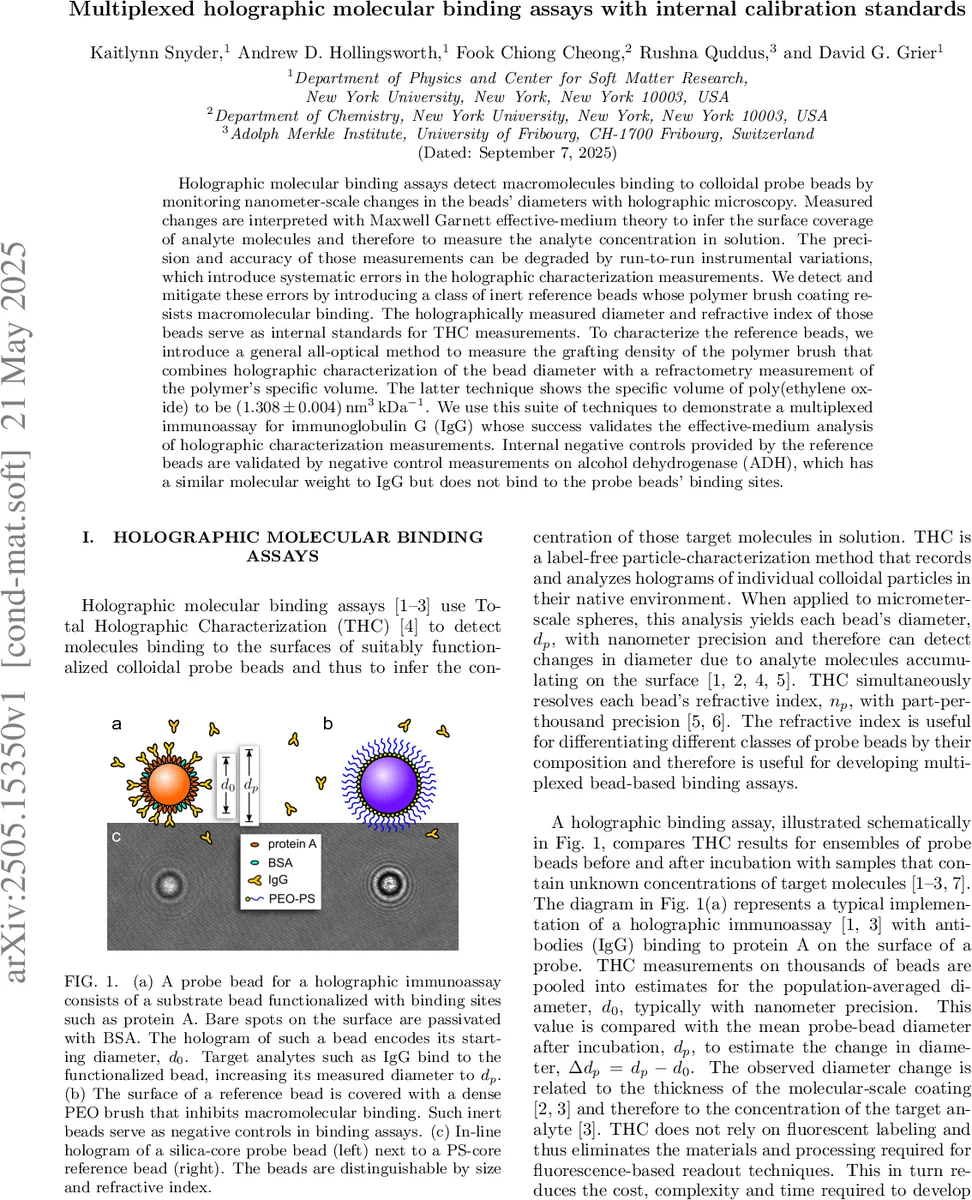
To address this, the authors introduce a class of inert reference beads that serve as internal calibration standards. These beads consist of 1.4 µm polystyrene (PS) cores coated with a dense brush of poly(ethylene oxide) (PEO). The PEO brush sterically blocks any nonspecific adsorption, making the reference beads effectively “non‑binding.” Because the reference beads are measured in the same THC run as the functional probe beads, any systematic drift in instrument response can be directly observed from the reference bead population and used to correct the probe bead data.
A key technical contribution is an all‑optical method to determine the optical specific volume (vₛ) of the polymer brush. By measuring the refractive index of aqueous solutions of polyethylene glycol (PEG) of known molecular weights at several concentrations, and applying Maxwell‑Garnett effective‑medium theory together with the Lorentz‑Lorenz relation, the authors extract a linear relationship between vₛ and molecular weight. The slope is 1.308 ± 0.004 nm³ kDa⁻¹, a value not previously reported for PEO. This specific volume, together with the intrinsic refractive index of PEO, enables quantitative conversion between polymer concentration and optical response.
Using the measured vₛ, the authors develop a second optical method to quantify the grafting density (Γ_c) of the PEO brush on the reference beads. THC measurements before and after functionalization provide the average diameter shift Δd_p. By modeling the coating as a thin shell with thickness a_c and refractive index n_c, and linking n_c to the volume fraction of polymer through the Lorentz‑Lorenz relation, they derive an equation that relates Δd_p, a_c, and Γ_c. Solving this equation yields a grafting density of approximately 0.5 nm⁻², indicating a densely packed brush sufficient to prevent macromolecular binding.
The experimental platform uses a commercial Spheryx xSight instrument with a microfluidic chip (xCell8) to automatically acquire holograms of thousands of beads per run. A mixed suspension containing three bead types—(i) 1 µm PS probe beads functionalized with Protein A, (ii) 1 µm silica probe beads also functionalized with Protein A, and (iii) the PEO‑coated PS reference beads—is prepared at a total concentration of 3 × 10⁶ beads mL⁻¹. In a single measurement, roughly 1 000 beads of each type are characterized, producing distinct clusters in the diameter–refractive‑index (d_p, n_p) plane that enable multiplexed assays.
The authors demonstrate a multiplexed immunoassay for immunoglobulin G (IgG). After incubation with IgG, the Protein A‑functionalized probe beads exhibit a mean diameter increase of ~5 nm, corresponding to a quantifiable surface coverage via the Maxwell‑Garnett model. The reference beads show no measurable change, confirming their role as internal negative controls. As a further validation, alcohol dehydrogenase (ADH), which has a similar molecular weight to IgG but does not bind Protein A, is used. Both probe and reference beads display negligible Δd_p in the ADH experiment, confirming assay specificity and the effectiveness of the internal calibration.
Overall, the paper delivers three major advances: (1) a reliable optical measurement of polymer specific volume, (2) a method to extract polymer grafting density from THC data, and (3) the implementation of inert reference beads as internal standards that correct for instrumental drift in real time. These innovations substantially improve the limit of detection and quantitative accuracy of label‑free holographic binding assays, paving the way for low‑cost, high‑throughput, multiplexed biosensing platforms.
Comments & Academic Discussion
Loading comments...
Leave a Comment