A Picard little theorem for entire functions of matrices
An analog of Picard’s little theorem for entire functions of matrices is proved.
💡 Research Summary
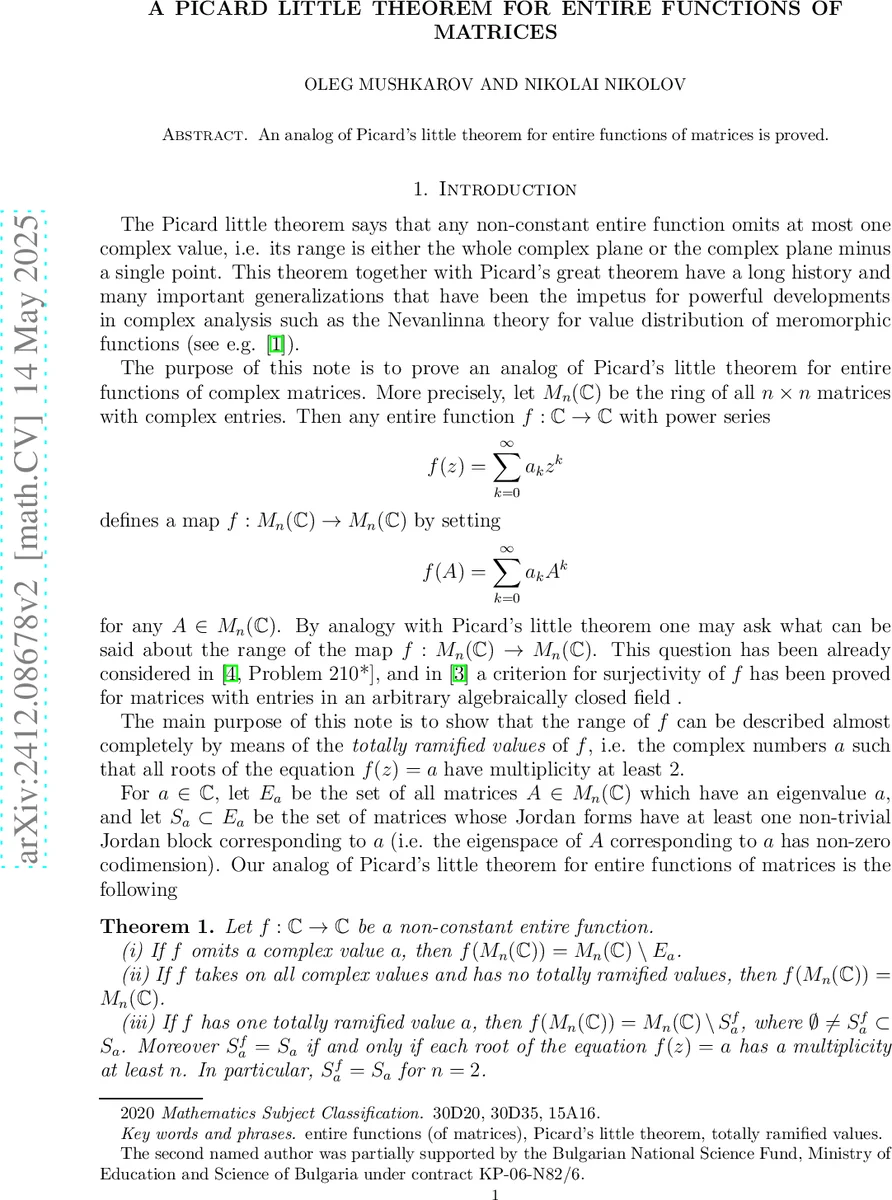
The paper investigates the image of the map induced by a complex entire function (f) when it is applied to complex (n\times n) matrices. For a scalar entire function with power series (f(z)=\sum_{k\ge0}a_kz^k) the natural matrix extension is defined by (f(A)=\sum_{k\ge0}a_kA^k). The central question is: which matrices can be written as (f(A)) for some (A\in M_n(\mathbb C))?
The authors introduce the notion of a totally ramified value: a complex number (a) such that every solution of (f(z)=a) has multiplicity at least 2. Classical Picard theory guarantees that a non‑constant entire function has at most two such values (Fact 6), and if it omits a value it has none (Fact 7).
The main result, Theorem 1, classifies the image of (f) according to the ramification pattern of (f):
-
One totally ramified value (a). The image is the whole matrix space minus the set (E_a) of matrices that have (a) as an eigenvalue. In other words, matrices whose spectrum contains the forbidden value cannot be attained.
-
No totally ramified values and (f) is surjective on (\mathbb C). Then (f(M_n(\mathbb C))=M_n(\mathbb C)).
-
Exactly one totally ramified value (a). The image is (M_n(\mathbb C)\setminus S_{f,a}), where (S_{f,a}) is a (possibly proper) subset of (S_a). Here (S_a) consists of matrices that have eigenvalue (a) and possess at least one non‑trivial Jordan block (i.e., the eigenspace for (a) is not the whole space). If every root of (f(z)=a) has multiplicity at least (n), then (S_{f,a}=S_a); otherwise (S_{f,a}) is a proper subset. In particular, for (n=2) the two sets coincide.
-
Two totally ramified values (a) and (b). The image is (M_n(\mathbb C)\setminus (S_{f,a}\cup S_{f,b})). For (n\ge3) each of the excluded subsets is non‑empty, while for (n=2) they coincide with the full (S_a) and (S_b).
The proof rests on several elementary but crucial facts about matrices and entire functions: (i) similarity invariance of the matrix functional calculus, (ii) explicit formula for (f) applied to a Jordan block, (iii) block‑diagonal behavior, (iv) properties of upper‑triangular matrices, and (v) a characterization of when an upper‑triangular matrix has a single Jordan block. Using these, the equation (f(X)=A) is reduced to a condition on eigenvalues: for each eigenvalue (a) of (A) there must exist a scalar (z) with (f(z)=a) and (f’(z)\neq0). If (a) is a totally ramified value, the derivative condition fails, which explains why matrices with non‑trivial Jordan blocks for (a) are excluded.
The authors also discuss concrete examples illustrating each case: quadratic polynomials have exactly one totally ramified value; the polynomial (z^k(z-1)) (with (k\ge2)) has none; a suitably shifted sine function (\frac{a-b}{2}\sin(cz+d)+\frac{a+b}{2}) has precisely two totally ramified values; and transcendental entire functions either omit a value (hence have no ramified values) or, when of the form (a+Pe^{g(z)}), may have a single totally ramified value determined by the zeros of the polynomial (P).
Finally, the paper notes that the same reasoning applies to holomorphic functions on (\mathbb C\setminus{0}) defined via Laurent series, yielding analogous image descriptions for maps on the general linear group (GL_n(\mathbb C)).
Overall, the work provides a clear and complete classification of the range of matrix‑valued entire functions, extending Picard’s classical theorems to the non‑commutative setting of matrix algebras and highlighting the interplay between ramification of scalar functions and Jordan structure of matrices.
Comments & Academic Discussion
Loading comments...
Leave a Comment