Multi-component Hamiltonian difference operators
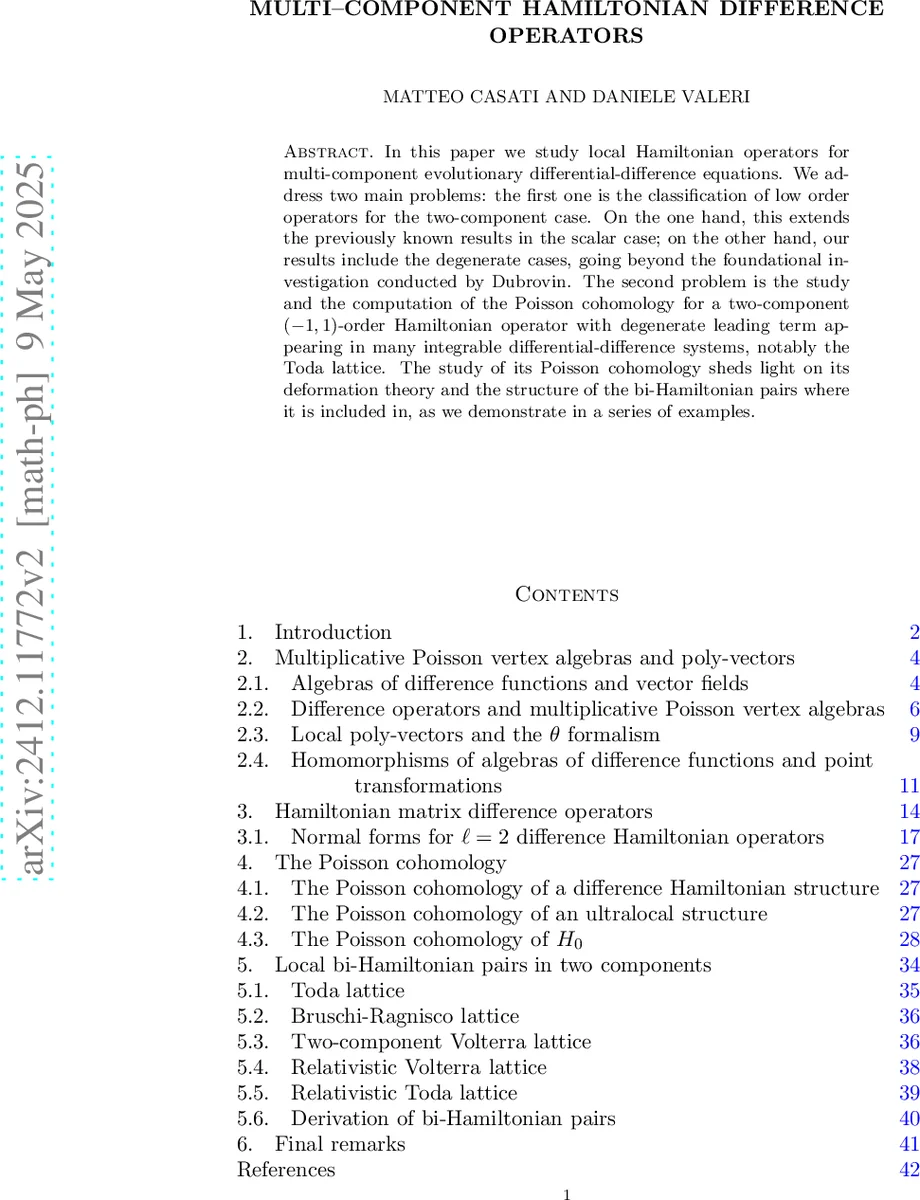
In this paper we study local Hamiltonian operators for multi-component evolutionary differential-difference equations. We address two main problems: the first one is the classification of low order operators for the two-component case. On the one hand, this extends the previously known results in the scalar case; on the other hand, our results include the degenerate cases, going beyond the foundational investigation conducted by Dubrovin. The second problem is the study and the computation of the Poisson cohomology for a two-component (-1,1)-order Hamiltonian operator with degenerate leading term appearing in many integrable differential-difference systems, notably the Toda lattice. The study of its Poisson cohomology sheds light on its deformation theory and the structure of the bi-Hamiltonian pairs where it is included in, as we demonstrate in a series of examples.
💡 Research Summary
The paper investigates local Hamiltonian operators for multi‑component evolutionary differential‑difference equations (DΔEs). Its two main goals are: (i) to classify low‑order Hamiltonian operators in the two‑component case, extending scalar results and incorporating degenerate leading terms; (ii) to compute the Poisson cohomology of a distinguished (−1, 1)‑order operator with a degenerate leading term, which appears in many integrable lattices such as the Toda lattice.
The authors begin by recalling the algebra of difference functions, the shift operator S, and the variational derivative. They adopt two equivalent formalisms: multiplicative Poisson vertex algebras (mPVA) with λ‑brackets, and the θ‑formalism for difference multivectors. The Master Formula links a λ‑bracket to a matrix difference operator K(S), and the skew‑adjointness condition K* = −K translates into concrete relations among the coefficients of K.
In Section 3 the paper focuses on operators of order (−1, 1). For a matrix operator K(S)=∑{l=−1}^{1}K_l S^{l} the skew‑adjointness forces K{−l}=−S^{−l}K_{l}^{T}. The Jacobi identity yields a system of polynomial equations for the entries of K_{−1}, K_0, K_1. The authors solve this system for ℓ=2 under the additional restriction that the coefficients depend only on nearest‑neighbour lattice sites. They obtain normal forms covering both non‑degenerate (invertible leading matrix A=K_{−1}) and degenerate cases (A singular). Theorem 6 gives necessary conditions for the non‑degenerate case (recovering Dubrovin‑Parodi results), while Theorem 7 provides a complete classification in the degenerate setting. A prominent example is the Toda lattice, whose first Hamiltonian structure can be reduced to the constant degenerate operator
H₀ = (\begin{pmatrix}0 & S^{-1}\ 1−S^{-1} & 0\end{pmatrix}).
Section 4 introduces Poisson cohomology for difference Hamiltonian operators. Using the θ‑formalism, the authors define a differential d_P on the space of local multivectors and study the cohomology groups H^p(ℱ̂,d_P). They treat two concrete operators: (a) an “ultralocal” operator of order (0,0) (essentially a constant matrix), and (b) the degenerate H₀ from the Toda lattice. Theorem 19 states that for both operators H^p vanishes for p>2, while for p=0,1,2 the cohomology is concentrated in the ultralocal sector. In particular, H^2 for H₀ is essentially one‑dimensional, encoding first‑order deformations; all higher‑order deformations (order N>1) are shown to be trivial, i.e. they are obtained from H₀ by a Miura transformation. This result mirrors Getzler’s theorem for continuous hydrodynamic‑type Poisson brackets and confirms that H₀ is rigid up to Miura equivalence.
Section 5 applies the theory to several well‑known lattice systems: the Toda lattice, the Bruschi‑Ragnisco lattice, a two‑component Volterra lattice, relativistic Volterra and relativistic Toda lattices. Each model admits a bi‑Hamiltonian pair (H₁, H₂) where H₂ is a non‑degenerate (−1, 1) operator and H₁ is either the ultralocal operator or the degenerate H₀. By invoking the cohomology calculations, the authors demonstrate that any compatible higher‑order Hamiltonian operator must be Miura‑equivalent to the known ones, thereby establishing the completeness of the listed bi‑Hamiltonian structures.
The final remarks outline future directions: classification of higher‑order multi‑component operators, global aspects of deformation theory, and possible quantization of the discrete Poisson structures.
Overall, the paper delivers a thorough classification of two‑component difference Hamiltonian operators, introduces a robust method for computing their Poisson cohomology, and uses these tools to clarify deformation and bi‑Hamiltonian properties of a broad class of integrable differential‑difference systems.
Comments & Academic Discussion
Loading comments...
Leave a Comment