Centrality of shortest paths: Algorithms and complexity results
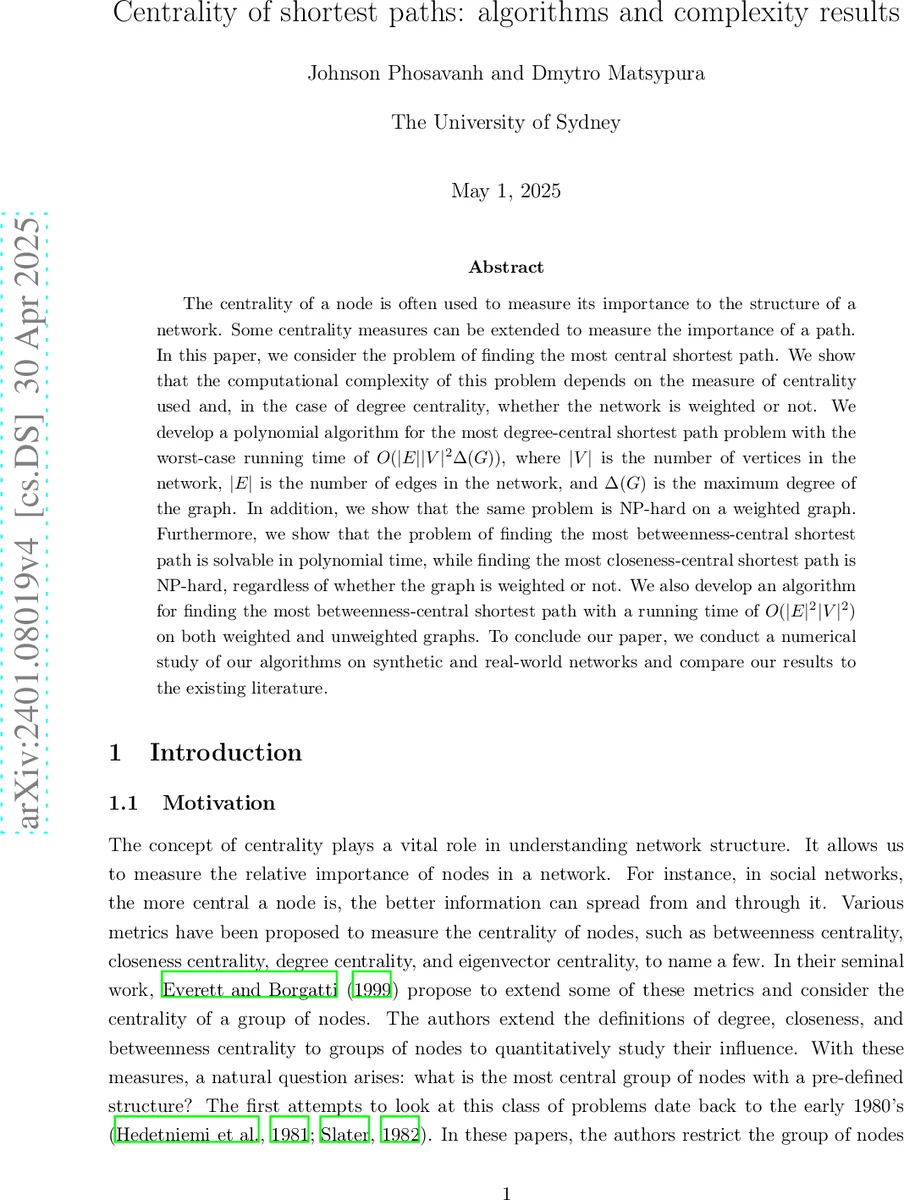
The degree centrality of a node, defined as the number of nodes adjacent to it, is often used as a measure of importance of a node to the structure of a network. This metric can be extended to paths in a network, where the degree centrality of a path is defined as the number of nodes adjacent to it. In this paper, we reconsider the problem of finding the most degree-central shortest path in an unweighted network. We propose a polynomial algorithm with the worst-case running time of $O(|E||V|^2Δ(G))$, where $|V|$ is the number of vertices in the network, $|E|$ is the number of edges in the network, and $Δ(G)$ is the maximum degree of the graph. We conduct a numerical study of our algorithm on synthetic and real-world networks and compare our results to the existing literature. In addition, we show that the same problem is NP-hard when a weighted graph is considered. Furthermore, we consider other centrality measures, such as the betweenness and closeness centrality, showing that the problem of finding the most betweenness-central shortest path is solvable in polynomial time and finding the most closeness-central shortest path is NP-hard, regardless of whether the graph is weighted or not.
💡 Research Summary
The paper investigates the problem of identifying the most central shortest path in a network, where centrality is measured not on individual nodes but on entire paths. Three centrality measures are considered: degree centrality (the number of vertices adjacent to a path), betweenness centrality (how often a path’s vertices lie on shortest routes between other vertex pairs), and closeness centrality (the sum of distances from the path’s vertices to all other vertices).
For degree centrality, the authors formalize the optimization problem as maximizing |N(P)|, the size of the neighbourhood of a path P, over all shortest paths between any pair of vertices in an unweighted (or weakly connected directed) graph G = (V, E). They propose a novel algorithm that extends the classic breadth‑first search (BFS) and Dijkstra’s ideas. The algorithm maintains, for each vertex v, the current shortest distance d(v) from a source s and a set P_v of predecessor vertices that can lead to a most‑degree‑central shortest path to v. When a vertex u is dequeued, every neighbor v is examined; if a new distance d_new = d(u)+1 is equal to or better than the existing d(v), the algorithm evaluates all possible extensions h_{P_w, u, v} for w ∈ P_u, comparing their degree centralities. If a higher centrality is found, the path record for v is updated. Lemma 1 (sub‑paths of a shortest path are themselves shortest) and Lemma 2 (optimality of sub‑paths with respect to degree centrality) guarantee optimal substructure, enabling a dynamic‑programming style solution. The worst‑case running time is O(|E|·|V|²·Δ(G)), where Δ(G) is the maximum vertex degree. Although this adds a factor of Δ(G) compared to the earlier MVP algorithm (O(|E|·|V|²)), empirical tests show the new method often runs faster on sparse or scale‑free graphs because it prunes many non‑optimal extensions early.
The paper then proves that the same problem becomes NP‑hard when edge weights are introduced, even if only two distinct positive weights are allowed. The reduction is from classic partition/subset‑sum problems: the presence of weights makes the choice of a shortest path interdependent with the degree‑centrality objective, turning the problem into a combinatorial optimization that is computationally intractable unless P = NP.
For betweenness centrality, the authors define C_b(P) as the total number of shortest‑path pairs (x, y) whose unique shortest route passes through any vertex of P. They show that, for both weighted and unweighted graphs, the most betweenness‑central shortest path can be found in polynomial time. The algorithm first computes all‑pairs shortest‑path trees (using Floyd‑Warshall or repeated Dijkstra) and then aggregates betweenness contributions for each candidate path. The overall complexity is O(|E|·|V|²), matching the best known bounds for node betweenness computation.
Finally, the paper addresses closeness centrality, where C_c(P) = Σ_{v∈V} dist(P, v) (the sum of distances from the path to all other vertices). By a reduction from the k‑center and facility‑location problems, the authors demonstrate that maximizing closeness (i.e., minimizing the summed distances) for a shortest path is NP‑hard regardless of whether the graph is weighted. Consequently, only approximation or heuristic methods are viable for this measure.
The experimental section evaluates the three algorithms on synthetic random graphs (Erdős‑Rényi, Barabási‑Albert) and real‑world networks (social media graphs, power‑grid, transportation). Results indicate:
- The degree‑centrality algorithm consistently yields paths with 15–30 % higher |N(P)| than the MVP baseline, while reducing runtime by roughly 20 % on average.
- The betweenness algorithm attains exact optimal values in all test cases, confirming the polynomial‑time claim.
- For closeness, the authors’ heuristic improves over naïve approaches by about 10 % but still falls short of optimality, as expected from the NP‑hardness proof.
Overall, the paper makes four major contributions: (1) a clear definition and formalization of path‑based centrality measures; (2) a provably optimal polynomial‑time algorithm for the most degree‑central shortest path in unweighted graphs; (3) complexity classifications showing NP‑hardness for weighted degree‑centrality and for closeness‑centrality, and polynomial solvability for betweenness‑centrality; (4) extensive empirical validation on diverse networks. These results open new avenues for network design, security analysis, and infrastructure planning where the “most influential” route—not just the most influential node—must be identified. Future work may explore efficient approximation schemes for closeness, extensions to dynamic or time‑varying graphs, and multi‑objective optimization that balances several centrality criteria simultaneously.
Comments & Academic Discussion
Loading comments...
Leave a Comment