Moiré Band Engineering in Twisted Trilayer WSe2
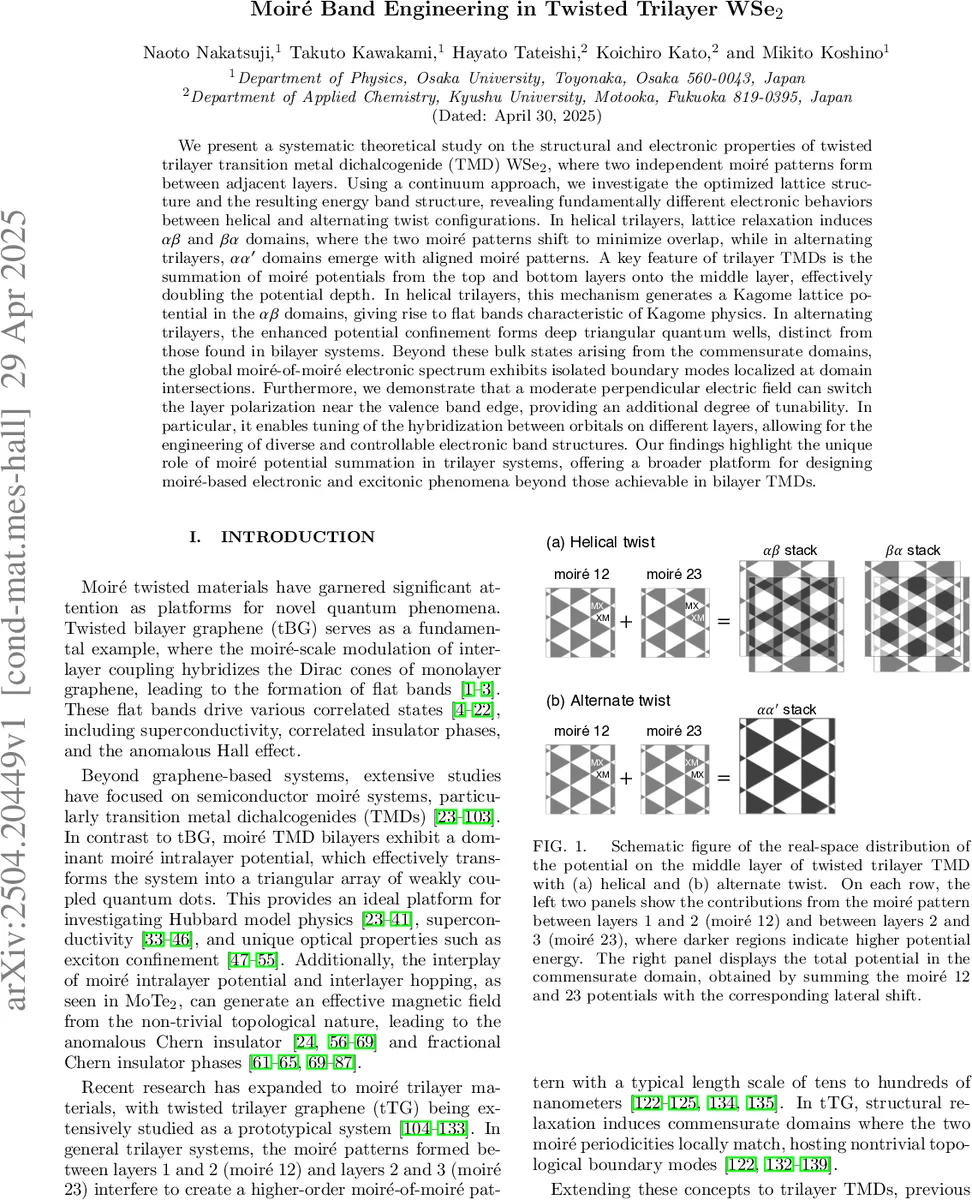
We present a systematic theoretical study on the structural and electronic properties of twisted trilayer transition metal dichalcogenide (TMD) WSe$_2$, where two independent moiré patterns form between adjacent layers. Using a continuum approach, we investigate the optimized lattice structure and the resulting energy band structure, revealing fundamentally different electronic behaviors between helical and alternating twist configurations. In helical trilayers, lattice relaxation induces $αβ$ and $βα$ domains, where the two moiré patterns shift to minimize overlap, while in alternating trilayers, $αα’$ domains emerge with aligned moiré patterns. A key feature of trilayer TMDs is the summation of moiré potentials from the top and bottom layers onto the middle layer, effectively doubling the potential depth. In helical trilayers, this mechanism generates a Kagome lattice potential in the $αβ$ domains, giving rise to flat bands characteristic of Kagome physics. In alternating trilayers, the enhanced potential confinement forms deep triangular quantum wells, distinct from those found in bilayer systems. Furthermore, we demonstrate that a moderate perpendicular electric field can switch the layer polarization near the valence band edge, providing an additional degree of tunability. In particular, it enables tuning of the hybridization between orbitals on different layers, allowing for the engineering of diverse and controllable electronic band structures. Our findings highlight the unique role of moiré potential summation in trilayer systems, offering a broader platform for designing moiré-based electronic and excitonic phenomena beyond those achievable in bilayer TMDs.
💡 Research Summary
This paper presents a systematic theoretical investigation into the structural and electronic properties of twisted trilayer tungsten diselenide (WSe2), a transition metal dichalcogenide (TMD) system featuring two independent moiré patterns formed between adjacent layers. The study focuses on elucidating the fundamentally distinct behaviors arising from two primary twist configurations: helical (θ12θ23 > 0) and alternating (θ12θ23 < 0) twists.
Using a continuum model approach, the authors first calculate the optimized lattice structure after relaxation. They find that relaxation leads to the formation of distinct commensurate domains. In helical trilayers, the two moiré patterns shift relative to each other to minimize overlap, creating αβ and βα domains. In alternating trilayers, the patterns align, forming αα’ domains. This structural optimization forms the foundation for the subsequent electronic property analysis.
A central and unique feature of trilayer moiré systems identified in this work is the “moiré potential summation” effect on the middle layer. The middle layer experiences the superposition of moiré potentials from both the top and bottom layers, effectively doubling the potential depth compared to the outer layers. This summation, however, manifests in qualitatively different ways depending on the twist configuration.
In helical trilayers, the two triangular potentials from the top and bottom layers are spatially translated relative to each other. Their summation within the αβ domains naturally generates a potential landscape resembling a Kagome lattice. This Kagome potential gives rise to characteristic ultra-flat bands near the valence band edge, which are highly localized and promising for hosting strongly correlated electron phenomena. The global electronic spectrum consists of clusters of these bulk states from the αβ and βα domains, along with isolated boundary modes localized at the intersections of domains.
In alternating trilayers, the potentials from the top and bottom layers coincide in the αα’ domains. Their direct summation creates triangular quantum wells that are twice as deep as those found in twisted bilayer TMDs. This leads to enhanced carrier confinement and electronic states distinct from bilayer systems.
Beyond these intrinsic properties, the paper demonstrates a powerful external control knob: a perpendicular electric field. The field can selectively tune the relative potential of each layer. This capability allows for reversible switching of the layer polarization of electronic states near the valence band edge. More importantly, it enables precise control over the hybridization between orbitals (such as s-, p-, and d-like orbitals) residing on different layers and localized in different triangular potential wells. This electrical tunability engineers a wide variety of band structures, including graphene-like Dirac bands, flat bands, quadratic band touchings, and hybridized bands from different orbital origins.
In conclusion, this theoretical study establishes twisted trilayer TMDs, particularly WSe2, as a rich and versatile platform for moiré band engineering. The key mechanism of moiré potential summation in the middle layer unlocks phenomena—like Kagome physics and deeply confined quantum dots—that are inaccessible in bilayer systems. Coupled with the ability to electrically control band structure and orbital hybridization, these trilayer systems offer a significantly broader design space for exploring correlated electronics, topological phases, and excitonic phenomena in moiré superlattices.
Comments & Academic Discussion
Loading comments...
Leave a Comment