Physical Layer Security for Integrated Sensing and Communication: A Survey
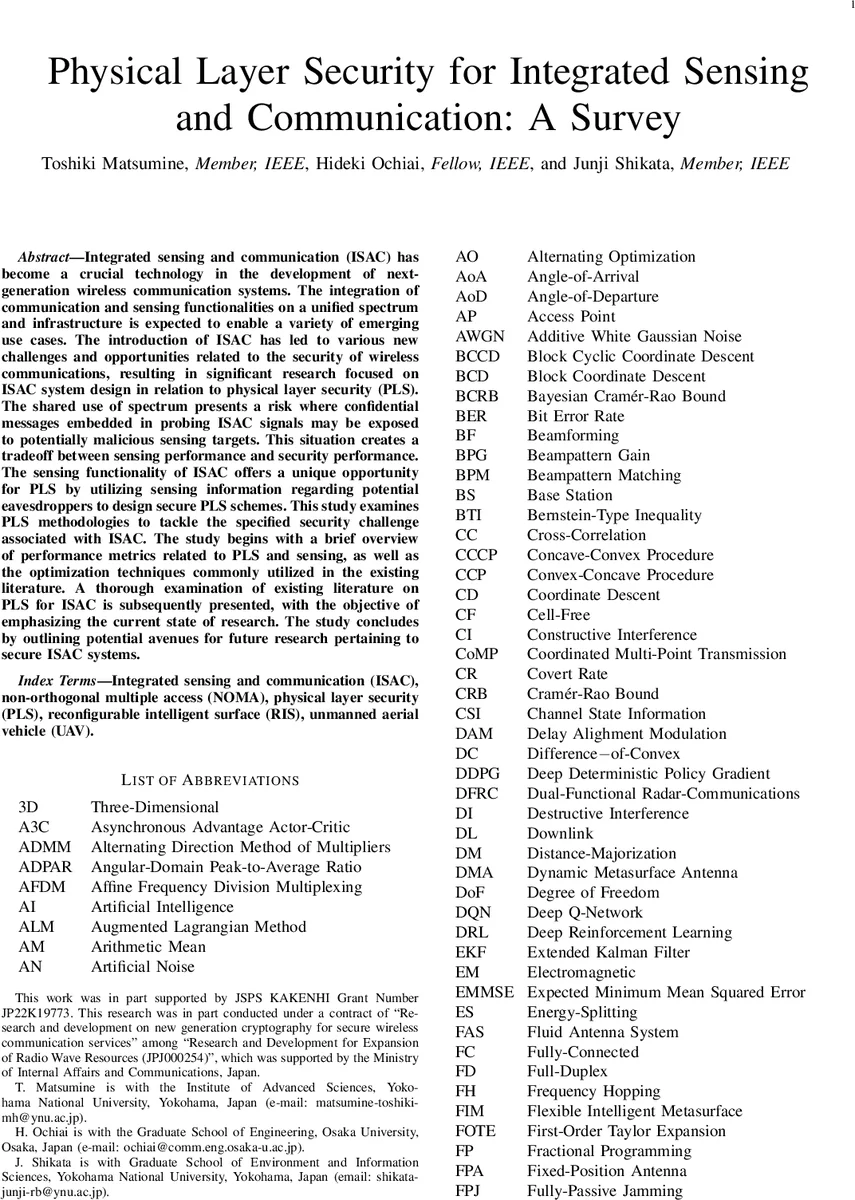
Integrated sensing and communication (ISAC) has become a crucial technology in the development of next-generation wireless communication systems. The integration of communication and sensing functionalities on a unified spectrum and infrastructure is expected to enable a variety of emerging use cases. The introduction of ISAC has led to various new challenges and opportunities related to the security of wireless communications, resulting in significant research focused on ISAC system design in relation to physical layer security (PLS). The shared use of spectrum presents a risk where confidential messages embedded in probing ISAC signals may be exposed to potentially malicious sensing targets. This situation creates a tradeoff between sensing performance and security performance. The sensing functionality of ISAC offers a unique opportunity for PLS by utilizing sensing information regarding potential eavesdroppers to design secure PLS schemes. This study examines PLS methodologies to tackle the specified security challenge associated with ISAC. The study begins with a brief overview of performance metrics related to PLS and sensing, as well as the optimization techniques commonly utilized in the existing literature. A thorough examination of existing literature on PLS for ISAC is subsequently presented, with the objective of emphasizing the current state of research. The study concludes by outlining potential avenues for future research pertaining to secure ISAC systems.
💡 Research Summary
**
This paper provides a comprehensive survey of physical‑layer security (PLS) techniques for integrated sensing and communication (ISAC) systems, a technology that is poised to become a cornerstone of next‑generation (6G) wireless networks. By merging communication and radar functionalities on a common spectrum and hardware platform, ISAC enables high‑precision positioning, real‑time 3‑D mapping, digital twins, and environment‑aware networking. However, the shared use of waveforms creates a new security challenge: confidential data embedded in the probing signals can be intercepted by the sensing targets themselves, which may act as passive eavesdroppers. This dual‑use scenario introduces a fundamental trade‑off between sensing performance (e.g., detection accuracy, Cramér‑Rao bound, signal‑to‑clutter‑plus‑noise ratio) and security performance (e.g., secrecy rate, secrecy outage probability).
The authors first review existing ISAC literature and note that only a few surveys focus specifically on PLS. They then outline their contributions: (1) a systematic presentation of key performance metrics for both communication and sensing, together with the most widely used optimization tools; (2) an exhaustive classification of state‑of‑the‑art PLS schemes for ISAC, highlighting their interaction with emerging technologies such as reconfigurable intelligent surfaces (RIS), non‑orthogonal multiple access (NOMA), and unmanned aerial vehicles (UAV); and (3) a set of forward‑looking research directions aimed at fostering deeper investigation of secure ISAC.
Three design philosophies for ISAC waveforms are described: (i) communication‑centric design, which reuses standard communication waveforms (e.g., OFDM, OTFS, AFDM) for sensing with minimal modifications; (ii) sensing‑centric design, which embeds communication symbols into radar waveforms (e.g., amplitude/phase modulation of chirps, index modulation) but suffers from limited data rates due to pulse‑repetition‑frequency constraints; and (iii) joint design, which formulates a multi‑objective optimization problem that simultaneously accounts for communication and sensing metrics. The joint approach offers the greatest flexibility but incurs higher computational complexity.
A generic MIMO dual‑functional radar‑communication (DFRC) system is used as a running example. A base station equipped with Nt transmit and Nr receive antennas serves K single‑antenna users while detecting T point‑like targets that may act as eavesdroppers. Because passive eavesdroppers do not reveal channel state information (CSI), the authors emphasize the role of sensing: estimating the direction, range, or Doppler of potential eavesdroppers provides surrogate CSI that can be exploited for secure transmission.
The survey classifies existing PLS methods for ISAC into four main categories:
-
Artificial Noise (AN) and Dummy Signal Injection – Random or structured interference is deliberately transmitted in directions where eavesdroppers are likely to be located, degrading their received signal quality while preserving the legitimate link.
-
Beamforming and Antenna Array Design – Directional transmission (e.g., zero‑forcing, sidelobe suppression) is optimized to maximize the signal‑to‑interference‑plus‑noise ratio (SINR) at intended users and minimize it at suspected eavesdroppers.
-
RIS‑Assisted Schemes – The phase shifts of a reconfigurable intelligent surface are jointly optimized with the transmit precoder to reshape the propagation environment, creating constructive paths for legitimate users and destructive interference for eavesdroppers.
-
UAV‑Enabled Mobility – UAVs act as aerial base stations or relays; their 3‑D trajectories are optimized to maintain favorable geometry with legitimate users while keeping eavesdroppers out of line‑of‑sight or at unfavorable angles.
Across these categories, the paper details the mathematical tools employed: alternating optimization, successive convex approximation (SCA), majorization‑minimization (MM), ADMM, semidefinite programming (SDP), mixed‑integer linear programming (MILP), and various reinforcement‑learning algorithms (DQN, PPO, TRPO). These techniques address the non‑convex, coupled nature of the joint design problems and enable the incorporation of practical constraints such as power budgets, hardware impairments, and mobility limits.
A key insight highlighted by the authors is that sensing information can serve as a practical substitute for explicit eavesdropper CSI, thereby making PLS feasible even when eavesdroppers are passive. However, the accuracy of the sensed parameters directly impacts the effectiveness of the security measures; thus, robust estimation and real‑time feedback mechanisms are essential.
The paper concludes with several promising research directions: (i) development of low‑latency, high‑accuracy eavesdropper detection and CSI inference algorithms; (ii) distributed optimization frameworks for large‑scale RIS‑UAV networks that reduce signaling overhead; (iii) integration of quantum‑resistant PLS concepts with ISAC; (iv) adaptive weighting strategies that dynamically balance secrecy rate and sensing accuracy based on network conditions; and (v) experimental testbeds that validate theoretical findings in realistic propagation environments.
In summary, the survey establishes that the convergence of sensing and communication creates both vulnerabilities and opportunities at the physical layer. By leveraging the inherent sensing capability to acquire environmental intelligence, ISAC systems can implement sophisticated, information‑theoretic security schemes that are resilient to both classical and emerging threats. The authors call for interdisciplinary collaboration among signal processing, information theory, machine learning, and hardware design communities to advance secure ISAC toward practical 6G deployments.
Comments & Academic Discussion
Loading comments...
Leave a Comment