ATLAS EFT Results in the Top Quark Sector
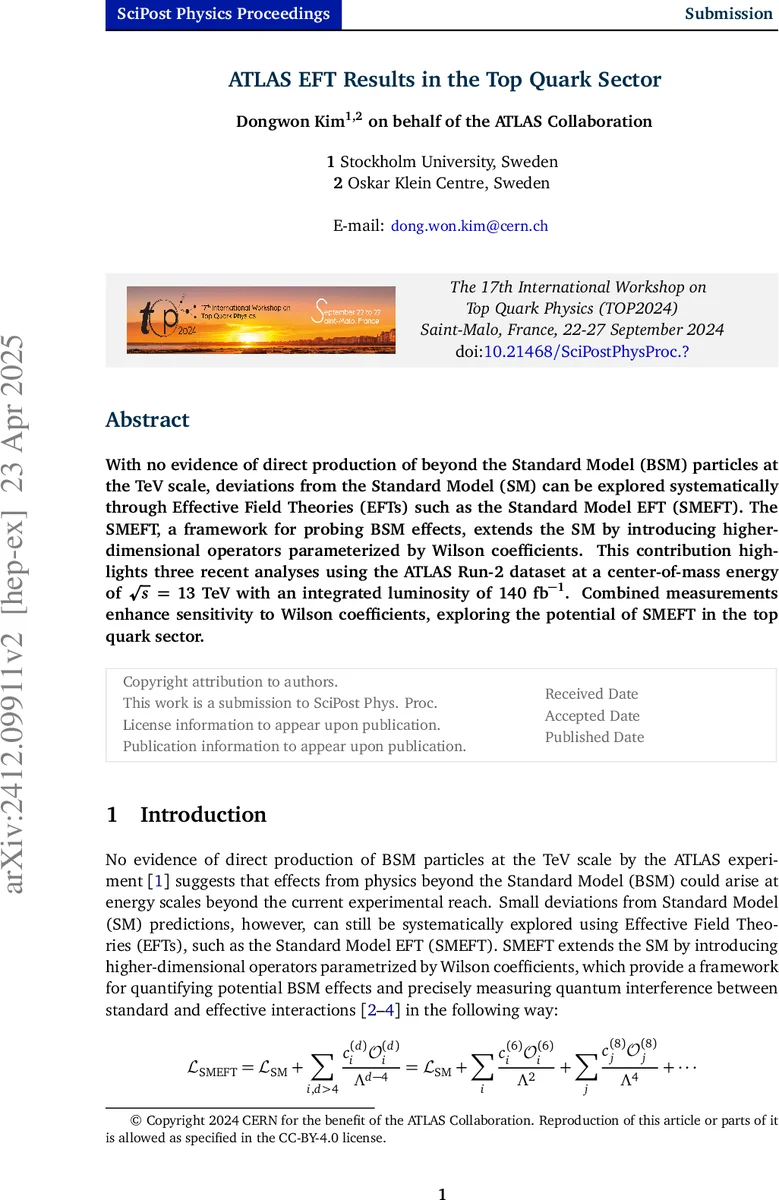
With no direct evidence for new physics at the TeV scale, deviations from the Standard Model (SM) can be explored systematically through Effective Field Theories (EFTs) such as the Standard Model EFT (SMEFT). SMEFT extends the SM by introducing higher-dimensional operators parametrized by Wilson coefficients, offering a framework to probe beyond the SM (BSM) effects. This contribution highlights three recent analyses using the ATLAS Run-2 dataset at a center-of-mass energy of $\sqrt{s}$ = 13 TeV with an integrated luminosity of 140 $\text{fb}^{-1}$. Combined measurements improve the sensitivity to Wilson coefficients by reducing degeneracies and tightening constraints, exploring the potential of SMEFT in the top quark sector.
💡 Research Summary
The ATLAS Collaboration presents a comprehensive set of Effective Field Theory (EFT) analyses in the top‑quark sector using the full Run‑2 dataset collected at √s = 13 TeV, corresponding to an integrated luminosity of 140 fb⁻¹. Three distinct measurements are interpreted within the Standard Model EFT (SMEFT) framework, focusing on dimension‑six operators and their Wilson coefficients.
-
Inclusive and differential t t̄γ production – Both single‑lepton and dilepton final states are examined. A multi‑class neural network separates signal from background in the single‑lepton channel, while a binary classifier is used for dileptons. The photon transverse‑momentum (p_T) spectrum is fitted with a profile likelihood that includes linear, interference, and quadratic terms of the Wilson coefficients C_{tB} and C_{tW} (real and imaginary parts). By combining the t t̄γ results with t t̄Z measurements, the analysis achieves significantly tighter constraints, especially on C_{tW}. No deviation from the Standard Model is observed; 95 % confidence intervals are consistent with zero.
-
t‑channel single‑top (t q) production – Events with exactly one isolated electron or muon, missing transverse energy, and two high‑p_T jets (one b‑tagged) are selected. An artificial neural‑network discriminant D_{NN} is constructed to separate signal from background, and the D_{NN} distribution is used in a profile maximum‑likelihood fit. The SMEFT interpretation yields 95 % CL limits on the four‑quark operator C_{3,1}^{Qq}/Λ² (−0.37 < C/Λ² < 0.06 TeV⁻²) and on the third‑generation quark–Higgs operator C_{3}^{φQ}/Λ² (−0.87 < C/Λ² < 1.42 TeV⁻²). Fully simulated samples with SMEFT effects ensure accurate modeling.
-
Search for charged‑lepton‑flavour‑violating (cLFV) μτ qt interactions – The analysis targets same‑sign dilepton events with a hadronically decaying τ and at least one b‑tagged jet. The scalar sum of lepton and jet transverse momenta (H_T) defines the signal region. No excess is found, leading to a branching‑ratio limit B(t → μτ q) < 8.7 × 10⁻⁷ at 95 % CL. SMEFT limits are set on the 2‑quark‑2‑lepton operators C_{lequ}^{(3)}: |C|/Λ² < 0.10 TeV⁻² for μτ u t and < 1.8 TeV⁻² for μτ c t, improving upon previous constraints.
All three studies assume a new‑physics scale Λ = 1 TeV for the Wilson‑coefficient extraction, but the paper also explores direct limits on Λ for various coupling strengths (c_i = 0.01, 1, 4π²). By combining the individual measurements, ATLAS reduces degeneracies among operators and tightens the overall bounds by roughly 10–30 % compared with separate analyses. The results demonstrate that the top quark, being the heaviest Standard Model particle, remains a highly sensitive probe of possible BSM effects, and that the current LHC precision is sufficient to constrain SMEFT parameters at the TeV scale. These findings provide essential inputs for future global SMEFT fits and guide the strategy for probing new physics in upcoming LHC runs.
Comments & Academic Discussion
Loading comments...
Leave a Comment