Victor Borisovich Lidskii (1924-2008)
This is the editors' preface to the volume 'Operator theory and its applications, in memory of V. B. Lidskii (1924-2008)'. The volume was published by the American Mathematical Society in the series A
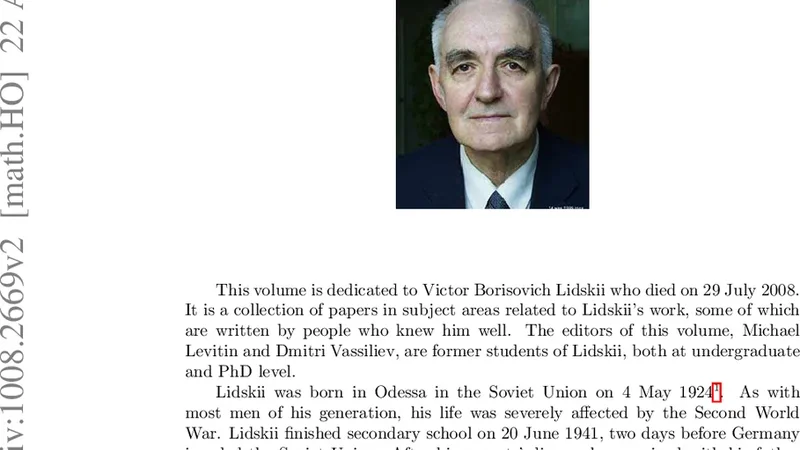
This is the editors’ preface to the volume “Operator theory and its applications, in memory of V. B. Lidskii (1924-2008)”. The volume was published by the American Mathematical Society in the series AMS Translations, series 2, volume 231 (2010).
💡 Research Summary
The editorial preface commemorates the life and scientific legacy of Victor Borisovich Lidskii (1924‑2008), a central figure in modern operator theory. It begins with a concise biography, highlighting Lidskii’s early years in the Soviet Union, his experience as a World War II soldier and prisoner of war, and his subsequent return to academia where he enrolled at Moscow State University. Despite the hardships of war and the oppressive political climate of the Stalinist era, Lidskii emerged as a brilliant mathematician, quickly gravitating toward functional analysis and the spectral theory of linear operators on Hilbert spaces.
The core of the preface is devoted to Lidskii’s most celebrated contribution, the so‑called “Lidskii theorem.” The theorem states that for a trace‑class operator (A) on a separable Hilbert space, the sum of its eigenvalues (counted with algebraic multiplicities) equals the trace of (A). This result bridges the finite‑dimensional notion of the matrix trace with the infinite‑dimensional setting, providing a rigorous foundation for many applications in quantum mechanics, statistical physics, and the stability analysis of infinite‑dimensional dynamical systems. The preface explains how the theorem resolved longstanding ambiguities about the relationship between eigenvalue sums and operator traces, and how it paved the way for subsequent work on non‑self‑adjoint operators, pseudo‑spectra, and dissipative systems.
Beyond the theorem, the preface surveys Lidskii’s broader research agenda. He pioneered the study of eigenvalue distributions for non‑normal matrices, introducing a complex‑plane density function that captures the asymptotic behavior of eigenvalues in large random ensembles. This line of inquiry anticipated modern random matrix theory and free probability, influencing fields as diverse as wireless communications, signal processing, and high‑dimensional statistics. The preface notes that many of Lidskii’s ideas have been re‑interpreted in contemporary language, yet the underlying concepts remain fundamentally his.
The editorial also emphasizes Lidskii’s role as a mentor and community builder. He supervised dozens of Ph.D. students at both Moscow and Leningrad (now St. Petersburg) universities, many of whom have become leading researchers worldwide. His teaching style—combining intuitive examples with rigorous proofs—left a lasting impression on generations of mathematicians. The preface credits him with fostering an international network of scholars interested in operator theory, despite the Cold‑War barriers that limited scientific exchange.
The volume itself, published by the American Mathematical Society in the AMS Translations series, gathers original research papers that extend Lidskii’s legacy. Each contribution revisits a central theme of his work—trace‑class operators, non‑self‑adjoint spectra, and applications to infinite‑dimensional systems—while introducing novel techniques, such as modern functional calculus, microlocal analysis, and numerical methods for spectral approximation. The editors stress that the collection is not merely a tribute but a living research agenda, intended to inspire new investigations that build on Lidskii’s foundational insights.
In concluding remarks, the preface reflects on Lidskii’s personal qualities: his resilience in the face of adversity, his humility despite towering achievements, and his unwavering commitment to scientific collaboration. By intertwining biographical anecdotes with technical exposition, the editors aim to present a holistic portrait that honors both the man and the mathematician. The preface thus serves a dual purpose: it documents the historical and intellectual context of Lidskii’s work, and it calls on current and future researchers to continue exploring the rich terrain he helped to chart.
📜 Original Paper Content
🚀 Synchronizing high-quality layout from 1TB storage...