On positive Jacobi matrices with compact inverses
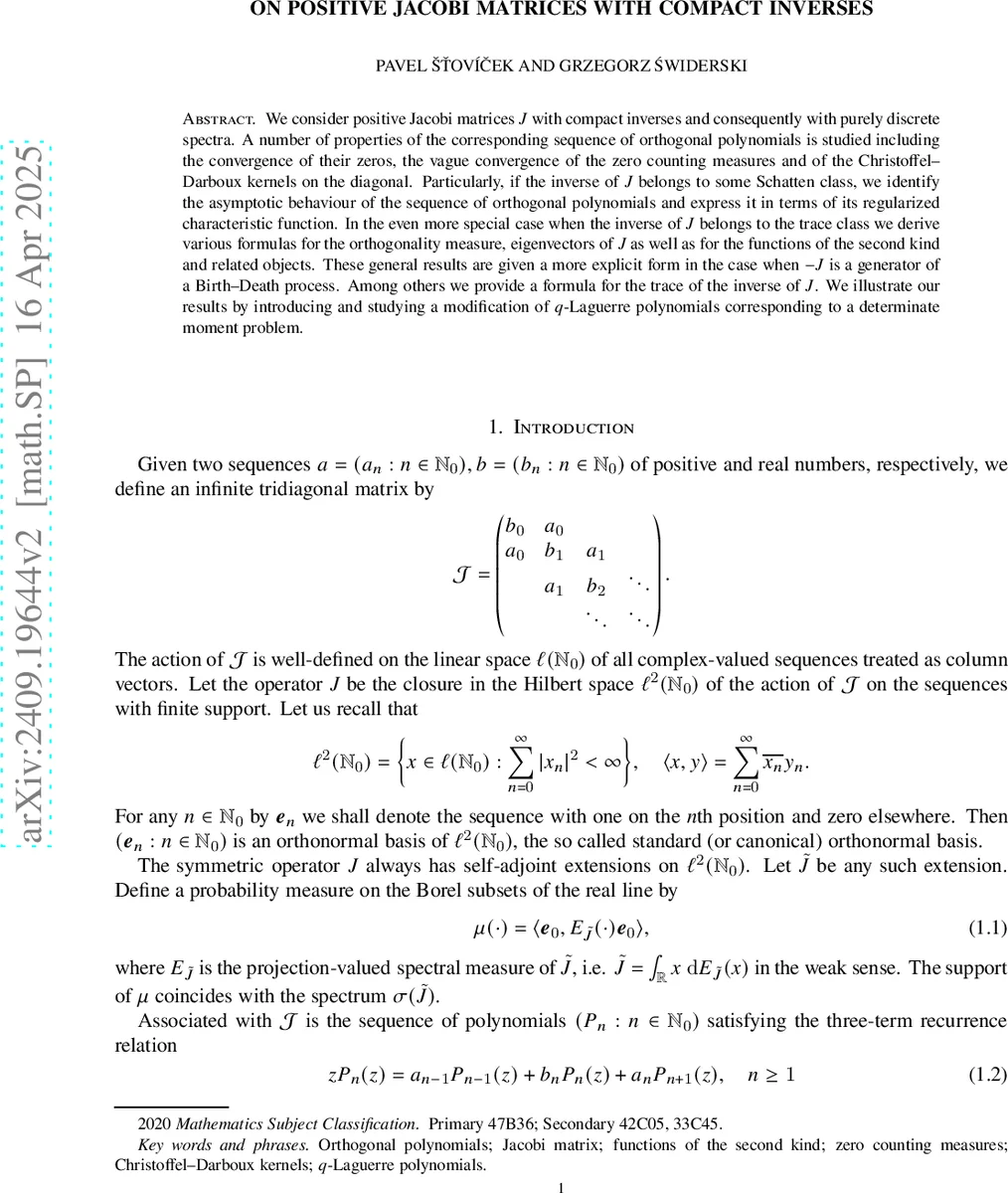
We consider positive Jacobi matrices $J$ with compact inverses and consequently with purely discrete spectra. A number of properties of the corresponding sequence of orthogonal polynomials is studied including the convergence of their zeros, the vague convergence of the zero counting measures and of the Christoffel–Darboux kernels on the diagonal. Particularly, if the inverse of $J$ belongs to some Schatten class, we identify the asymptotic behaviour of the sequence of orthogonal polynomials and express it in terms of its regularized characteristic function. In the even more special case when the inverse of $J$ belongs to the trace class we derive various formulas for the orthogonality measure, eigenvectors of $J$ as well as for the functions of the second kind and related objects. These general results are given a more explicit form in the case when $-J$ is a generator of a Birth–Death process. Among others we provide a formula for the trace of the inverse of $J$. We illustrate our results by introducing and studying a modification of $q$-Laguerre polynomials corresponding to a determinate moment problem.
💡 Research Summary
This paper investigates infinite Jacobi matrices J that are positive definite and whose inverses are compact operators. Under this hypothesis the spectrum of J consists solely of simple eigenvalues accumulating only at infinity, and the associated orthogonal polynomials {Pₙ} exhibit a rich asymptotic structure. The authors begin by establishing a convenient trace‑class criterion: J⁻¹ belongs to the trace class 𝔖₁(ℓ²) if and only if the series ∑ₙPₙ(0)² diverges, and in that case the trace can be expressed explicitly as a convergent series involving the recurrence coefficients aₙ and the values Pₙ(0), Pₙ₊₁(0). This result links the analytic behaviour of the orthogonal polynomials at the origin with the operator‑theoretic property of J⁻¹.
The paper then introduces the family of second‑kind functions wₖ(z)=⟨eₖ,(J−zI)⁻¹e₀⟩, which are meromorphic on ℂ with simple poles precisely at the eigenvalues of J. The characteristic (or regularized Fredholm) determinant 𝔉(z)=det(I−zJ⁻¹) is shown to be an entire function whose zeros coincide with the spectrum of J. By multiplying w(z)=w₀(z) with 𝔉(z) one obtains an entire function 𝔚(z); the residues of 𝔚/𝔉 at the poles yield the atomic masses of the spectral measure μ, namely μ({ζ})=−𝔚(ζ)𝔉′(ζ). This provides a compact formula for the orthogonality measure directly from the operator data.
A substantial part of the work is devoted to Jacobi matrices that arise as generators of birth–death processes. In this probabilistic setting the recurrence coefficients are expressed through birth rates λₙ>0 and death rates μₙ≥0 as aₙ=√(λₙμₙ₊₁) and bₙ=λₙ+μₙ. The trace‑class condition translates into the summability of λₙμₙ₊₁Pₙ(0)Pₙ₊₁(0). The authors derive explicit formulas for the characteristic function, for the matrix K that appears in the representation 𝔉(z)=1−z kᵀ(I−zK)⁻¹k, and for the spectral measure in terms of the birth–death parameters.
The analysis is then extended to the more general situation where J⁻¹ belongs to an arbitrary Schatten class 𝔖_p (0<p<∞). By defining a regularized Fredholm determinant 𝔉_p(z) the authors prove that 𝔉_p(z) is the uniform limit of the products Pₙ(z)Pₙ(0) and that its zeros again coincide with the eigenvalues of J. This generalization shows that the asymptotic behaviour of the orthogonal polynomials is governed by the Schatten class of the inverse, not merely by trace‑class membership.
Section 4 deals with the weak convergence of the zero‑counting measures νₙ associated with the roots of Pₙ and of the diagonal Christoffel–Darboux kernels Kₙ(x,x)=∑_{k=0}^{n-1}P_k(x)². Under the compactness of J⁻¹ the authors prove νₙ→μ weakly and Kₙ(x,x)→μ in the sense of measures. Moreover, when J⁻¹∈𝔖_p with p>1, the kernels multiplied by the recurrence coefficient aₙ remain uniformly bounded, a fact that has implications for numerical approximation schemes.
The paper also discusses the limitations of these results for non‑semibounded Jacobi matrices, providing counter‑examples where the weak convergence fails. This highlights the essential role of positivity (or at least semiboundedness) in the theory.
Finally, the authors introduce a modified family of q‑Laguerre polynomials ˜Lₙ^{(α)}(x;q). These polynomials are constructed via a quasi‑orthogonal transformation of the classical q‑Laguerre system and correspond to a determinate moment problem. Their recurrence coefficients fit the birth–death framework, and the associated orthogonality measure is supported on the zeros of a suitably rescaled q‑Bessel function J_{α+1}^{(q)}(2√z). The paper provides explicit expressions for the moments, for the trace of J⁻¹ in terms of q‑gamma functions, and for the spectral measure, thereby illustrating the abstract theory with a concrete, analytically tractable example.
In summary, the work offers a comprehensive operator‑theoretic and analytic description of positive Jacobi matrices with compact inverses, connects Schatten‑class properties to the asymptotics of orthogonal polynomials, treats the probabilistic birth–death case in depth, and demonstrates the applicability of the theory through a new family of q‑Laguerre‑type polynomials. The results unify several strands of spectral theory, orthogonal polynomial asymptotics, and stochastic processes, and they open avenues for further research on non‑self‑adjoint extensions, multivariate generalizations, and applications in quantum and statistical mechanics.
Comments & Academic Discussion
Loading comments...
Leave a Comment