Two curious strongly invertible L-space knots
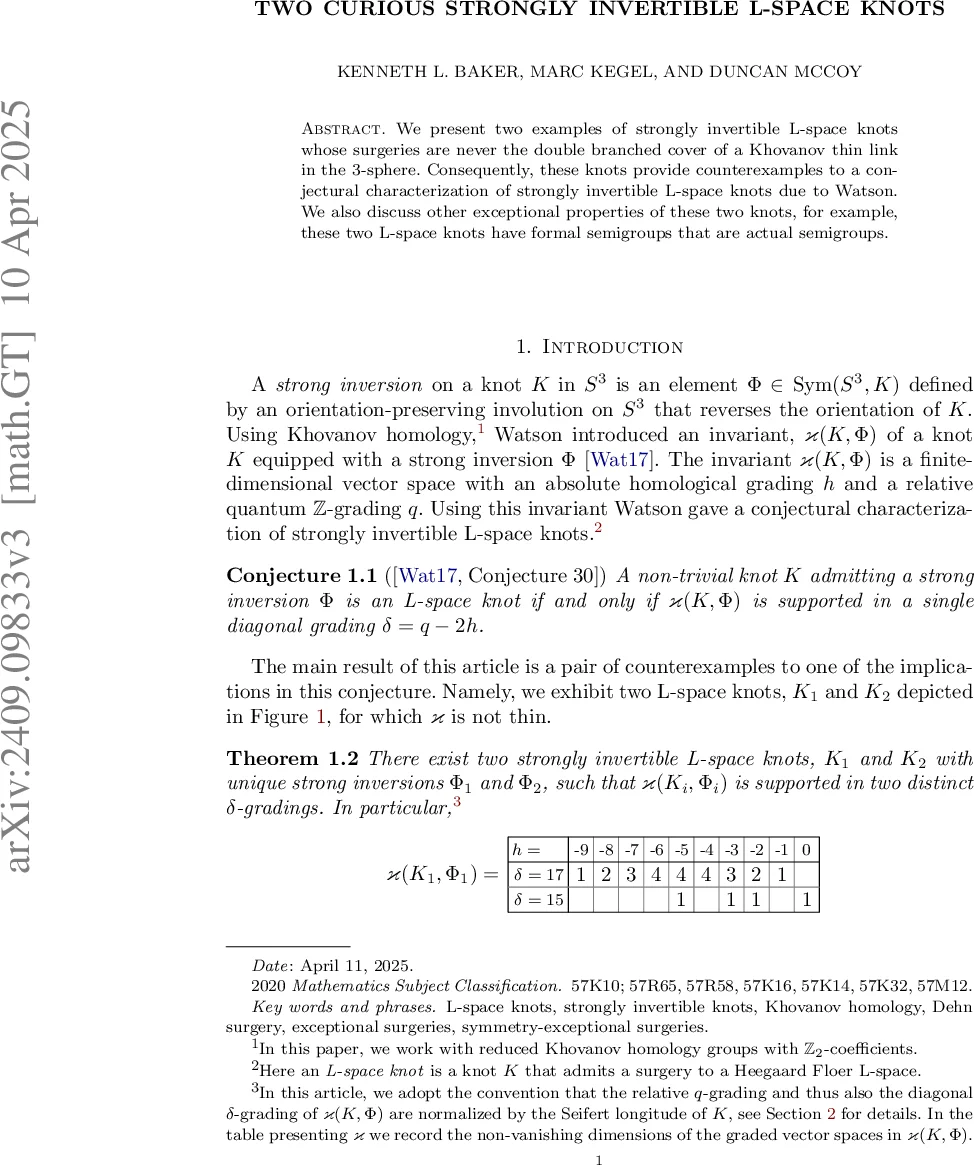
We present two examples of strongly invertible L-space knots whose surgeries are never the double branched cover of a Khovanov thin link in the 3-sphere. Consequently, these knots provide counterexamples to a conjectural characterization of strongly invertible L-space knots due to Watson. We also discuss other exceptional properties of these two knots, for example, these two L-space knots have formal semigroups that are actual semigroups.
💡 Research Summary
In this paper the authors address a conjecture of Liam Watson concerning the relationship between strong inversions on knots, L‑space knots, and a Khovanov‑theoretic invariant denoted κ. Watson’s conjecture (Conjecture 1.1 in the paper) asserts that a non‑trivial knot K admitting a strong inversion Φ is an L‑space knot if and only if the associated κ‑invariant is supported on a single diagonal δ = q − 2h in its (q, h) bigrading. The “only‑if” direction of this statement has been widely believed, but the authors produce explicit counterexamples that falsify it.
The two counterexamples are the hyperbolic, non‑alternating knots K₁ and K₂, each with 17 crossings. In Burton’s notation they are 17nh0000014 and 17nh0000019, respectively, and they appear in the SnapPy census as the complements of manifolds t09847 and o930634. Both knots admit a unique strong inversion, which the authors verify using SnapPy’s symmetry analysis. From the inversion one obtains a tangle exterior T (depicted in Figure 3) whose double branched cover recovers the knot complement. The κ‑invariant is defined via the inverse limit of the reduced Khovanov homology groups Kh(T(n)) for integer fillings n, together with the natural maps fₙ: Kh(T(n)) → Kh(T(n − 1)). For each knot there exists an integer N (N = 20 for K₁, N = 16 for K₂) such that fₙ is surjective for n > N and injective for n < N; κ is then isomorphic to the image of f_{N} ∘ f_{N+1}.
Using the Mathematica KnotTheory package, KnotJob, and auxiliary programs, the authors compute Kh(T(n)) for a range of n and explicitly determine the maps fₙ. Their calculations (shown in Figure 4) reveal that κ(K₁) and κ(K₂) each have non‑zero components in two distinct δ‑gradings, namely δ = 17 and δ = 15. Consequently κ is not thin; it is supported on two diagonals, contradicting Watson’s conjecture.
Beyond the κ‑calculation, the authors prove that every rational surgery on either knot yields a manifold that cannot be the double branched cover of a Khovanov‑thin link. The key observation is that for any slope r the filling T(r) has Khovanov width exactly two (Proposition 3.1). By Watson’s Lemma 4.10, this width propagates to all rational fillings, guaranteeing that no surgery produces a thin branched cover.
To rule out the possibility that a thin surgery could arise from an exceptional (non‑hyperbolic) or symmetry‑exceptional slope, the paper includes two lemmas. Lemma 4.1 shows that a small Seifert‑fibered L‑space with infinite fundamental group has a unique description as a double branched cover of a Montesinos link, and such a cover is never thin. Lemma 4.2 treats manifolds with a JSJ decomposition into two knot exteriors, proving that if such a manifold is a double branched cover of two knots then those knots are mutants; thinness is preserved under mutation, so again thin surgeries cannot occur. Combining these results with Thurston’s hyperbolic Dehn surgery theorem, the authors conclude (Theorem 1.3) that for all rational r, the r‑surgery on K₁ or K₂ is never thin.
The paper also highlights several intriguing side facts. Both K₁ and K₂ are the only knots in the SnapPy census whose formal semigroups are actual semigroups, a property previously known only for infinite families of L‑space knots. Moreover, K₂ is the only known hyperbolic L‑space knot that is not braid‑positive.
Finally, the authors pose open questions that invite further exploration: (1) whether the non‑thinness of κ is equivalent to the non‑thinness of all sufficiently large surgeries when the formal semigroup fails to be a semigroup; (2) whether κ‑width can be arbitrarily large for strongly invertible L‑space knots; and (3) whether a strongly invertible L‑space knot can admit a thin surgery while its κ‑invariant remains non‑thin. These questions suggest a rich landscape beyond the current counterexamples.
In summary, the paper delivers concrete counterexamples to Watson’s conjecture, establishes that the two knots have no thin surgeries at all, and uncovers additional exceptional algebraic and geometric features, thereby deepening our understanding of the interplay between strong inversions, L‑space phenomena, and Khovanov homology.
Comments & Academic Discussion
Loading comments...
Leave a Comment