Evaluation of angular dispersion for various propagation environments in emerging 5G systems
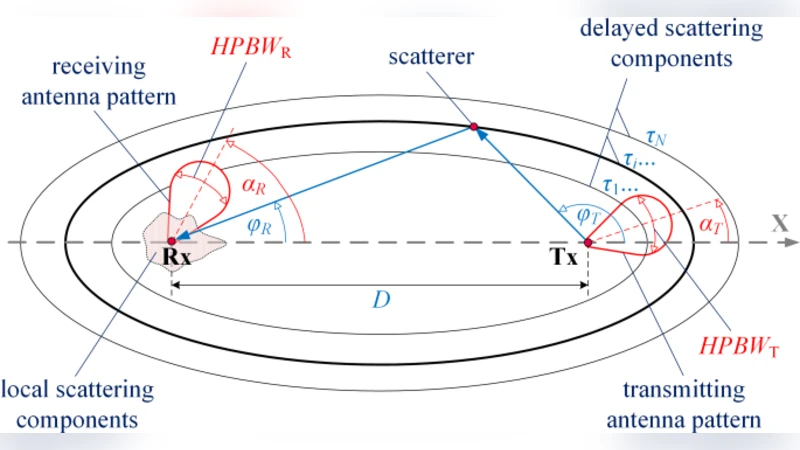
Angular dispersion is the effect of a multi-path propagation observed in received signals. An assessment of this phenomenon is particularly important from the viewpoint of emerging fifth generation (5G) communication systems. In these systems, using the beam-forming and massive multiple-input multiple-output antenna arrays are planned. This phenomenon also has a negative impact on direction finding and older generation communication systems used in an urban environment. In this paper, we present the angular dispersion evaluation for various propagation environments based on simulation studies. This analysis is carried out for different environment types defined in the 3GPP standard model for a selected frequency. In this case, the angular spread is determinated based on the power angular spectrum. This parameter is the basis for the influence evaluation of the propagation environment on the received signal angular dispersion.
💡 Research Summary
**
The paper addresses angular dispersion (AD), a fundamental phenomenon of multipath propagation that becomes especially critical in fifth‑generation (5G) wireless systems employing narrow‑beam beam‑forming and massive multiple‑input multiple‑output (MIMO) antenna arrays. The authors evaluate AD across a set of propagation environments defined in the 3GPP TR 38.901 channel model—Urban Macro (UMa), Urban Micro (UMi), Rural Macro (RMa), Indoor Office (InO), and Indoor Factory (InF). Using a selected carrier frequency (illustrated with 28 GHz millimeter‑wave, though the methodology is applicable to any band), they generate the Power Angular Spectrum (PAS) for each scenario through stochastic ray‑tracing simulations. The angular spread (AS), defined as the root‑mean‑square (RMS) deviation of the arrival angles weighted by received power, is extracted from the PAS and serves as a quantitative metric of AD.
Simulation results reveal a clear hierarchy of AS values. Environments dominated by a line‑of‑sight (LOS) component—UMa and RMa—exhibit narrow AS values typically between 3° and 7°, indicating that most of the received energy arrives from a small angular sector. This condition favors highly directional beams and allows designers to use relatively modest antenna apertures while still achieving the desired beam‑forming gain. In contrast, non‑LOS dense urban and indoor scenarios (UMi, InO, InF) produce much larger AS values, ranging from 15° up to 30° or more. The PAS in these cases shows multiple peaks corresponding to strong reflected and diffracted paths, reflecting the rich scattering environment. The Indoor Office case, in particular, demonstrates an average AS of about 22° with occasional peaks exceeding 35°, driven by metallic furniture, glass partitions, and wall reflections.
The authors discuss the implications of these findings for 5G system design. A larger AS reduces the effective beam‑forming gain because the energy is spread over a wider angular region, which can increase side‑lobe levels and degrade interference suppression. Consequently, massive MIMO arrays intended for high‑AS environments must either increase the physical size of the array (larger aperture) or adopt adaptive multi‑beam strategies that can simultaneously cover multiple dominant angular clusters. Moreover, the dynamic nature of AD in mobile scenarios necessitates rapid channel state information (CSI) acquisition and real‑time beam‑tracking algorithms to maintain alignment with the dominant clusters. For direction‑finding and positioning systems that rely on angle‑of‑arrival (AoA) estimates, high AS directly translates into larger positioning errors unless sophisticated multipath mitigation techniques are employed.
The study acknowledges several limitations. It relies solely on simulated channel realizations, which, while conforming to the 3GPP statistical model, may not capture site‑specific peculiarities observed in real‑world measurements. Validation against field data, extension to additional frequency bands (e.g., 3.5 GHz, 60 GHz), and inclusion of mobility‑induced Doppler effects are identified as necessary future work. Despite these constraints, the paper provides a practical framework for quantifying AD and demonstrates that environment‑specific AS values should be incorporated early in the antenna array sizing, beam‑width selection, and CSI‑feedback design processes for 5G and beyond. In summary, the work highlights that angular dispersion is not a peripheral parameter but a central design driver, especially in dense urban and indoor deployments where multipath richness can substantially impact beam‑forming performance, interference management, and positioning accuracy.
Comments & Academic Discussion
Loading comments...
Leave a Comment