Large-scale Thermo-Mechanical Simulation of Laser Beam Welding Using High-Performance Computing: A Qualitative Reproduction of Experimental Results
💡 Research Summary
The paper presents an integrated experimental‑computational framework for investigating solidification cracking during laser beam welding (LBW), a critical defect in high‑alloy steels such as austenitic stainless steel. The authors employ the Controlled Tensile Weldability (CTW) test, developed at the German Federal Institute for Materials Research and Testing (BAM), to impose a controlled planar tensile strain perpendicular to the welding direction while simultaneously recording high‑resolution temperature and deformation fields. Specimens of AISI 304 stainless steel (1 mm thick) are welded with a 1 kW Yb:YAG disc laser at a travel speed of 1 m min⁻¹. The CTW protocol consists of three stages: a stabilization stage with no external strain, a loading stage where a global strain rate of 6 % s⁻¹ is applied after 35 mm of weld, and a final stage where welding continues to a total length of 90 mm. Global strain levels are varied from 0.02 to 0.035 in steps of 0.005. Temperature is captured by a two‑color infrared camera, while surface deformation is measured at 778 fps using a pco.edge 5.5 sCMOS camera equipped with a narrow‑band illumination laser and a band‑pass filter. An optical‑flow/Lucas‑Kanade algorithm tracks pixel displacements within a region of interest (≈4.8 mm × 1.46 mm) to compute Green‑Lagrangian strain fields in the mushy zone (the solid‑liquid coexistence region).
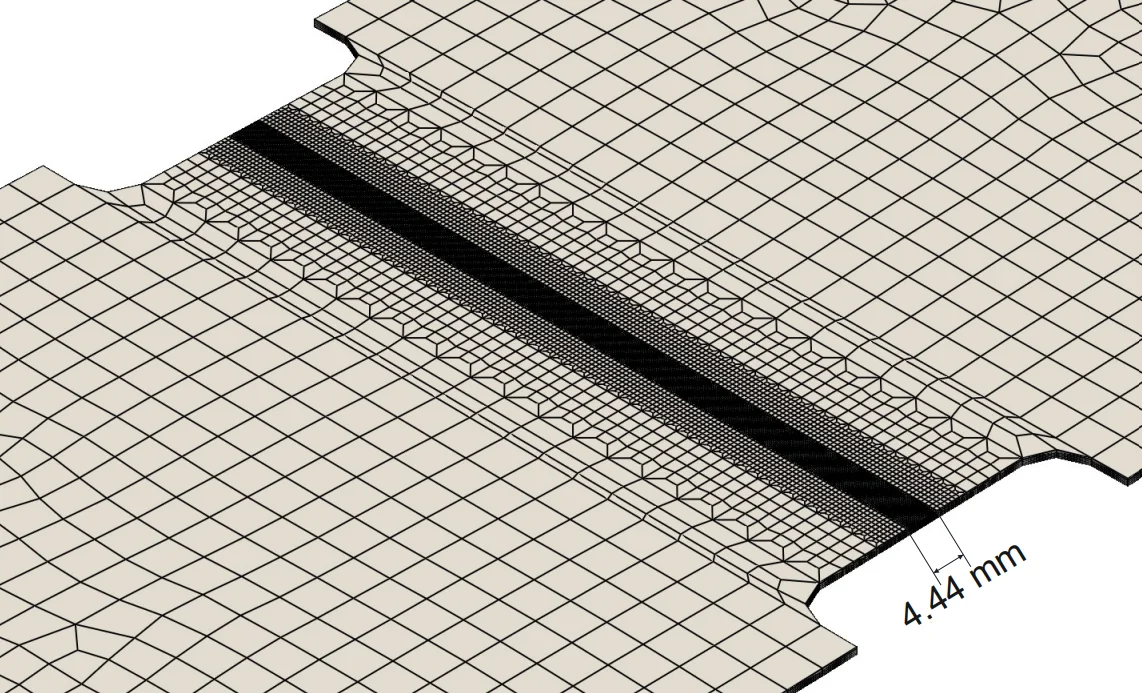
On the computational side, the authors construct a hybrid workflow that leverages the commercial finite‑element package ANSYS for the macroscopic thermal analysis of the whole specimen and a custom high‑performance code, FE2TI, for a highly resolved simulation of the weld pool and its immediate surroundings. ANSYS provides temperature and displacement boundary data on a thin strip surrounding the weld seam; these data are interpolated onto a finer mesh and fed into FE2TI. FE2TI implements a fully coupled thermo‑elastoplastic formulation at small strains, based on an additive decomposition of total strain into elastic, plastic, and thermal parts. The material model follows a temperature‑dependent multilinear isotropic hardening law with a von Mises yield surface, calibrated for AISI 304. The free‑energy functional incorporates bulk and shear moduli, heat capacity, thermal expansion, and a hardening function, leading to coupled momentum and energy balance equations. The spatial discretization uses trilinear hexahedral elements for both displacement and temperature fields.
The nonlinear system is solved by a Newton method; each Newton step requires the solution of a large sparse linear system. To achieve scalability on modern supercomputers, the authors employ PETSc‑based parallel domain‑decomposition solvers, specifically overlapping Schwarz methods with Generalized Dryja‑Smith‑Widlund (GDSW) coarse spaces. Additional algorithmic enhancements include recycling of Krylov subspace information, adaptive time stepping, optimal selection of direct sparse solvers for subdomain problems, and carefully tuned convergence tolerances. Strong‑scaling tests on a high‑performance cluster demonstrate near‑linear speed‑up from 64 to 1024 cores, confirming the suitability of the approach for simulations involving several million degrees of freedom.
Results show that the FE2TI simulations reproduce the experimentally observed temperature gradients and strain‑rate distributions within the mushy zone. Both approaches identify a region of high tensile stress and rapid strain accumulation that coincides with the onset of solidification cracking observed in the CTW tests. While the qualitative agreement is good, quantitative discrepancies remain, attributed to simplifications in the material model (e.g., neglect of δ‑ferrite morphology), limited spatial resolution of the optical measurement, and idealized boundary conditions in the numerical model.
The authors conclude that the combined CTW‑experimental and high‑performance FE2TI simulation framework provides a powerful tool for understanding and predicting solidification cracking in laser welding. The hybrid use of ANSYS for rapid setup and FE2TI for detailed, scalable analysis leverages the strengths of both commercial and research codes. Future work is suggested to incorporate microstructural‑based constitutive models, improve experimental resolution (e.g., X‑ray tomography), and explore real‑time feedback control of welding parameters based on the predictive simulations.
Comments & Academic Discussion
Loading comments...
Leave a Comment