GenTact Toolbox: A Computational Design Pipeline to Procedurally Generate Context-Driven 3D Printed Whole-Body Artificial Skins
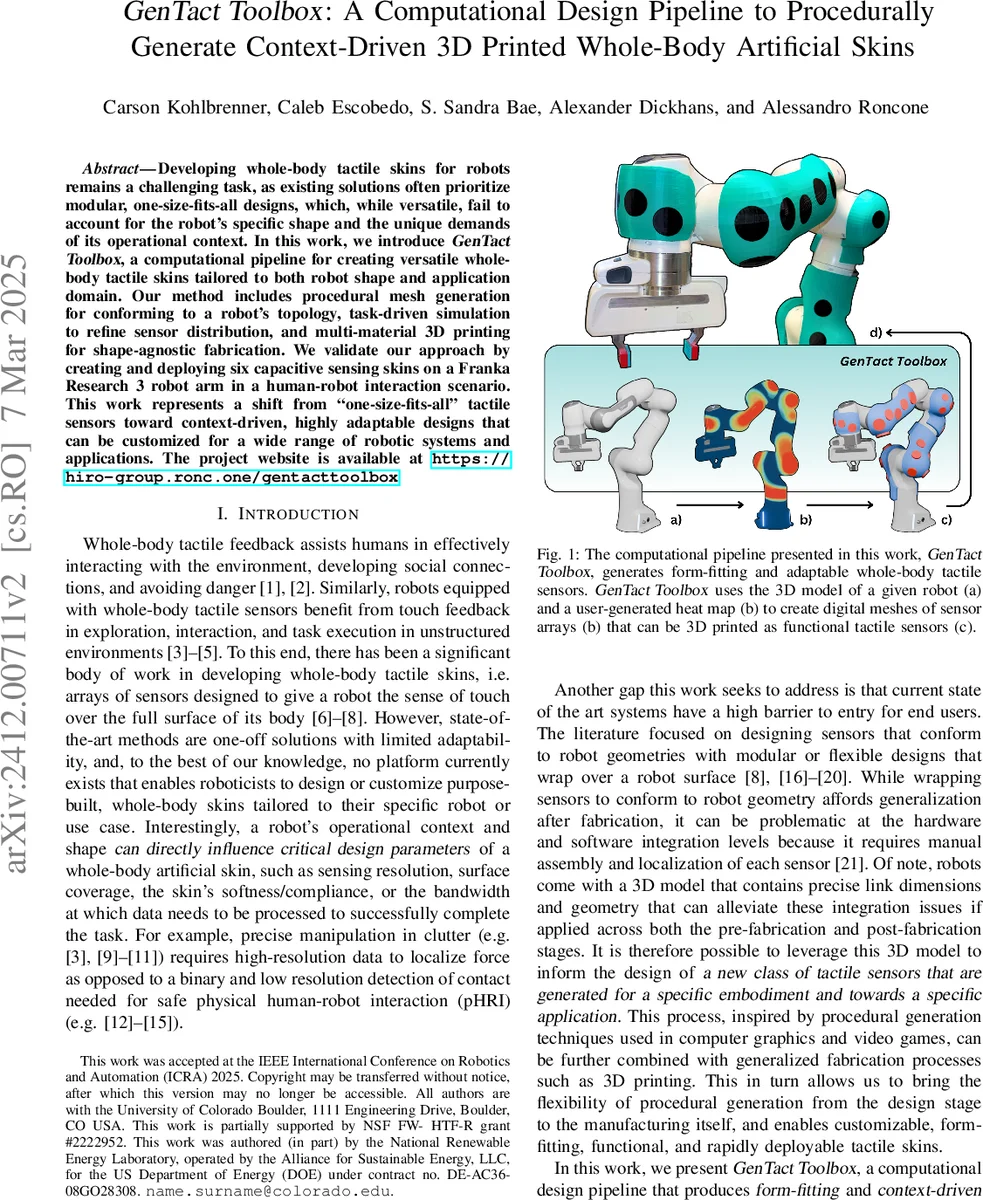
Developing whole-body tactile skins for robots remains a challenging task, as existing solutions often prioritize modular, one-size-fits-all designs, which, while versatile, fail to account for the robot’s specific shape and the unique demands of its operational context. In this work, we introduce GenTact Toolbox, a computational pipeline for creating versatile whole-body tactile skins tailored to both robot shape and application domain. Our method includes procedural mesh generation for conforming to a robot’s topology, task-driven simulation to refine sensor distribution, and multi-material 3D printing for shape-agnostic fabrication. We validate our approach by creating and deploying six capacitive sensing skins on a Franka Research 3 robot arm in a human-robot interaction scenario. This work represents a shift from “one-size-fits-all” tactile sensors toward context-driven, highly adaptable designs that can be customized for a wide range of robotic systems and applications. The project website is available at https://hiro-group.ronc.one/gentacttoolbox
💡 Research Summary
GenTact Toolbox is a comprehensive computational pipeline that automates the design, optimization, and fabrication of whole‑body tactile skins customized to a robot’s geometry and its intended task. The system takes as input a robot’s 3‑D CAD model and a user‑drawn heat map indicating desired coverage and sensor density. In the first stage, a custom Blender add‑on uses weight painting and geometry nodes to generate a conforming mesh (“skin unit”) that fits the robot surface. Parameters such as cutoff tolerance, smoothing, skin thickness, and minimum inter‑sensor distance are exposed, allowing designers to create smooth, C¹‑continuous skin boundaries and to place sensing nodules via Poisson‑disk sampling.
The second stage runs a task‑driven simulation in NVIDIA Isaac Sim. Sensor nodules are instantiated as PhysX contact sensors that output binary contact data. Contact frequency and proximity are fed into a heuristic based on a modified Butterworth filter (Eq. 1), producing an updated density heat map that concentrates sensors in high‑contact regions while sparing them elsewhere. Designers can tune the filter’s cutoff distance (α) and order (n) to match the requirements of manipulation, safety, or other interaction scenarios.
The third stage fabricates the optimized design using multi‑material 3‑D printing. Each sensing nodule is a small protrusion of conductive filament; conductive traces are printed to give each nodule a unique resistance, resulting in distinct RC‑delay signatures when a microcontroller measures the charging time. This RC‑delay approach eliminates complex wiring, as all nodal signals are encoded in a single trace network embedded within the non‑conductive skin matrix. After printing, the trace ends are soldered to a microcontroller for data acquisition.
The authors validated the pipeline on a Franka Research 3 (FR3) arm, creating six modular skin units that together cover the entire manipulator. They report detailed characterizations: number of nodules per unit, mesh volume, total trace resistance, average nodule radius, and signal‑to‑noise ratios (SNR). All units demonstrated reliable contact detection in a human‑robot interaction (pHRI) task, where the robot safely sensed human hand proximity and responded appropriately. Additional full‑body designs for a Unitree H1 humanoid and a Go2 quadruped illustrate scalability across diverse morphologies.
Key contributions are: (1) a procedural generation method that directly leverages a robot’s CAD geometry to produce form‑fitting tactile skins, (2) an open‑source, task‑driven simulation loop that automatically refines sensor placement based on contact statistics, and (3) a low‑complexity RC‑delay capacitive sensing fabrication that integrates sensing and structure in a single 3‑D printed part. Compared with prior modular or flexible wrap‑around skins, GenTact eliminates post‑fabrication alignment and manual assembly, reducing integration effort and improving repeatability.
The paper positions GenTact as a step toward democratizing whole‑body tactile sensing: researchers can quickly generate, simulate, and print custom skins without deep expertise in electronics or mechanical design. Future work could explore online re‑optimization for dynamic tasks, extension to soft or morphing robots, and large‑scale deployment across robot fleets. Overall, GenTact Toolbox offers a practical, extensible framework that bridges the gap between high‑level task requirements and low‑level tactile hardware, enabling more nuanced and safe physical interaction between robots and their environments.
Comments & Academic Discussion
Loading comments...
Leave a Comment