A variational and symplectic framework for model-free control: preliminary results
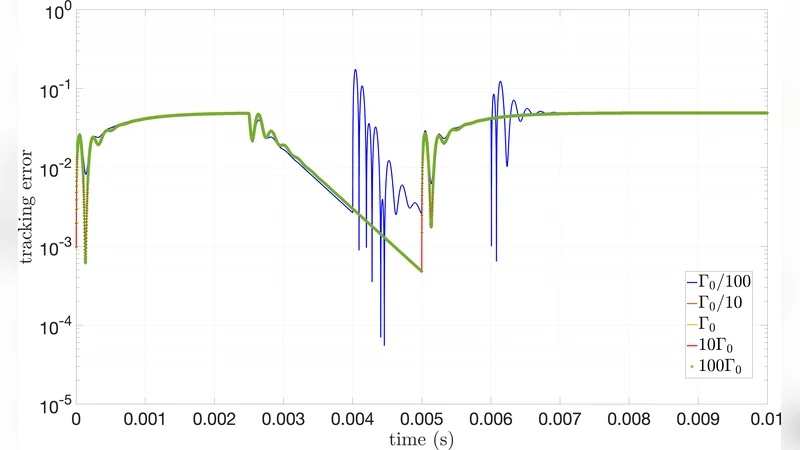
The model-free control approach is an advanced control law that requires few information about the process to control. Since its introduction in 2008, numerous applications have been successfully considered, highlighting attractive robustness properties towards tracking efficiency and disturbance rejection. In this work, a variational approach of the model-free control is proposed in order to extend its robustness capabilities. An adaptive formulation of the controller is proposed using the calculus of variations within a symplectic framework, that aims to consider the control law as an optimization problem toward the auto-tuning of its main key parameter. The proposed formulation provides a coupling between the model-free control law and a variational integrator to improve the robustness of the tracking towards process changes and emphasize closed-loop stabilization. Some illustrative examples are discussed to highlight the rightness of the proposed approach.
💡 Research Summary
The paper proposes a novel adaptive framework for model‑free control (MFC) by embedding the control law within a variational‑optimality formulation and solving it with a symplectic integrator. Traditional MFC relies on a fixed or manually tuned gain α that multiplies the estimated derivative of the output. While this approach eliminates the need for an explicit plant model, the fixed α makes the controller vulnerable to plant parameter variations, external disturbances, and nonlinearities, often leading to degraded tracking performance. To overcome this limitation, the authors reinterpret the MFC law as an optimization problem: the control input remains u = –K·e + α·ẋ̂, but α is promoted to a dynamic decision variable whose evolution minimizes a cost functional J = ∫₀ᵀ
Comments & Academic Discussion
Loading comments...
Leave a Comment