Toward a statistical mechanics of four letter words
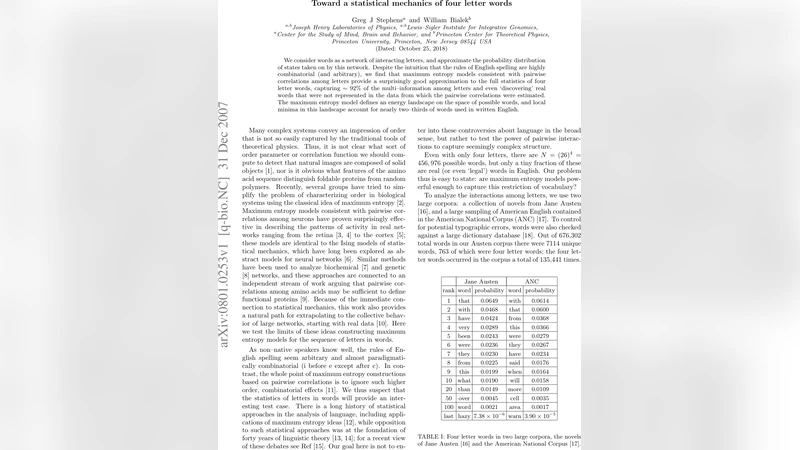
We consider words as a network of interacting letters, and approximate the probability distribution of states taken on by this network. Despite the intuition that the rules of English spelling are highly combinatorial (and arbitrary), we find that maximum entropy models consistent with pairwise correlations among letters provide a surprisingly good approximation to the full statistics of four letter words, capturing ~92% of the multi-information among letters and even “discovering” real words that were not represented in the data from which the pairwise correlations were estimated. The maximum entropy model defines an energy landscape on the space of possible words, and local minima in this landscape account for nearly two-thirds of words used in written English.
💡 Research Summary
The paper treats four‑letter English words as a statistical‑mechanical system in which each position in the word is a “site” occupied by one of the 26 letters. The authors first enumerate the full configuration space of 26⁴ = 456 976 possible strings and then estimate the empirical probability distribution P(s) from a large corpus of written English. Rather than invoking the myriad spelling rules traditionally taught in linguistics, they ask how much of the observed structure can be captured by the simplest non‑trivial statistical constraints: the one‑body frequencies of each letter at each position and the two‑body (pairwise) correlations between letters at different positions.
Using the maximum‑entropy principle, they construct the least‑biased distribution consistent with these constraints. The resulting model has the Boltzmann‑form
P_ME(s) = Z⁻¹ exp
Comments & Academic Discussion
Loading comments...
Leave a Comment