Chiral electronic network within skyrmionic lattice on topological insulator surfaces
We consider a proximity effect between Dirac surface states of a topological insulator and the skyrmion phase of an insulating magnet. A single skyrmion results in the surface states having a chiral gapless mode confined to the perimeter of the skyrmion. For the lattice of skyrmions, the tunneling coupling between confined states leads to the formation of low energy bands delocalized across the whole system. We show that the structure of these bands can be investigated with the help of the phenomenological chiral network model with a kagome lattice geometry. While the network model by itself can be in a chiral Floquet phase unattainable without external periodic driving, we show how to use a procedure known as band reconstruction to obtain the low energy bands of the electrons on the surface of the topological insulator for which there is no external driving. We conclude that band reconstruction is essential for the broad class of network models recently introduced to describe the electronic properties of different nanostructures.
💡 Research Summary
In this work the authors investigate the electronic structure that emerges when the Dirac surface states of a three‑dimensional topological insulator (TI) are placed in proximity to an insulating magnetic film hosting a triangular lattice of skyrmions. The exchange coupling between the TI surface electrons and the local magnetization is described by a Hamiltonian
(H = v(\mathbf{p}\times\boldsymbol{\sigma})z - \Delta,\boldsymbol{\sigma}!\cdot!\mathbf{n}(\mathbf{r})),
where (\Delta) is the exchange energy and (\mathbf{n}(\mathbf{r})) is the unit vector field of the skyrmion texture. The out‑of‑plane component (n_z(\mathbf{r})) generates a spatially varying Dirac mass, while the in‑plane component produces an emergent vector potential that is irrelevant for Bloch‑type skyrmions (div (\mathbf{n}\parallel=0)).
For a single skyrmion the zero‑mass line (where (n_z=0)) forms a closed loop around the core. Along this loop a chiral, gapless mode propagates in a fixed direction. Semiclassical quantization of the circulating wave yields discrete energy levels (\epsilon_j = \hbar v,j/r_s) with half‑integer angular momentum (j=m+1/2). Numerical diagonalization of the full Dirac equation confirms the presence of a pair of well‑isolated chiral states whose localization length (r_\Delta=\hbar v/\Delta) is comparable to the skyrmion radius (r_s). When (r_s) becomes much smaller than (r_\Delta) the centrifugal term pushes the bound states into the continuum and they disappear.
When many skyrmions arrange themselves into a triangular lattice (period (L\approx 65!-!95) nm, skyrmion radius (r_s\approx 25) nm, exchange (\Delta\approx 20) meV), the chiral modes on neighboring skyrmions hybridize via tunnelling across the narrow gaps (\Delta L = L-2r_s). By truncating the reciprocal‑lattice expansion of the Dirac Hamiltonian the authors compute miniband structures for several values of (\Delta L). For large (\Delta L) the minibands are narrow and essentially inherit the energies of the isolated chiral states. As (\Delta L) is reduced, the lowest minibands broaden, eventually touching at zero energy and undergoing a topological transition: the Chern number of the occupied bands changes from 0 (trivial) to (\pm1) (Chern insulator). Further reductions of (\Delta L) generate additional band inversions at higher energies.
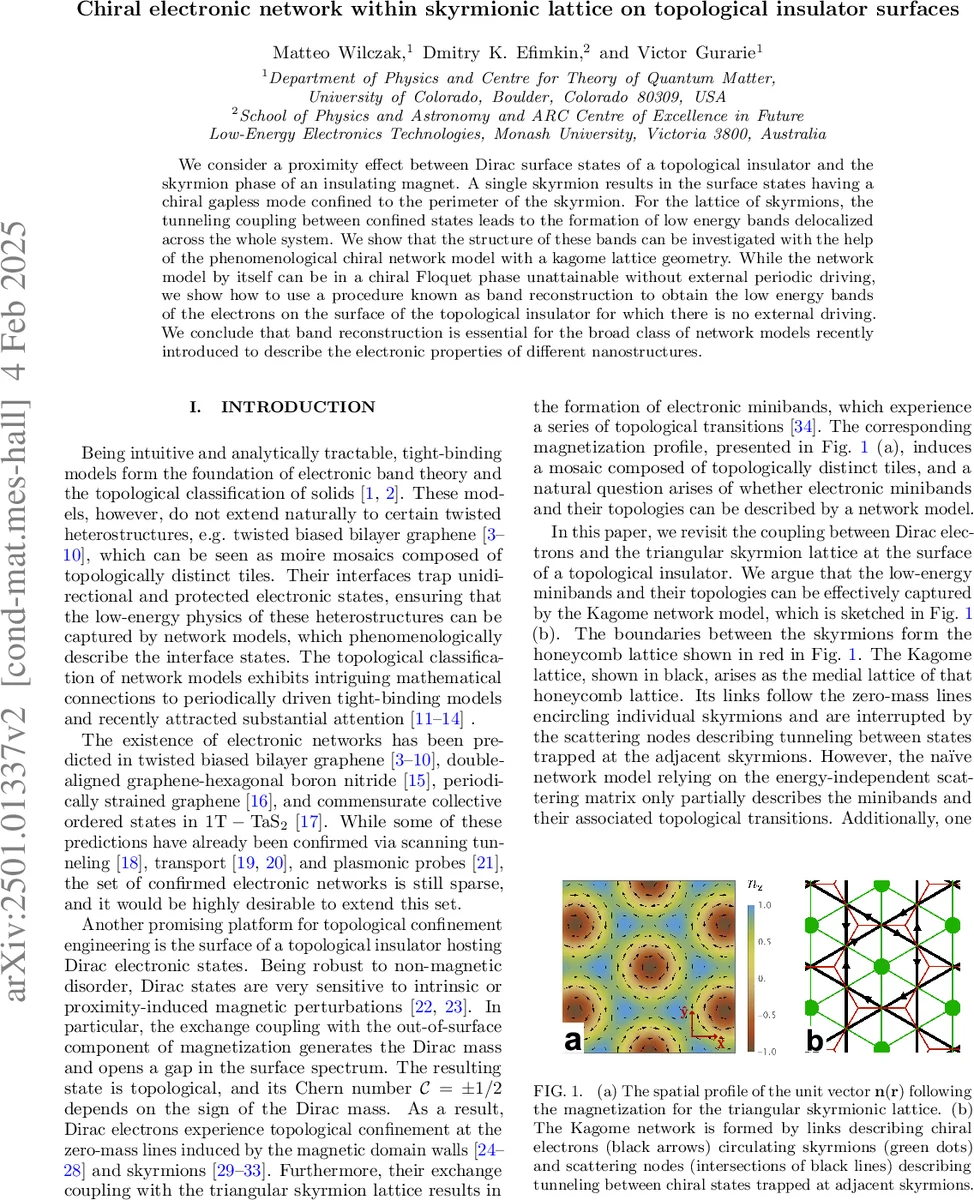
To capture this low‑energy physics without the heavy numerical effort of the full Dirac model, the authors introduce a phenomenological network model. The zero‑mass lines form a kagome lattice of directed links; each link carries a single chiral mode, and the intersections of links act as scattering nodes where tunnelling between neighboring skyrmion‑bound states occurs. The scattering at a node is described by a unitary (2\times2) matrix (S) parametrized by an angle (\theta) (tunnelling strength) and three phases (\phi_T,\phi,\Phi). The time evolution over one “step” is encoded in a Floquet operator (U_{\mathbf{k}}); its eigenphases give quasienergies (\epsilon_{\mathbf{k}}). Because the model is intrinsically periodic in time, it naturally exhibits a “chiral Floquet” phase characterized by a non‑zero winding number but zero Chern numbers for all bands.
However, the physical TI‑skyrmion system is static; there is no external periodic drive. Consequently, a network model with energy‑independent scattering parameters cannot faithfully reproduce the band topology obtained from the microscopic Dirac calculation. The authors resolve this inconsistency by employing a “band reconstruction” procedure: they allow the scattering angle (\theta) to depend on the quasienergy (\epsilon), effectively feeding back the microscopic dispersion into the network description. This self‑consistent mapping restores agreement between the network model and the Dirac‑based miniband spectra, correctly reproducing the trivial, critical, and Chern‑insulating regimes.
Key insights of the paper are:
- Skyrmion textures provide natural one‑dimensional chiral channels (zero‑mass lines) on TI surfaces.
- The hybridization of these channels in a periodic skyrmion lattice yields minibands whose topology can be tuned by the lattice spacing relative to the localization length.
- A kagome‑type chiral network model captures the essential low‑energy degrees of freedom, but only when its scattering parameters are allowed to be energy dependent.
- The band‑reconstruction technique is essential for reconciling static network models with the Floquet formalism and may be broadly applicable to other emergent electronic networks (e.g., twisted bilayer graphene, Moiré superlattices).
In conclusion, the study demonstrates that the combination of a topological‑insulator surface with a skyrmion lattice creates a versatile platform for engineering chiral electronic networks. The phenomenological kagome network, supplemented by band reconstruction, provides a compact yet accurate description of the resulting miniband structure and its topological transitions, offering a valuable tool for future theoretical and experimental explorations of engineered topological matter.
Comments & Academic Discussion
Loading comments...
Leave a Comment