Uniting Quantum Processing Nodes of Cavity-coupled Ions with Rare-earth Quantum Repeaters Using Single-photon Pulse Shaping Based on Atomic Frequency Comb
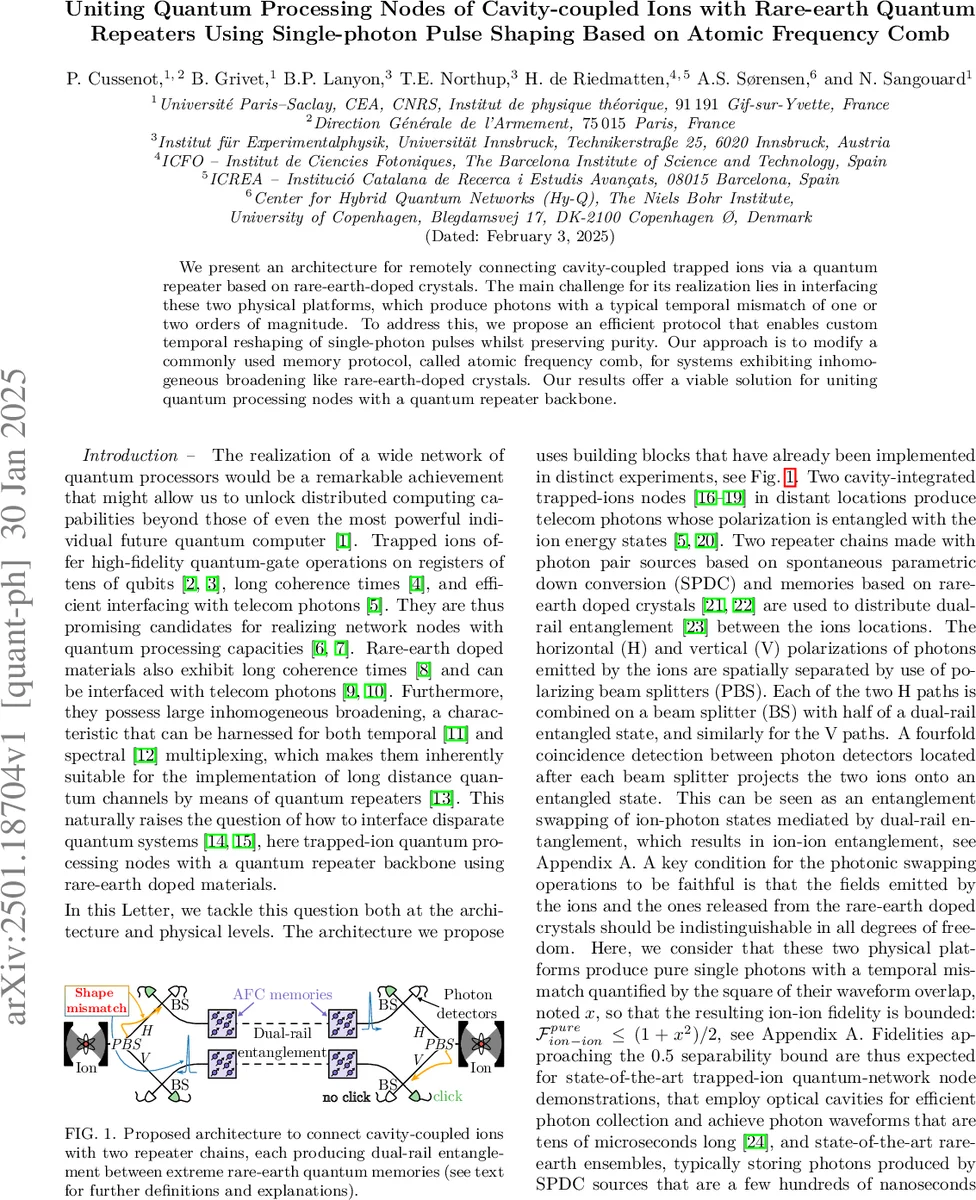
We present an architecture for remotely connecting cavity-coupled trapped ions via a quantum repeater based on rare-earth-doped crystals. The main challenge for its realization lies in interfacing these two physical platforms, which produce photons with a typical temporal mismatch of one or two orders of magnitude. To address this, we propose an efficient protocol that enables custom temporal reshaping of single-photon pulses whilst preserving purity. Our approach is to modify a commonly used memory protocol, called atomic frequency comb, for systems exhibiting inhomogeneous broadening like rare-earth-doped crystals. Our results offer a viable solution for uniting quantum processing nodes with a quantum repeater backbone.
💡 Research Summary
The paper proposes a concrete architecture for linking cavity‑coupled trapped‑ion quantum processors with long‑distance quantum repeaters based on rare‑earth‑doped crystal memories. The central technical obstacle is the large temporal mismatch between the photons emitted by the ion nodes (tens of microseconds long) and those that can be stored and re‑emitted by atomic‑frequency‑comb (AFC) memories (hundreds of nanoseconds). To bridge this gap, the authors modify the standard AFC protocol, replacing the single π‑pulse readout with a sequence of weak, partially‑absorbing control pulses. Each control pulse transfers only a fraction of the stored excitation from the long‑lived spin state back to the excited optical state, causing a small “slice” of the photon wavepacket to be emitted. By carefully choosing the pulse areas (r_j) and thus the transfer fractions (q_j = arcsin(r_j/π)), the emitted slices can be arranged to reconstruct any desired temporal shape, including the long, asymmetric profile of a cavity‑mediated 40 Ca⁺ ion photon.
Key theoretical developments include: (i) a scalar model derived from Heisenberg‑Langevin equations that captures the dynamics of a cavity‑enhanced AFC under weak control fields; (ii) an impedance‑matching condition (cooperativity C = C_opt) that guarantees unit efficiency for the overall read‑out sequence despite the partial nature of each pulse; (iii) an analytic recipe for the optimal set of q_j that maximizes overlap with a target waveform while preserving the single‑photon purity. The authors also introduce a “cropped‑echo” technique: two synchronization π‑pulses are inserted before the read‑out sequence to locate the photon’s time bin after storage, and the spacing between read‑out pulses is adjusted to suppress unwanted echo tails, thereby retaining multimode capacity.
Numerical simulations are performed for a realistic Pr³⁺:Y₂SiO₅ crystal placed inside a high‑finesse (F≈6.6) optical cavity. The comb parameters (Δ = 2π·61 kHz, tooth width 1 kHz, total bandwidth 4 MHz) satisfy the impedance‑matching condition with κ = 2π·55 MHz and collective coupling g√N = 2π·8.4 MHz. An input Gaussian photon of 330 ns FWHM is first stored with a π‑pulse, then re‑emitted using 20 weak read‑out pulses. The overall AFC efficiency remains ≈96 % (limited by absorption and control‑pulse bandwidth), while the conditional overlap with the target ion photon shape improves from 32 % (standard read‑out) to 78 % with shaped read‑out, and to 95 % when the cropped‑echo technique and modest spectral filtering are applied. Efficiency loss in the latter case is modest (≈90 %).
The target waveform is taken from a cavity‑mediated Raman transition of a single 40 Ca⁺ ion, which experimentally exhibits an 11 µs FWHM asymmetric pulse. The authors show that the proposed AFC shaping can reproduce this waveform to a high degree, limited only by the intrinsic impurity of the ion photon (as measured by Hong‑Ou‑Mandel visibility). Importantly, the shaping process does not introduce additional decoherence; the photon purity is preserved because the AFC dynamics remain linear and the control fields are weak.
In summary, the work delivers a practical solution to the temporal‑mode mismatch that has long hindered hybrid quantum networks. By exploiting partial AFC read‑out, impedance‑matched cavity enhancement, and an algorithmic pulse‑shaping scheme, the authors enable high‑efficiency, high‑fidelity conversion of short, broadband photons into long, ion‑compatible waveforms while retaining the multimode advantages of AFC memories. This paves the way for integrating trapped‑ion quantum processors with rare‑earth‑based quantum repeaters, a crucial step toward scalable, long‑distance quantum communication.
Comments & Academic Discussion
Loading comments...
Leave a Comment