Multiplicative Chern insulator
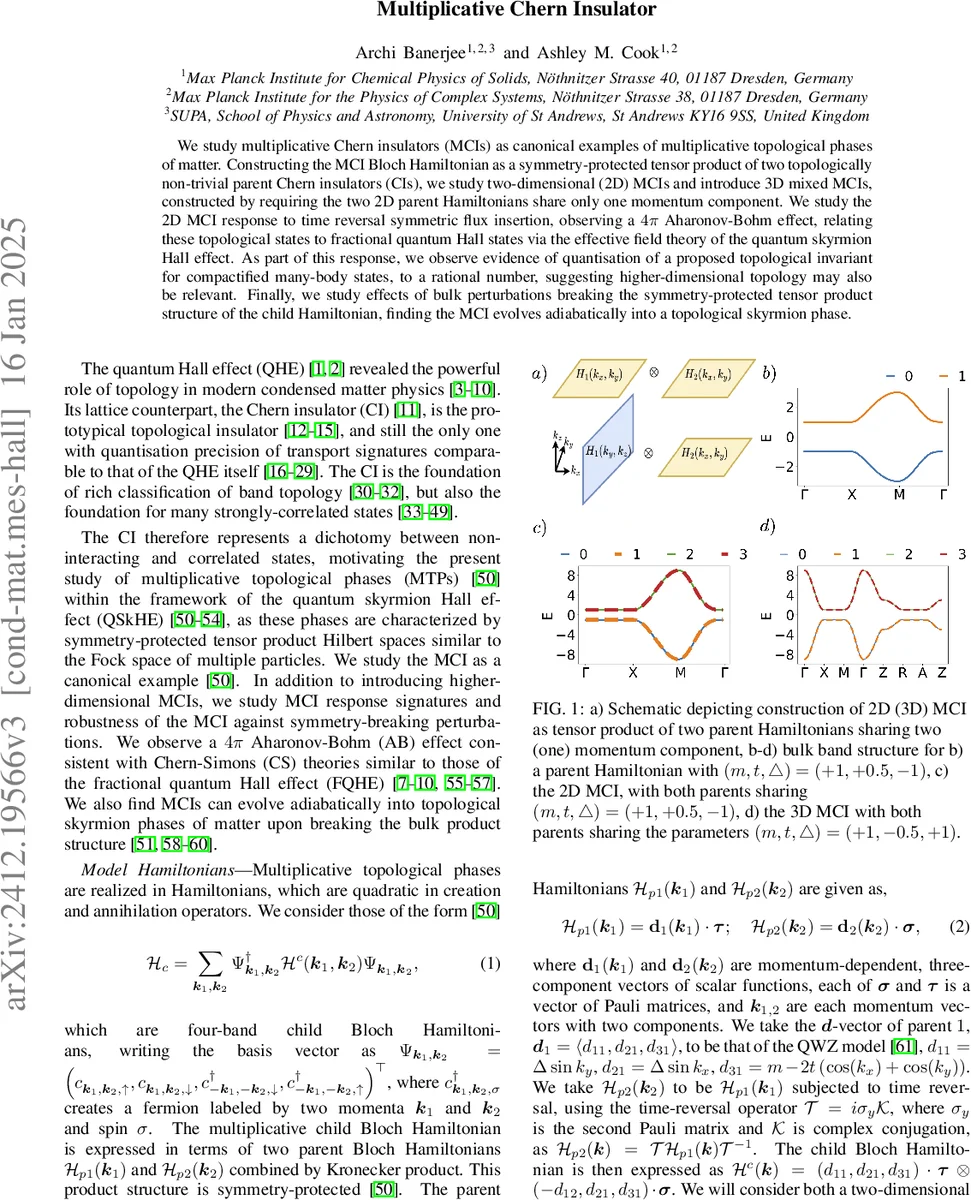
We study multiplicative Chern insulators (MCIs) as canonical examples of multiplicative topological phases of matter. Constructing the MCI Bloch Hamiltonian as a symmetry-protected tensor product of two topologically non-trivial parent Chern insulators (CIs), we study two-dimensional (2D) MCIs and introduce 3D mixed MCIs, constructed by requiring the two 2D parent Hamiltonians share only one momentum component. We study the 2D MCI response to time reversal symmetric flux insertion, observing a $4π$ Aharonov-Bohm effect, relating these topological states to fractional quantum Hall states via the effective field theory of the quantum skyrmion Hall effect. As part of this response, we observe evidence of quantisation of a proposed topological invariant for compactified many-body states, to a rational number, suggesting higher-dimensional topology may also be relevant. Finally, we study effects of bulk perturbations breaking the symmetry-protected tensor product structure of the child Hamiltonian, finding the MCI evolves adiabatically into a topological skyrmion phase.
💡 Research Summary
In this work the authors introduce “multiplicative Chern insulators” (MCIs) as concrete realizations of multiplicative topological phases (MTPs). Starting from two non‑trivial Chern‑insulator parent Hamiltonians, they construct a four‑band child Hamiltonian by taking a symmetry‑protected tensor product of the parents. The resulting spectrum is the product of the parent spectra, guaranteeing at least double degeneracy and a quadratic scaling of bandwidth. Two families are explored: a two‑dimensional “parallel” MCI where both parents share the same momentum (kₓ,k_y), and a three‑dimensional “mixed” MCI where the parents share only one momentum component (k_y). Band‑structure analysis shows that in the parallel case the child bands are the square of the parent bands, while in the mixed case the dispersion is quadratic along the shared direction and linear along the unshared direction.
Slab calculations with open boundary conditions reveal distinctive bulk‑boundary correspondence. In the parallel MCI edge modes disperse quadratically and remain exponentially localized, in contrast to the linear edge modes of a single Chern insulator. In the mixed MCI, open boundaries along the shared direction produce doubly‑degenerate surface bands that traverse the bulk gap, whereas open boundaries along the unshared direction generate additional bulk‑like states that are absent under periodic boundaries, effectively turning a bulk insulator into a bulk semimetal at the edge.
The authors then probe the topological response by inserting time‑reversal‑symmetric flux tubes. A single‑plaquette flux insertion reproduces the usual ϕ₀‑periodic spectrum of a Chern insulator. When a pair of opposite fluxes is inserted, the spectrum becomes 2ϕ₀‑periodic, with a gap closing near ϕ = ϕ₀, which the authors interpret as a 4π Aharonov‑Bohm effect. This effect originates from entanglement between the two parent degrees of freedom and signals the formation of a composite quasiparticle—a quantum skyrmion—that can be described by a minimal Chern‑Simons theory analogous to the ν = 1/2 fractional quantum Hall state. By constructing the occupied‑state density matrix and a spin‑representation for each parent, they compute a many‑body topological invariant Tr
Comments & Academic Discussion
Loading comments...
Leave a Comment