The Impact of AI-Driven Tools on Student Writing Development: A Case Study From The CGScholar AI Helper Project
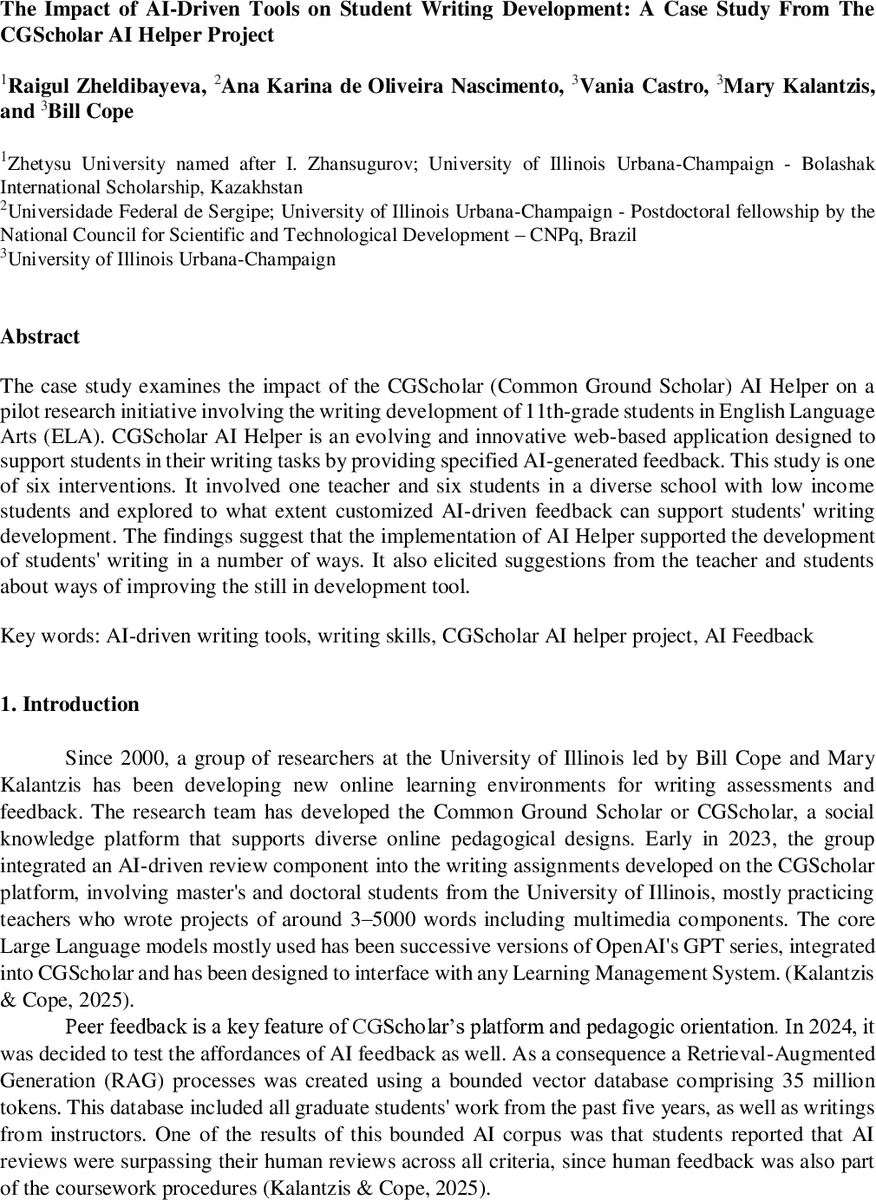
The case study examines the impact of the CGScholar (Common Ground Scholar) AI Helper on a pilot research initiative involving the writing development of 11th-grade students in English Language Arts (ELA). CGScholar AI Helper is an evolving and innovative web-based application designed to support students in their writing tasks by providing specified AI-generated feedback. This study is one of six interventions. It involved one teacher and six students in a diverse school with low income students and explored to what extent customized AI-driven feedback can support students’ writing development. The findings suggest that the implementation of AI Helper supported the development of students’ writing in a number of ways. It also elicited suggestions from the teacher and students about ways of improving the still in development tool.
💡 Research Summary
The paper reports a qualitative case study investigating the impact of the CGScholar AI Helper, a web‑based generative‑AI feedback tool, on the writing development of a small group of 11th‑grade English Language Arts (ELA) students in a low‑income public high school in the U.S. Midwest. The intervention involved one English teacher and six students who completed a 200‑word comparative writing assignment. The AI Helper was built on a Retrieval‑Augmented Generation (RAG) architecture that draws from a bounded corpus of roughly 35 million tokens consisting of past graduate‑level essays, instructor writings, and other academic texts. The teacher supplied a customized rubric and learning objectives, which were encoded into prompts that guided the large language model (primarily OpenAI’s GPT series) to generate feedback aligned with the teacher’s expectations rather than generic suggestions.
The research employed an “agile‑style cyber‑social education research” methodology. Early prototypes of the AI Helper were released to the teacher and students, and data were collected through observations, a teacher post‑survey, focus‑group interviews with students, and the students’ original and revised drafts. Qualitative analysis followed Braun and Clarke’s six‑step thematic coding process, yielding four major themes: (1) feedback receptivity, (2) increased self‑efficacy, (3) improved content organization, and (4) reduced teacher feedback workload.
Findings indicate that AI‑generated feedback positively affected multiple dimensions of student writing. Students reported that immediate grammatical corrections, suggestions for lexical variety, and prompts to restructure arguments helped reduce anxiety during the drafting phase and encouraged autonomous revision. Teachers noted that the AI’s rapid, rubric‑aligned comments shortened the in‑class feedback cycle, freeing them to focus on higher‑order instructional goals such as critical analysis and genre awareness. Both teachers and students offered constructive criticism of the tool, highlighting issues such as insufficient explanatory depth in feedback, occasional misalignment with specific learning objectives, and the need for a more intuitive user interface.
The study also discusses several limitations and ethical considerations. Over‑reliance on AI feedback could impede the development of independent writing skills, echoing concerns raised in prior literature. The underlying corpus may embed cultural or disciplinary biases, potentially leading the AI to reproduce stereotyped language. Privacy risks arise because student drafts are transmitted to a cloud‑based language model; the paper notes that robust encryption and anonymization protocols are required for broader deployment.
Overall, the authors argue that the CGScholar AI Helper demonstrates a viable, “calibrated” use of generative AI in K‑12 settings when it is tightly coupled with teacher‑authored rubrics and iterative, user‑driven development cycles. This aligns with Cope and Kalantzis’s (2025) position that generative AI is not ready for unmediated classroom use but can be effective when carefully mediated. The paper calls for future research with larger, more diverse samples, longitudinal tracking of writing outcomes, systematic bias audits, and deeper exploration of hybrid human‑AI feedback models to validate and extend the promising results observed in this pilot.
Comments & Academic Discussion
Loading comments...
Leave a Comment