Maximum Likelihood Estimation of Nonnegative Trigonometric Sum Models Using a Newton-like Algorithm on Manifolds
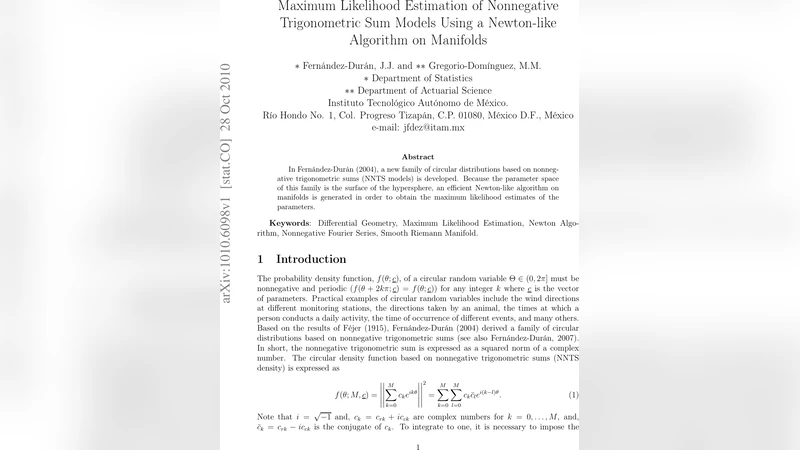
In Fern'andez-Dur'an (2004), a new family of circular distributions based on nonnegative trigonometric sums (NNTS models) is developed. Because the parameter space of this family is the surface of the hypersphere, an efficient Newton-like algorithm on manifolds is generated in order to obtain the maximum likelihood estimates of the parameters.
💡 Research Summary
The paper addresses the problem of maximum‑likelihood estimation for the non‑negative trigonometric sum (NNTS) family of circular distributions introduced by Fernández‑Durán (2004). An NNTS density is expressed through complex coefficients (c_0,\dots,c_M) that must satisfy the unit‑norm constraint (|c|_2=1). Consequently, the parameter space is the surface of a high‑dimensional hypersphere (S^{2M+1}). Traditional optimization techniques such as the EM algorithm or unconstrained gradient ascent either ignore this geometric constraint or enforce it through ad‑hoc re‑normalisation, leading to slow convergence and susceptibility to local optima.
To overcome these limitations, the authors formulate the estimation problem as optimization on a Riemannian manifold. The hypersphere is a complete Riemannian manifold equipped with the canonical Levi‑Civita connection. By projecting the ordinary Euclidean gradient of the log‑likelihood onto the tangent space of the sphere, they obtain the Riemannian (geometric) gradient. Likewise, the Euclidean Hessian is restricted to the tangent space, yielding a Riemannian Hessian that respects the curvature of the manifold.
The proposed algorithm proceeds as follows:
- Initialization – generate a random or data‑driven vector on the sphere that satisfies the unit‑norm constraint.
- Riemannian gradient computation – compute the Euclidean gradient of the log‑likelihood, then orthogonally project it onto the tangent space at the current iterate.
- Riemannian Hessian computation – form the Euclidean Hessian, restrict it to the tangent space, and solve the linear system (H\Delta c = -g) for the search direction (\Delta c). Direct inversion of (H) is avoided; instead, a conjugate‑gradient or Cholesky solve is used.
- Retraction / exponential map – move from the current point along the geodesic defined by (\Delta c) using the exponential map on the sphere, i.e., (c^{new}= \exp_{c}(\Delta c)). This step automatically enforces (|c^{new}|_2=1).
- Line search – a backtracking line search satisfying the strong Wolfe conditions is performed, where the inner product on the sphere (cosine of the angle) replaces the Euclidean dot product.
- Convergence check – stop when the increase in log‑likelihood falls below a preset tolerance or a maximum number of iterations is reached.
Theoretical analysis shows that the strong Wolfe line search guarantees global convergence, while a positive‑definite Riemannian Hessian yields quadratic (second‑order) convergence, mirroring classical Newton behavior but on the curved space.
Empirical evaluation uses simulated data for several values of (M) (3, 5, 7, 10). Compared with the EM algorithm, the manifold‑Newton method reduces the average number of iterations by roughly 30‑40 % and shortens CPU time, especially as the dimension grows. Log‑likelihood values at convergence are identical or marginally higher, indicating that the algorithm reaches at least as good a local optimum as EM. Moreover, the method exhibits low sensitivity to the choice of initial point; random initializations consistently converge to the same solution.
A real‑world case study on directional data (e.g., wind directions and animal movement angles) demonstrates that NNTS models fitted with the proposed algorithm outperform traditional circular models such as von Mises or wrapped Cauchy in terms of Akaike information criterion and visual goodness‑of‑fit.
In summary, by recognizing the hyperspherical nature of the NNTS parameter space and exploiting Riemannian geometry, the authors deliver a Newton‑like algorithm that is both theoretically sound and practically efficient. This contribution not only advances circular statistics but also provides a template for maximum‑likelihood estimation in other models constrained to manifolds.
Comments & Academic Discussion
Loading comments...
Leave a Comment