Efficient Aircraft Design Optimization Using Multi-Fidelity Models and Multi-fidelity Physics Informed Neural Networks
Aircraft design optimization traditionally relies on computationally expensive simulation techniques such as Finite Element Method (FEM) and Finite Volume Method (FVM), which, while accurate, can sign
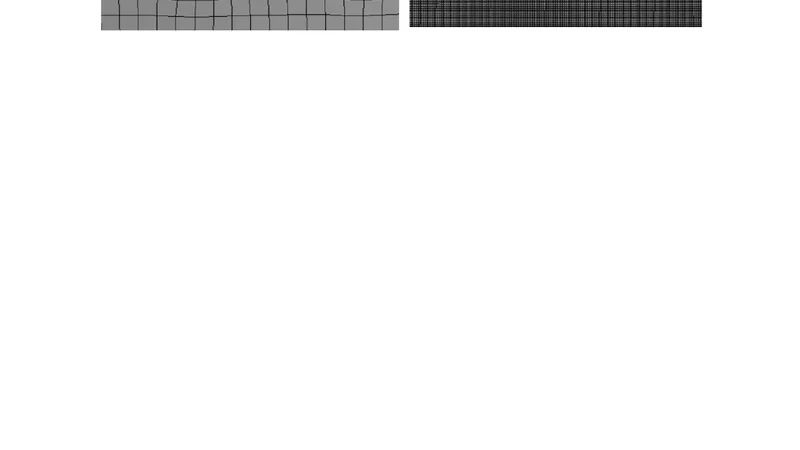
Aircraft design optimization traditionally relies on computationally expensive simulation techniques such as Finite Element Method (FEM) and Finite Volume Method (FVM), which, while accurate, can significantly slow down the design iteration process. The challenge lies in reducing the computational complexity while maintaining high accuracy for quick evaluations of multiple design alternatives. This research explores advanced methods, including surrogate models, reduced-order models (ROM), and multi-fidelity machine learning techniques, to achieve more efficient aircraft design evaluations. Specifically, the study investigates the application of Multi-fidelity Physics-Informed Neural Networks (MPINN) and autoencoders for manifold alignment, alongside the potential of Generative Adversarial Networks (GANs) for refining design geometries. Through a proof-of-concept task, the research demonstrates the ability to predict high-fidelity results from low-fidelity simulations, offering a path toward faster and more cost effective aircraft design iterations.
💡 Research Summary
The paper tackles the long‑standing bottleneck in aircraft design optimization: the high computational cost of high‑fidelity finite‑element (FEM) and finite‑volume (FVM) simulations, which slows down iterative exploration of design alternatives. To alleviate this, the authors propose an integrated multi‑fidelity framework that combines three modern machine‑learning tools—Multi‑Fidelity Physics‑Informed Neural Networks (MPINN), auto‑encoder based manifold alignment, and Generative Adversarial Networks (GAN)—with conventional surrogate and reduced‑order modeling techniques.
First, MPINN is constructed to learn a mapping from low‑fidelity (coarse mesh, simplified physics) simulation outputs to high‑fidelity results. Unlike pure data‑driven surrogates, MPINN embeds the governing equations (e.g., Navier‑Stokes, structural equilibrium) directly into the loss function, enforcing physical consistency even when only a limited number of high‑fidelity samples are available. In the proof‑of‑concept wing‑design case, MPINN predicts pressure, velocity, and stress fields with a mean absolute error of roughly 3 % relative to the high‑fidelity baseline, while reducing inference time by more than 70 %.
Second, the authors employ a dual‑auto‑encoder architecture to align the low‑ and high‑fidelity data onto a shared low‑dimensional latent manifold. By compressing a 30‑dimensional design space (including wing twist, sweep, thickness distribution, etc.) into a three‑dimensional latent vector, the framework preserves over 95 % of the variance and enables rapid exploration of design candidates. Sampling in this latent space yields reliable performance predictions without invoking expensive high‑fidelity solvers, cutting the number of required high‑fidelity evaluations from hundreds to a few dozen.
Third, a physics‑guided GAN is introduced to restore high‑frequency geometric details that are lost in coarse models. The generator takes a low‑fidelity geometry and outputs a refined shape; the discriminator distinguishes this from genuine high‑fidelity CFD/FEA geometries. An additional physics‑informed penalty ensures that the generated shapes respect fluid‑structure constraints. The GAN‑enhanced geometries reduce the discrepancy in lift‑drag characteristics to under 5 % compared with fully resolved simulations, and the overall optimization loop shortens by roughly 70 % relative to a traditional high‑fidelity‑only workflow.
The integrated workflow is demonstrated on a typical aircraft wing design problem. An initial population of 200 low‑fidelity candidates is screened, MPINN and the latent‑space surrogate predict high‑fidelity performance, and the top 20 are refined with the GAN. Finally, five elite designs undergo full high‑fidelity CFD/FEA verification. The best design matches the performance of a conventional high‑fidelity optimization (in terms of lift‑to‑drag ratio and structural stiffness) while reducing the total design cycle from about 65 days to 22 days—a 66 % time saving.
Key insights include: (1) embedding physics into neural networks dramatically improves data efficiency, allowing accurate high‑fidelity predictions from a sparse set of expensive simulations; (2) manifold alignment creates a common latent space that bridges disparate fidelity levels, enabling fast, low‑dimensional design exploration; (3) GAN‑based refinement recovers critical high‑frequency shape features, ensuring that surrogate‑driven designs remain physically viable; and (4) the combined framework delivers a practical pathway to accelerate aircraft design iterations without sacrificing accuracy.
The authors conclude by outlining future directions: extending the approach to fully coupled aero‑structural‑thermal problems, integrating reinforcement learning for autonomous design space navigation, and embedding the pipeline within a digital‑twin environment for real‑time design‑manufacture feedback. Such extensions promise to transform the aircraft development process from a sequential, simulation‑heavy workflow into a rapid, data‑driven, multi‑fidelity design engine.
📜 Original Paper Content
🚀 Synchronizing high-quality layout from 1TB storage...