The dynamical structure of partial group algebras with relations, with applications to subshift algebras
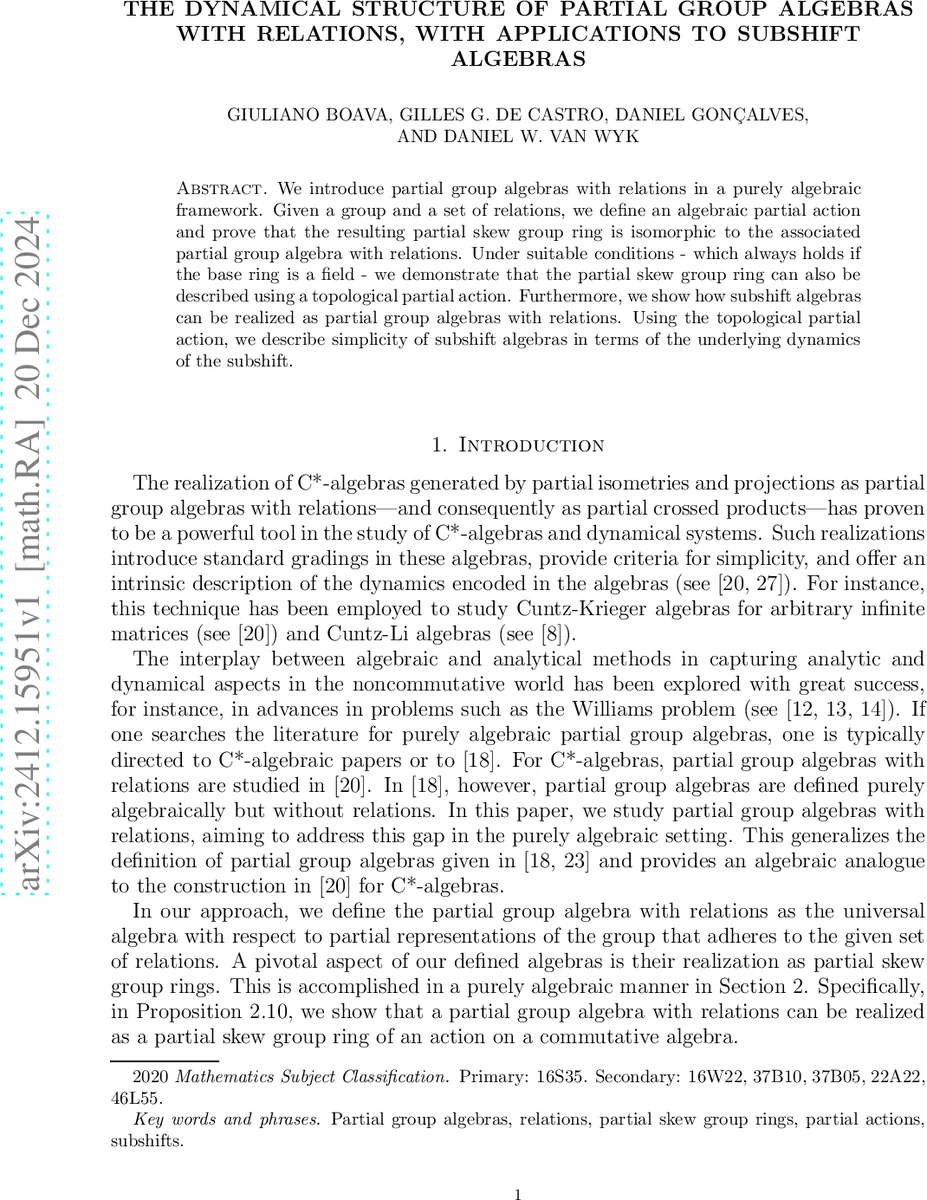
We introduce partial group algebras with relations in a purely algebraic framework. Given a group and a set of relations, we define an algebraic partial action and prove that the resulting partial skew group ring is isomorphic to the associated partial group algebra with relations. Under suitable conditions - which always holds if the base ring is a field - we demonstrate that the partial skew group ring can also be described using a topological partial action. Furthermore, we show how subshift algebras can be realized as partial group algebras with relations. Using the topological partial action, we describe simplicity of subshift algebras in terms of the underlying dynamics of the subshift.
💡 Research Summary
This paper presents a rigorous mathematical investigation into the dynamical structure of partial group algebras augmented with relations, providing a profound bridge between abstract algebra and symbolic dynamics. The research focuses on extending the classical notion of partial group algebras to a more complex framework where specific relations are introduced, and then analyzing the resulting algebraic and topological properties.
The authors begin by establishing a purely algebraic framework for partial group algebras with relations. A primary contribution of the work is the proof of an isomorphism between the partial skew group ring, constructed from an algebraic partial action, and the associated partial group algebra with relations. This isomorphism is significant because it allows the complex structural properties of algebras with relations to be studied using the well-established mathematical tools associated with partial skew group rings. By demonstrating this equivalence, the authors provide a method to simplify the analysis of intricate algebraic structures.
A key advancement in the paper is the transition from algebraic to topological descriptions. The authors demonstrate that under the condition where the base ring is a field, the algebraic partial action can be reformulated as a topological partial action. This connection is crucial as it enables the application of topological dynamics to the study of algebraic structures. It implies that the algebraic operations within these algebras can be interpreted as dynamical movements within a topological space, thereby allowing researchers to utilize topological invariants and dynamical systems theory to probe algebraic properties.
The most impactful application of this theoretical framework is found in the study of subshift algebras within the field of symbolic dynamics. The authors successfully demonstrate that subshift algebras can be realized as specific instances of partial group algebras with relations. This realization provides a powerful unified language for studying both algebraic and dynamical systems. By leveraging the topological partial action framework, the paper provides a definitive method to characterize the simplicity of subshift algebras based on the underlying dynamics of the subshift itself. Specifically, the authors show how the dynamical properties of the subshift (such as its orbit structure or pattern complexity) directly dictate whether the corresponding algebra is simple.
In conclusion, this paper provides a comprehensive synthesis of algebraic, topological, and dynamical perspectives. By linking the algebraic property of simplicity to the dynamical properties of subshifts, the research offers new insights into the classification of both algebraic structures and dynamical systems. This work stands as a significant contribution to the fields of non-commutative algebra and symbolic dynamics, offering a robust framework for future explorations into the interplay between algebraic relations and dynamical complexity.
Comments & Academic Discussion
Loading comments...
Leave a Comment