Earthquake Early Warning and Beyond: Systems Challenges in Smartphone-based Seismic Network
Earthquake Early Warning (EEW) systems can effectively reduce fatalities, injuries, and damages caused by earthquakes. Current EEW systems are mostly based on traditional seismic and geodetic networks, and exist only in a few countries due to the hig…
Authors: Qingkai Kong, Qin Lv, Richard M. Allen
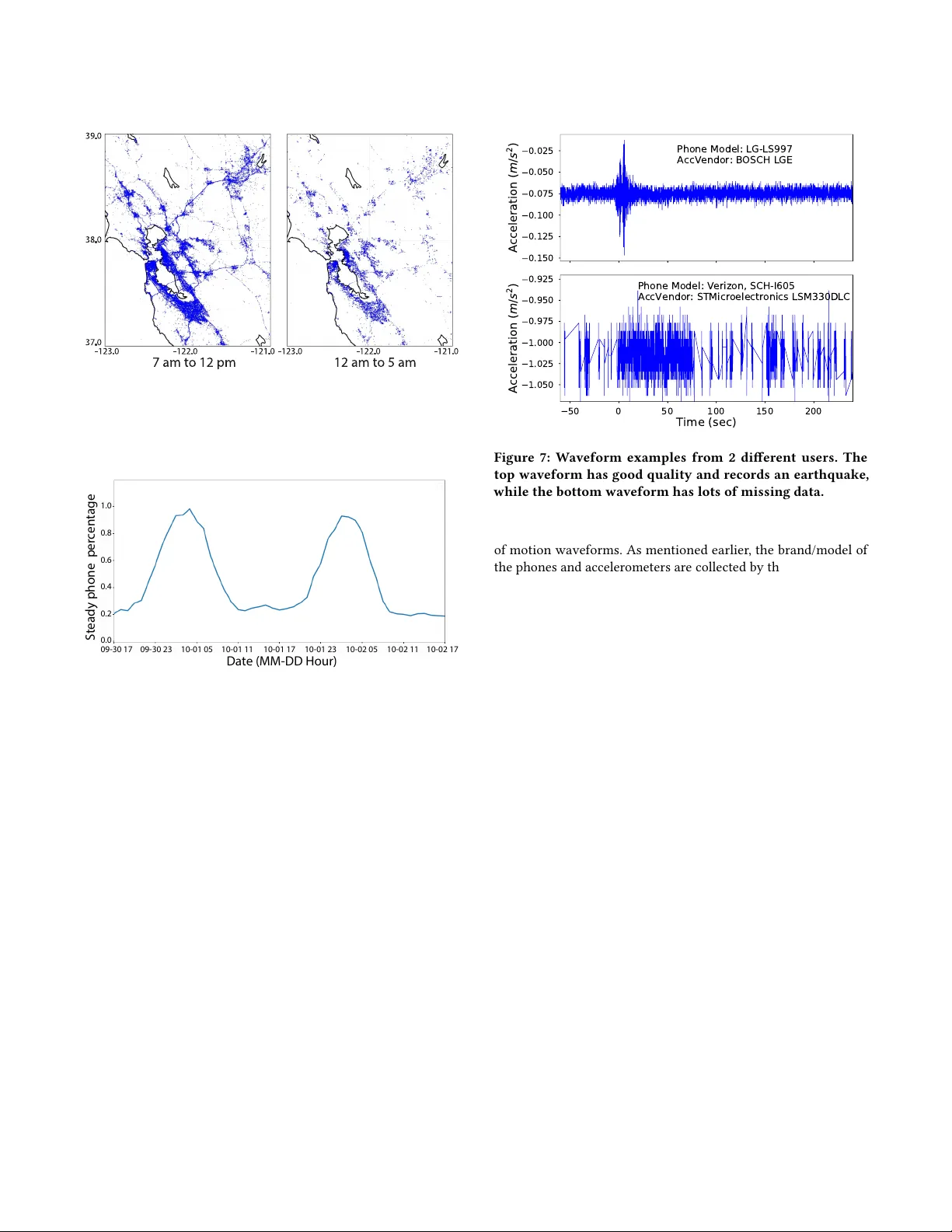
Earthquake Early W arning and Bey ond: Systems Challenges in Smartphone-based Seismic Network Qingkai Kong University of California, Berkeley Berkeley, CA kongqk@berkeley .edu Qin Lv University of Colorado Boulder Boulder, CO qin.lv@colorado.edu Richard M. Allen University of California, Berkeley Berkeley, CA rallen@berkeley .edu ABSTRA CT Earthquake Early W arning (EEW) systems can eectively r educe fatalities, injuries, and damages caused by earthquakes. Current EEW systems are mostly based on traditional seismic and ge odetic networks, and exist only in a few countries due to the high cost of installing and maintaining such systems. The MyShake system takes a dierent approach and turns people’s smartphones into portable seismic sensors to detect earthquake-like motions. However , to issue EEW messages with high accuracy and low latency in the real world, we need to address a number of challenges related to mobile computing. In this paper , we rst summarize our e xperience building and deploying the MyShake system, then focus on two key challenges for smartphone-based EEW (sensing heterogeneity and user/system dynamics) and some preliminary exploration. W e also discuss other challenges and new research directions asso ciated with smartphone-based seismic network. CCS CONCEPTS • Human-centered computing → Ubiquitous and mobile com- puting systems and tools ; • Applied computing → Earth and atmospheric sciences . KEY W ORDS Earthquake Early W arning, Smartphone Seismic Network A CM Reference Format: Qingkai Kong, Qin Lv, and Richard M. Allen. 2019. Earthquake Early W arn- ing and Beyond: Systems Challenges in Smartphone-based Seismic Network. In The 20th International W orkshop on Mobile Computing Systems and A ppli- cations (HotMobile ’19), February 27–28, 2019, Santa Cruz, CA, USA. A CM, New Y ork, NY, USA, 6 pages. https://doi.org/10.1145/3301293.3302377 1 IN TRODUCTION Earthquakes are global hazards that frequently shake our nerves at various places on the Earth by killing people, interrupting normal life and work, and destro ying cities. In order to r ecord and under- stand earthquakes, instruments such as seismometers are installed globally to convert earthquake waves into digital time series includ- ing acceleration, velocity or displacement of the ground motion. Permission to make digital or hard copies of all or part of this work for personal or classroom use is granted without fee provided that copies are not made or distributed for prot or commercial advantage and that copies bear this notice and the full citation on the rst page. Copyrights for components of this work owned by others than the author(s) must be honor ed. Abstracting with cr edit is permitted. T o copy otherwise, or republish, to post on servers or to redistribute to lists, requires prior specic permission and /or a fee. Request p ermissions from permissions@acm.org. HotMobile ’19, February 27–28, 2019, Santa Cruz, CA, USA © 2019 Copyright held by the owner/author(s). Publication rights licensed to A CM. ACM ISBN 978-1-4503-6273-3/19/02. . . $15.00 https://doi.org/10.1145/3301293.3302377 Although many scientists and engineers hav e devoted their liv es to study earthquakes, it is still not feasible to pr edict earthquakes using today’s science and technology . The recent development of Earthquake Early W arning (EEW) systems provides at least one way to identify the occurrence of an earthquake in near real-time and issue a warning to the public [ 1 ]. The eectiv eness of EEW has been proved in various regions over the past decade by reducing fatalities, injuries, and damage caused by earthquakes, by alerting people to take cover , slowing do wn and stopping trains, opening elevator doors, and many other applications [ 22 ]. The concept of EEW is simple – seismic waves generated by earthquakes travel at the speed of sound, while electronic signals travel at the speed of light (analogous to seeing lightning before hearing the sound of thunder). If we can detect seismic waves quickly after the earth- quake occur , we can leverage electronic signals travels much faster than the seismic waves to warn people at further distances before seismic waves arrive [13]. Traditional seismometers are high-quality resear ch-grade sen- sors, which are costly to deploy and maintain. As such, only a limited number of seismic networks exist in the world to monitor earthquakes, and few places ( will) have EEW systems ( e.g., Japan, California, T aiwan, China, Mexico, Italy , Turke y , Romania, Switzer- land). Many other regions with high earthquake hazar ds and dense populations (e.g., Nepal, Ecuador , New Zealand, Indonesia) do not have EEW systems [ 1 ]. Ev en for places with EEW systems, many of them are limited by low station density due to the lack of funding to increase the number of sensors. T o overcome the limitations of traditional seismic networks, the MyShake system takes a dierent approach – a smartphone-based seismic network that turns people’s smartphones into portable seismic sensors [ 17 ]. Using sensors and communication units that are readily-available in consumer smartphone devices, we can achieve rapid detection of earthquakes and issue warnings to indi- vidual users in target regions. The advantages of building such a smartphone-based EEW system ar e multifold: (a) no need to deplo y sensors and maintain them, (b) easily scale up to the global level, (c) increase public awar eness and knowledge of earthquakes. This approach also allows us to bring EEW to any region where the local population is exposed to earthquake hazards, esp ecially in areas where do not exist the traditional EEW system. Such a high-gain system does come with a number of unique challenges in the real world. In this paper , we rst summarize our experience building and deploying the MyShake system, then present the unique challenges of EEW and our initial exploration to address these challenges. While initiated as a seismology pr oject, through this workshop pap er , our goal is to introduce MyShake to the mobile computing community , so that we could seek expert Figure 1: MyShake global user distribution. Brighter color indicates higher user density . Data use d here are from all registered users with locations available during the period of 2016-02-12 to 2018-08-12. feedback on possible solutions, potential improvements, and even new challenges/directions. 2 MYSHAKE SYSTEM MyShake is a free Android app that has the ability to recognize earthquake shaking using the sensors in every smartphone. The app runs “silently” in the backgr ound, and when the shaking ts the vibrational prole of an earthquake , the app sends the anony- mous information to a central ser ver , which then conrms the location and magnitude of the quake by aggregating phones in a r e- gion. The whole system design is a collaboration between academia and industry , where seismologists at Berkeley Seismology Lab pro- vided earthquake knowledge and designed the detection algorithms, while developers from Deutsche T elecom Silicone V alley Innova- tion Center implemented the whole system. An upgraded version of MyShake with new UIs and functionalities for both Android and iOS phones will b e released in Spring 2019 to better engage partici- pants and start issuing earthquake early warning to the public [ 20 ]. In this section, we give an ov er view of MyShake’s curr ent status and the overall system design. 2.1 MyShake Current Status MyShake was released to the public on 2016-02-12 and grew rapidly into a global seismic network. It currently has more than 296K downloads, 40K active users, with 6K to 7K phones contributing data on a daily basis. Figure 1 shows the global distribution of MyShake users with available location information. W e can see that the MyShake seismic network has already reached global coverage, and new users can join the network easily by downloading the MyShake app. Initial observations from the MyShake users show very promising results, indicating that the data collected from the phones are capable of supp orting various seismological applications [ 16 ]. Within the rst two and half years, the MyShake network has detected around 900 earthquakes globally with magnitudes ranging from M1.6 to M7.8. There are also initial results sho wing that the MyShake network could potentially provide structural health monitoring of buildings [ 15 ], or use the sensor array to detect smaller earthquakes. Figure 2: An overview of the MyShake system. T able 1: T op 10 phone brands among 276,140 MyShake users. Phone Brand Percentage Phone Brand Percentage Samsung 43.5% Sony 4.4% Motorola 6.1% Google 4.2% LG 5.6% H TC 3.5% V erizon 4.7% Xiaomi 2.8% Huawei 4.5% Lenovo 2.7% 2.2 MyShake System Design Figure 2 illustrates the current design of the MyShake system, which consists of two key components: (1) Each phone downloads MyShake application which has the capability of listening to the ac- celerometer and making decisions whether the experienced motion is due to earthquake by using an articial neural network ( ANN) model. The ANN model is trained by searching for the dierent characteristics between earthquake and human motions from vari- ous features [ 17 , 19 ]. (2) The MyShake cloud ser ver collects data from smartphones including state of health heartbeats, event trig- gers of the phones when they detect earthquake-like motions, and the corresponding time series of the phones’ accelerometer data. A spatial and temporal clustering algorithm runs on the cloud server to aggregate information from multiple smartphones to identify earthquakes [ 18 ]. Whenever a phone detects an earthquake-like motion, it sends a trigger message including the time, location, and amplitude to the cloud server , where the clustering algorithm will conrm the earthquake and estimate earthquake parameters such as magnitude, location, and origin time. At the same time, the phone also records 5-minute (1 minute before and 4 minutes after the trigger) 3-component time series of acceleration and upload to the cloud server when the phone connects to WIFI and power . A detailed technical system architecture can be found in [17]. 3 EEW CHALLENGES FOR MYSHAKE While the current MyShake system is capable of detecting earth- quakes on individual phones and collectively conrming earth- quakes at the seismic network level, a number of unique challenges Figure 3: T op 5 accelerometer typ es in MyShake users’ phones. Data are from 276,140 users. need to be addressed in order to issue real-world EEW using such a smartphone-based seismic network. The key is to concurr ently achieve highly accurate earthquake detection and highly ecient early warning, which requires pushing the boundaries of prior re- search. In this section, we highlight two key challenges that we have been working on, and discuss a few other challenges that are relevant to the mobile computing community . 3.1 Diversity of Sensing Hardware Unlike traditional seismic networks, the MyShake network consists of individual users’ smartphones. It is dicult to control the consis- tency of the sensing hardwar e. From the data collected by MyShake, it is clear that there exists a wide spectrum of brands/makes of the phones and sensors. As a result, these phones have dierent de- tection sensitivities due to the quality of the sensors, and even two dierent phones/sensors at the same location may or may not trigger on the same motion. A one-size-ts-all solution would not work well, and a comprehensive understanding of device diversity and sensitivity for earthquake detection is nee ded for the design of adaptive system strategies and parameters. The real-world data collected by MyShake include phone/sensor information as well as recorded waveforms from users’ phones. An initial analysis using 276,140 MyShake users’ data reveals a wide variety of phone brands and sensor types. The top 10 phone brands and their proportions are shown in T able 1. The top 5 accelerometer types account for about 40% of all the phones, as shown in Figure 3, and there are in total 367 dierent types of sensors in MyShake users’ phones. Inconsistent timing among commodity phones is particularly challenging for smartphone-based EEW . Seismic waves travel at about 3–6 km/s, and our clustering detection on the cloud server looks for coherent triggers from multiple phones. If there is a 5- sec oset on the phones with respect to the true time, seismic waves could have trav eled for 30 km, which signicantly impacts the eectiveness of earthquake detection and early warning. In the current MyShake system, each phone synchronizes via N TP (Network Time Protocol) ev er y hour . Figure 4 shows the distribution of time oset between the phone clock and the true time at the time of N TP synchronization for 1 million randomly sample d records from our database. W e can see that using hourly synchronization, most of the phones would have an oset time within 2.5 seconds. Figure 4: Distribution of MyShake phones’ time oset base d on 1 million randomly sampled N TP records using hourly synchronization. 3.2 Dynamics of Users and System In the MyShake smartphone-based seismic network, the phones move with their users. As such, the seismic netw ork changes con- stantly both in space and time, and the detection capability of the network varies by region and o ver time . For example, it is observed that more phones move to oce ( home) during the day (night), and during the night, more phones are stationary for longer peri- ods of time. For example, Figure 5 shows the spatial distribution of MyShake users in the San Francisco Bay Area during day and night. W e can see clear network distinctions b etween the two time periods, where the network is much denser and more spr ead out during the day vs. during the night. Figure 6 shows the percentage of phones which were steady for more than 30 minutes in the same area for two consecutive days. Again, we se e a wide uctuation of the percentage over time . When phones are steady , they ar e in the best positions to detect earthquakes, while phones on the move cannot detect earthquakes reliably . Therefore , the percentage of steady phones in an area at any given time is actually a good indica- tor of the network’s detection capability . Depending on the specic time and region when an earthquake occurs, the system may have dierent numbers of phones available at dierent lo cations, and dierent earthquake detection strategies and parameters may be needed for the system to dete ct the specic earthquake. 3.3 Other Challenges Besides the two challenges mentioned ab ove, there exist other challenges that are related to supporting EEW in the MyShake system. For instance, when an earthquake strikes, near r eal-time communication is crucial in terms of receiving trigger messages from individual phones and sending EEW messages to millions of users in one region ( e.g., around 7 million people in the San Fran- cisco Bay Area). Understanding the scalability and limitations of the current system and de veloping inno vative techniques to reduce the notication latency could have a signicant impact on saving lives and critical infrastructures. In addition, tradeos b etween the condence and latency of earthquake detection should be carefully Figure 5: MyShake user distribution (sampled every 2 hours) in the San Francisco Bay Area. (Left) During the day from 7am to 12pm; (Right) During the night from 12am to 5am. Data used here are from 2017-07-01 to 2018-07-01. Da t e (MM -DD Hour) S t eady phone per c en tage 0.0 0.2 0.4 0.6 0.8 1.0 09-30 17 09-30 23 10-01 05 10-01 11 10-01 17 10-01 23 10-02 05 10-02 11 10-02 17 Figure 6: Percentage of steady MyShake phones (steady for more than 30 minutes) in the San Francisco Bay Area. Data plotted here are from 2017-09-30 5pm to 2017-10-02 5pm. examined, and some multi-tiered EEW system design may be nec- essary . Furthermore, given the disruptiv e nature of EEW , system security is paramount to avoid incidental or targeted attacks. One particular asp ect of system security is related to spoofed earthquake triggers, such as how easy it is to spoof earthquake triggers, and how robust the system is against spo ofed earthquake triggers from individual phones, ad-hoc or coordinated groups of phones in a specic region and time period. 4 T A CKLING THE EEW CHALLENGES W e have conducte d some preliminary research in order to tackle the challenges of diverse sensing hardware and user/system dynamics. Specically , we analyze the large-scale real-w orld data collected via MyShake, and have designed and developed a simulation platform to model dierent phone/user/system properties and evaluate their impact on the performance of EEW . 4.1 T ackling Diversity of Sensing Hardware Given the heterogeneity of the sensing har dware in the MyShake network, it is important to link sensor/phone types to the quality 0.150 0.125 0.100 0.075 0.050 0.025 A c c e l e r a t i o n ( m / s 2 ) Phone Model: LG-LS997 AccVendor: BOSCH LGE 50 0 50 100 150 200 Time (sec) 1.050 1.025 1.000 0.975 0.950 0.925 A c c e l e r a t i o n ( m / s 2 ) Phone Model: Verizon, SCH-I605 AccVendor: STMicroelectronics LSM330DLC Figure 7: W aveform examples from 2 dierent users. The top waveform has good quality and records an earthquake, while the bottom waveform has lots of missing data. of motion waveforms. As mentioned earlier , the brand/model of the phones and accelerometers are collected by the MyShake app. Meanwhile, time series of the acceleration recorded by these phones are also collected. Data quality information can be extracted from the collected waveforms. For example, using the 1-minute waveform before each earthquake trigger (background noise), the noise level of the phone can be estimated by calculating the standard deviation of the noise. The waveforms also contain data gaps which usually appear for some users, and the relative occurrence of these glitches could be monitored and used as an indicator of the sensor quality for dierent users. Besides, the sampling interval distribution can also tell us the recording stability of the sensor . Currently , we collect the 25th, 50th, 75th percentiles of the sampling intervals. Figure 7 shows two example waveforms from two dierent users. W e can see that the rst waveform has good quality and ade quately captures a real-world earthquake e vent, while the second waveform has lots of missing data. For the rst wav eform, the standard de viation of the noise level is around 0.005 m / s 2 , with no data gaps that are larger than 1s, and the 25th, 50th, 75th p ercentiles of the sampling interval are 39, 40, 41 msec. In contrast, the bottom waveform has a standard deviation of 0.03 m / s 2 , 35 instances of data gaps that are larger than 1s (32 of them are larger than 2s), and 1, 59, 60 for the 25th, 50th, 75th percentiles. Based on these extracted metrics from the waveforms, we can model the sensing quality for dierent phones/sensors/users. The sensing quality can then b e used as a weighting function of sensor importance/condence in the detection algorithm to downgrade sensors with poor quality . Since the dete ction algorithm is based on colle ctive intelligence of many smartphones, this quality measure can help make the algorithm more adaptive. For instance, in a given region, if only low-quality sensors are trigger ed, more triggered phones may be needed to declare an earthquake so as to decrease the chance of issuing a false warning, and vice versa. With the current implementation of N TP synchronization every hour , most of the MyShake phones have a time accuracy within 2 seconds. W e are investigating ways to further improve this accuracy . One approach is to increase the fr equency of N TP synchronization, and the question is how smaller time intervals would improve time accuracy at the cost of increased overhead. Another approach is to utilize the time of arrival when the ser ver receives heartbeats and triggers from individual phones, and the question is how lo- cation and neighboring phones may help augment existing time synchronization/calibration strategies. 4.2 T ackling D ynamics of Users and Systems T o tackle the challenge of user and system dynamics, we have developed a simulation platform to generate triggers caused by earthquakes in order to mimic actions in the MyShake seismic net- work and evaluate the performance of dier ent design strategies. Our simulation platform works as follows. Given the information of a specic earthquake, we rst use global population density within 1 km 2 to sample MyShake users in the region. Depending on the time of occurrence of the earthquake, dierent number of steady phones will be simulated. This sampling is based on the statistical relationship extracted from MyShake observations, which is sho wn in Figure 7b of [ 18 ]. Then, using both physical modeling (the spread of the P and S waves is based on a homogeneous medium, the Peak Ground Acceleration is based on an attenuation model de veloped by [ 4 ]) and statistical modeling (learned from MyShake obser va- tions, the distribution of the time errors on the phones ar e shown in Figure 4), we can determine each phone’s triggering probability when dierent seismic waves pass by and the time of trigger for the specic earthquake with corresponding uncertainties. In addition, based on false positive triggers observed overtime (see Figure 2 in [ 18 ]), randomized false positive triggers and uncertainties in trigger time are added to the simulation. Finally , the triggers generated by the simulation platform can b e evaluated by spatial-temporal clustering to conrm the earthquake and estimate its correspond- ing parameters. The current algorithm under testing is DBSCAN (Density-Based Spatial Clustering of Applications with Noise) [ 5 ], which is modied to accommodate the temp oral information. Using this simulation platform, we can easily generate multiple simulations for dierent network congurations to reect spatial and temp oral changes of MyShake users according to the o ccur- rence time of the earthquake, and evaluate the eectiveness of dierent strategies and parameters for adaptive earthquake detec- tion and early warning. Figure 8 shows the result of one example simulation. W e can see the pr opagation of the seismic waves and the corresponding phones that are triggered in the network. The triggers outside the green seismic wave circle are random false positive triggers. In this simulation, our system is able to dete ct the earthquake within 5.2 seconds after the initial onset of the earthquake, and the green star in the gure shows the estimated location. 5 RELA TED W ORK Besides MyShake, there are multiple eorts to develop EEW sys- tems using smartphone sensors in the seismology community . [7] Figure 8: Simulation snapshots for the 2010 New Zealand M7.2 Dareld earthquake, obtaine d at 3.2 seconds ( left) and 5.2 seconds after the earthquake, respe ctively . The origin of the earthquake is indicated by the purple star . The legend on the right shows the time when the MyShake system de- tected the event, and estimated the magnitude as M7.0 (blue fonts) at the location indicated by the green star . The blue dots are steady phones running MyShake at the moment of the earthquake , and the red dots are phones triggered by the earthquake. The green and red circles show the two types of seismic waves – P and S waves. The estimated intensity MMI (Modied Mercalli Intensity) and the warning time for 3 nearby cities are shown by the red text. talked about a smartphone EEW system, but there was no pub- lic deployment. [ 8 ] also aims to build a global smartphone early warning system, but it lacks the capability of MyShake to separate earthquake signals from other human activities. There is also an app that detects earthquakes by monitoring when users launch the app and collecting users’ reports [ 3 ], but it is much slo wer in terms of detection due to the added human reaction time. Our own prior MyShake publications were in the seismology domain and focuse d mostly on the functionalities and applications in geophysics. Specif- ically , [ 17 , 19 ] described the initial development of the system and the design of the core ANN algorithm. [ 16 ] and [ 15 ] reported some seismological observations and the potential use of MyShake to monitor the health of buildings. [ 18 ] described the machine learn- ing algorithms used in the MyShake system. In contrast, this paper focuses on new systems challenges related to issuing real-world EEW and aims to seek expert feedback from the mobile computing community . Beyond the geophysics community , many eorts related to un- derstanding sensing hardware heterogeneity including mobile de- vices and other low-cost sensors can provide insights to the MyShake project. [ 6 ] investigated performance of several low-cost accelerom- eters in terms of recording motions in the laboratory environment. [ 21 ] evaluated sensor biases, sampling rate heter ogeneity and in- stability using 36 dierent de vices, as well as their impact on the performance of human activity recognition. These studies used only a few models in controlled environments, and there was no corresponding evaluation in large-scale real-world applications. Researchers have also investigated sensor calibration in mobile de- vices, such as a time-varying Kalman ltering calibration technique to reduce sensor biases [ 2 ] and a machine learning based multi- position calibration scheme to address hardware heterogeneity in mobile devices [ 10 ]. In our work, using the large-scale r eal-world data colle cted via MyShake, we will evaluate sensing quality in terms of measuring ground motion, and further le verage/develop sensor calibration techniques to improv e sensing quality and earth- quake detection accuracy . Characterizing human mobility dynamics using various datasets has received considerable attention. [ 14 ] extracted a human mobil- ity model using 13-month wireless netw ork traces collected from WiFi APs at Dartmouth College. [ 11 ] used WLAN traces to create a time-variant community mobility model. [ 9 ] derived a univer- sal model to explain how individuals move using cellular network data in a European country . [ 12 ] proposed an approach to model how large populations move within dierent metropolitan areas using Call Detail Records. All these works aim to model human movement as a spatial-temporal r elationship. Our w ork builds upon human mobility analysis, but further considers spatial-temporal availability and dynamics of steady phones for ee ctive and e- cient earthquake detection at both the individual phone level and overall seismic network le vel. 6 CONCLUSIONS AND F U T URE DIRECTIONS Earthquakes are serious hazards globally , and MyShake has demon- strated the feasibility of building a smartphone-based seismic net- work for earthquake detection and early warning at the global scale. The initial deplo yment of MyShake has been successful, generating valuable data and new insights. In this paper , we have highlighted two key challenges for real-world EEW , namely , sensing hetero- geneity and user/system dynamics, and p otential solutions that we are exploring in terms of sensing quality measure and a simula- tion platform to model phone/user/system and adapt to dierent earthquake scenarios. Further improvements of our w ork include adaptive algorithms that take into account sensing quality and user/system dynamics, as well as simulations and real-world evalu- ations of those algorithms. This paper is our rst step towards connecting with the mobile computing community . Several EEW challenges remain for real- world deployment, such as EEW system scalability , latency and security , which can really benet from the expertise of the mobile computing community . Furthermore, while our current focus is issuing earthquake early warning to the public, we envision much broader use of MyShake and smartphone-based seismic network from the hazard preparation and response aspects in smart cities. Specically , a system like MyShake could be use d before, during and after earthquake events, such as proactive structural surveil- lance, risk assessment, and context-aware earthquake e ducation before earthquakes occur , EEW during an earthquake, as well as emergency response, rapid hazard information distribution, and long-term learning after an earthquake. A CKNO WLEDGMEN TS W e would like to thank the shepherd Xia Zhou and re viewers of our paper for their insightful and constructive feedback. MyShake is a joint collaboration between the Berkeley Seismology Laboratory and Deutsche T elecom Silicone V alley Innovation Center . The Gor- don and Betty Moore Foundation funded this project thr ough grant GBMF5230. This work was also supported in part by the National Science Foundation under grant number 1442971. Finally , we thank the MyShake team members and all the MyShake users! REFERENCES [1] R. M. Allen, P. Gasparini, O . Kamigaichi, and M. Böse. 2009. The Status of Earth- quake Early Warning around the W orld: An Intr oductory Overview . Seismological Research Letters 80, 5 (2009), 682. [2] P Batista, C Silvestre , P Oliveira, and B Cardeira. 2011. Accelerometer Calibration and Dynamic Bias and Gravity Estimation: Analysis, Design, and Experimental Evaluation. IEEE Trans. Control Syst. T echnol. 19, 5 (Sept. 2011), 1128–1137. [3] R. Bossu, F. Roussel, L. Fallou, M. Landès, R. Steed, G. Mazet-Roux, A. Dupont, L. Frobert, and L. Petersen. 2018. LastQuake: From Rapid Information to Global Seismic Risk Re duction. International Journal of Disaster Risk Reduction 28, November 2017 (2018), 32–42. https://doi.org/10.1016/j.ijdrr .2018.02.024 [4] G.B. Cua. 2005. Creating the Virtual Seismologist: developments in ground motion characterization and seismic early warning . Ph.D. Dissertation. California Institute of T echnology. [5] M. Ester , H.P. Kriegel, Jörg Sander, and X. Xu. 1996. Density-based spatial clustering of applications with noise. In Int. Conf. Knowledge Discovery and Data Mining , V ol. 240. [6] J. R. Evans, R. M. Allen, A. I. Chung, E. S. Cochran, R. Guy , M. Hellweg, and J. F. Lawrence. 2014. Performance of Several Low-Cost Accelerometers. Seismological Research Letters 85, 1 (Jan. 2014), 147–158. [7] M. Faulkner, M. Olson, R. Chandy , J. Krause, K. Mani Chandy, and A. Krause. 2011. The next big one: Detecting earthquakes and other rare events from community-based sensors. IPSN ’11 (2011), 13–24. [8] F. Finazzi. 2016. The Earthquake Network Project: Towar d a Crowdsourced Smartphone-Based Earthquake Early W arning System. Bulletin of the Seismologi- cal So ciety of A merica 106, 3 (may 2016). [9] M. C González, C. A Hidalgo, and A.L. Barabási. 2008. Understanding individual human mobility patterns. Nature 453, 7196 (June 2008), 779–782. [10] A. Grammenos, C. Mascolo, and J. Cr owcroft. 2018. Y ou Are Sensing, but Are Y ou Biased?: A User Unaided Sensor Calibration Approach for Mobile Sensing. Proc. ACM Interact. Mob. W earable Ubiquitous T echnol. 2, 1 (March 2018), 11:1–11:26. [11] W . Hsu, T . Spyropoulos, K. Psounis, and A. Helmy. 2007. Modeling Time-V ariant User Mobility in Wireless Mobile Networks. In IEEE INFOCOM 2007 - 26th IEEE International Conference on Computer Communications . 758–766. [12] S. Isaacman, R. Be cker , R. Cáceres, M. Martonosi, J. Rowland, A. Varshavsky , and W . Willinger. 2012. Human Mobility Modeling at Metropolitan Scales. In Proceedings of the 10th International Conference on Mobile Systems, A pplications, and Ser vices (MobiSys ’12) . ACM, New Y ork, NY, USA, 239–252. [13] H. Kanamori. 2005. Real-Time Seismology and Earthquake Damage Mitigation. A nnu. Rev . of Earth & Planetar y Sci. 33, 1 (2005), 195–214. [14] M. Kim, D. K otz, and S. Kim. 2006. Extracting a Mobility Model from Real User Traces. In Proceedings IEEE INFOCOM 2006. 25TH IEEE International Conference on Computer Communications . 1–13. [15] Q.. K ong, R. M. Allen, M. D. Kohler , T . H. Heaton, and J. Bunn. 2018. Structural health monitoring of buildings using smartphone sensors. Seismological Research Letters 89, 2A (2018). [16] Q. K ong, R. M. Allen, and L. Schreier . 2016. MyShake: Initial observations from a global smartphone seismic network. Geophysical Research Letters 43, 18 (sep 2016), 9588–9594. [17] Q. K ong, R. M Allen, L. Schreier , and Y.- W . K won. 2016. MyShake: A smartphone seismic network for earthquake early warning and beyond. Science Advances 2, 2 (feb 2016). [18] Q. Kong, A. Inbal, R. M. Allen, Q. Lv ., and A. Puder. 2019. Machine Learning Aspects of the MyShake Global Smartphone Seismic Network. Seismological Research Letters (2019). https://doi.org/10.1785/0220180309 [19] Q. K ong and M. Zhao. 2012. Evaluation of earthquake signal characteristics for early warning. Earthquake Engineering and Engine ering Vibration 11, 3 (sep 2012), 435–443. [20] K. Rochford, J. A. Strauss, Q . Kong, and R. M. Allen. 2018. MyShake: Using Human-Centered Design Methods to Promote Engagement in a Smartphone- Based Global Seismic Network. Frontiers in Earth Science 6 (2018), 237. https: //doi.org/10.3389/feart.2018.00237 [21] A. Stisen, H. Blunck, S. Bhattachar ya, T . S. Prentow , M. B. Kjærgaard, A. Dey , T . Sonne, and M. Jensen. 2015. Smart Devices Are Dierent: Assessing and MitigatingMobile Sensing Heterogeneities for Activity Re cognition. In Proc. of the 13th A CM Conf. on Embedde d Networked Sensor Systems (SenSys ’15) . A CM, New Y ork, NY, USA, 127–140. [22] J. A. Strauss and R. M. Allen. 2016. Benets and Costs of Earthquake Early W arn- ing. Seismological Research Letters (2016). https://doi.org/10.1785/0220150149
Original Paper
Loading high-quality paper...
Comments & Academic Discussion
Loading comments...
Leave a Comment