How Will the Presence of Autonomous Vehicles Affect the Equilibrium State of Traffic Networks?
It is known that connected and autonomous vehicles are capable of maintaining shorter headways and distances when they form platoons of vehicles. Thus, such technologies can result in increases in the capacities of traffic networks. Consequently, it …
Authors: Negar Mehr, Roberto Horowitz
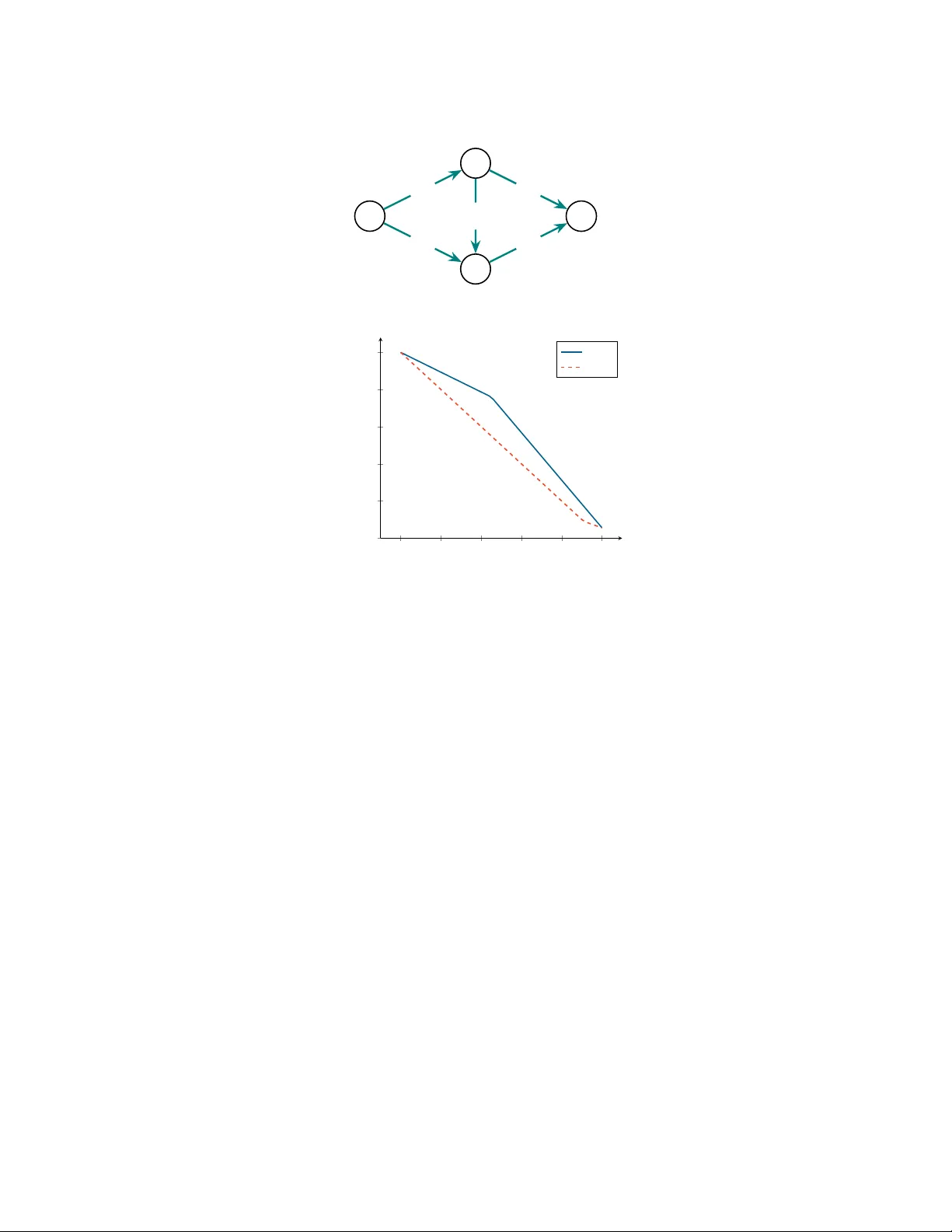
Ho w Will the Presence of Autonomous V ehicles Affect the Equilibrium State of T raffic Net w orks? Negar Mehr and Rob erto Horo witz ∗ Decem b er 20, 2024 Abstract It is kno wn that connected and autonomous vehicles are capable of main taining shorter head- w ays and distances when they form plato ons of vehicles. Th us, suc h technologies can result in increases in the capacities of traffic netw orks. Consequently , it is en visioned that their deplo yment will b o ost the netw ork mobility . In this pap er, we verify the v alidity of this impact under selfish routing b eha vior of drivers in traffic net works with mixed autonomy , i.e. traffic netw orks with b oth regular and autonomous vehicles. W e consider a nonatomic routing game on a netw ork with inelastic (fixed) demands for the set of net work O/D pairs, and study how replacing a fraction of regular vehicles by autonomous vehicles will affect the mobility of the netw ork. Using the well kno wn US bureau of public roads (BPR) traffic delay models, we show that the resulting W ardrop equilibrium is not necessarily unique even in its weak sense for netw orks with mixed autonomy . W e state the conditions under which the total netw ork delay is guaranteed not to increase as a result of autonom y increase. Ho wev er, we show that when these conditions do not hold, counter in tuitive b ehaviors may o ccur: the total delay can grow by increasing the netw ork autonomy . In particular, we pro ve that for net works with a single O/D pair, if the road degrees of asymmetry are homogeneous, the total delay is 1) unique, and 2) a nonincreasing contin uous function of netw ork autonom y fraction. W e show that for heterogeneous degrees of asymmetry , the total delay is not unique, and it can further grow with autonom y increase. W e demonstrate that similar behav- iors may b e observed in netw orks with multiple O/D pairs. W e further b ound such p erformance degradations due to the introduction of autonomy in homogeneous netw orks. Keyw ords: autonomous vehicles, W ardrop equilibrium, game theory , B raess’s paradox, rout- ing games, traffic netw orks. 1 In tro duction Connected and autonomous vehicles tec hnology hav e attracted significan t atten tion a s a result of their p oten tials for increasing vehicular safety and driv ers’ comfort. Connected technologies can b e used to inform drivers ab out the existing hazards through vehicle to vehicle (V2V) or vehicle to infrastructure (V2I) communication. Aligned with these safety considerations, automobile companies hav e started to equip vehicles with autonomous capabilities. In fact, some of these capabilities, such as driv er assistive tec hnologies and adaptive cruise control (ACC) ha ve already b een deploy ed in vehicles. The impact of these technologies is not limited to v ehicles safet y . Connected and autonomous v ehicles technology can facilitate vehicle plato oning . V ehicle plato ons are groups of more than one ∗ N. Mehr and R. Horowitz are with the Departmen t of Mechanical Engineering, Universit y of California, Berkeley , Berkeley , CA, 94720 USA e-mails: negar.mehr@b erkeley .edu, horowitz@berkeley .edu 1 v ehicle, capable of maintaining shorter headw ays; thus, plato oning can lead to increases in the capac- ities of netw ork links [ LPTV17 ]. Suc h increases can b e up to three–fold [ LPTV17 ] if all the vehicles are autonomous and connected. In addition to mobility b enefits, plato oning can hav e sustainabilit y b enefits, it can also reduce energy consumption for hea vy duty vehicles [ AAGJ10 , LMJ13 , ABT + 15 ]. The mobilit y b enefits of platooning and autonomous capabilities of v ehicles are not limited to increasing netw ork capacities. There has b een a focus on how to utilize vehicle autonom y and con- nectedness to remov e signal lights from intersections and co ordinate conflicting mov ements such that the netw ork throughput is improv ed [ ZMC16 , TC15 , MK14 , FV18 ]. How ever, in order for such ap- proac hes to b e implemented, all vehicles in the netw ork need to hav e autonomous capabilities. T o reac h the p oin t where all v ehicles are autonomous, transp ortation netw orks need to face a tr ansient era, when b oth regular and autonomous v ehicles co exist in the netw orks. Therefore, it is crucial to study net works with mixed autonomy . In [ AFKV16 ], the p erformance of traffic netw orks with mixed autonomy was studied via simula- tions. Moreo v er, it was shown in multiple works that in netw orks with mixed autonom y , autonomous v ehicles can b e utilized to stabilize the lo w–level dynamics of traffic netw orks and damp congestion sho c kwa v es [ WKVB17 , DR99 , YH06 , PvA10 , SCDM + 18 ]. In [ MLH18b , MLH18a ] altruistic lane c hoice of autonomous v ehicles w as studied. In [ LCP17a ], the capacit y of netw ork links w as modeled in a traffic setting with mixed autonomy . This mo deling framework w as further used in [ LCP17b ] to calculate the price of anarch y of traffic netw orks with mixed autonomy , where the price of anarch y is an indicator of ho w far the equilibrium of netw orks with mixed autonomy is from their so cial optimum that could ha ve been achiev ed if a so cial planner had routed all the vehicles. In [ LCPS18 ], it was sho wn that lo cal actions of the autonomous vehicles on the road can lead to optimal vehicle orderings for the global net work prop erties such as link capacities. It is well known that due to the selfish route choice b eha vior of drivers, traffic netw orks normally op erate in an equilibrium state, where no vehicle can decrease its trip time by unilaterally changing its route [ Smi79 ]. In this pap er, w e wish to study ho w the in tro duction of autonomous vehicles in the net work will affect the equilibrium state of traffic net works compared to the case when all vehicles are nonautonomous. W e extend our initial results presented in [ MH18 ]. In particular, giv en a fixed demand of vehicles, we study how replacing a fraction of regular vehicles by autonomous vehicles will affect the equilibrium state of traffic net works. W e study the system b ehavior when both regular and autonomous vehicles select their routes selfishly to in vestigate the necessit y of centrally enforcing autonomous vehicles routing by a net work manager. W e state the conditions under which increasing net work autonomy fraction is guaranteed to reduce the ov erall netw ork dela y . Moreov er, we show that when these conditions do not hold, counter intuitiv e and undesirable b eha viors might o ccur, such as the case when increasing the p ortion of autonomous vehicles in the netw ork can incr e ase the ov erall net work dela y . Suc h b eha viors are similar to Braess’ paradox, where the construction of a new road or expanding link capacities may increase total netw ork delay . W e mo del the net w ork in a macroscopic framew ork where v ehicle route choices are taken in to accoun t. W e model the selfish route choice b ehavior of the driv ers as a nonatomic routing game [ Rou02 ] where drivers choose their routes selfishly un til a W ardrop Equilibrium is ac hiev ed [ W ar52 ]. W e represen t a traffic netw ork b y a directed graph with a certain set of origin destination (O/D) pairs. F or each O/D pair, we consider tw o classes of v ehicles, regular and autonomous. F or a given fixed demand profile along O/D pairs, we study how increasing the autonomy fraction of O/D pairs will affect the total delay of the netw ork at equilibrium. W e first sho w that the equilibrium may not b e unique ev en in the weak sense of total link utilization. Then, we study netw orks with a single O/D pair and pro ve that if the degrees of road capacity asymmetry are homogeneous in the netw ork, the so cial or total delay of the netw ork is unique, and further it is a monotone nonincreasing function of the netw ork autonomy ratio. Ho wev er, in netw orks 2 with heterogeneous degrees of road asymmetry , w e first sho w that the social delay is not unique. Then, w e demonstrate that, surprisingly , increasing the autonomy ratio of the net w ork ma y lead to an incr e ase in the ov erall netw ork delay . This is a counter intuitiv e b ehavior as we might exp ect that having more autonomous vehicles in the netw ork will alwa ys b e b eneficial in terms of total netw ork delay . F or the net works with multiple O/D pairs, we show that similar complicated b eha viors may o ccur, namely increasing autonomy fraction of an O/D pair might worsen the so cial delay of the net work. Our w ork in fact sho ws that traffic parado xes similar to the well known Braess’s P aradox [ Bra68 ] can o ccur due to capacit y increases pro vided by autonomous vehicles. W e further b ound suc h p erformance degradations that can arise from the presence of autonomous vehicles. The organization of this pap er is as follows. In Section 2 , we describ e our notation and mo del. W e review the prior relev an t results in Section 3 . Then, in Section 4 , we study the uniqueness of equilibrium in our routing setting. Next, in Section 5 , we analyze mixed autonomy netw orks with a single O/D pair in Section 5 . Subsequen tly , we study mixed–autonomy netw orks with multiple O/D pairs in Section 6 . Finally , we conclude the pap er and provide relev an t future directions in Section 7 . 2 Nonatomic Selfish Routing W e mo del a traffic netw ork b y a directed graph G = ( N , L, W ), where N and L are resp ectively the set of no des and links in the netw ork. Each link l ∈ L in the netw ork is a pair of distinct no des ( v , w ) and represents a directed edge from v tow ards w . W e assume that each link joins tw o distinct no des; th us, no self loops are allo w ed. Define W = { ( o 1 , d 1 ) , ( o 2 , d 2 ) , · · · , ( o k , d k ) } to be the set of origin destination (O/D) vertex pairs of the netw ork. A no de n ∈ N can app ear in m ultiple O/D pairs. In a nonatomic selfish routing game, if eac h O/D pair has a fixed given nonzero demand, then it is called a nonatomic selfish routing game with inelastic demands. Each O/D pair consists of infinitesimally small agen ts where every agent decides on each path suc h that their own delay is minimized. The dela y of each path dep ends on how netw ork paths are shared among different O/D pairs. F or eac h O/D pair w = ( o i , d i ) , 1 ≤ i ≤ k , we let P w denote the set of all p ossible netw ork paths from o i to d i . W e assume that the netw ork top ology is such that for each O/D pair w ∈ W , there exists at least one path from its origin to its destination, i.e. P w 6 = ∅ . W e further let P = ∪ w ∈ W P w denote the set of all net work paths. F or an O/D pair w ∈ W , let r w b e the giv en fixed demand of vehicles asso ciated with w . F urther- more, for a path p ∈ P w , let f p b e the flow of the O/D pair w along path p . Note that each path connects exactly one origin to one and only one destination; thereb y , once a path is fixed, its origin and destination are uniquely determined. Consequen tly , there is no need to explicitly include path O/D pairs in the notation used for f p . It is imp ortant to note that in our setting, each O/D pair w has tw o classes of vehicles: autonomous and regular. Consequently , for each w ∈ W , we define α w to b e the fraction of vehicles in r w that are autonomous. W e let r = ( r w : w ∈ W ) and α = ( α w : w ∈ W ) b e the v ectors of netw ork demand and autonomy fraction resp ectively . Also, for each path p ∈ P w , we use f r p and f a p to resp ectively denote the flow of regular and autonomous vehicles along path p . Note that for eac h path p ∈ P , we ha ve f p = f r p + f a p . Moreov er, for each O/D pair w ∈ W , due to flow conserv ation, w e m ust ha ve P p ∈P w f r p = r w (1 − α w ), and P p ∈P w f a p = r w α w . The net w ork flo w v ector f is a nonnegativ e vector of regular and autonomous flows along netw ork paths, i.e. f = ( f r p , f a p : p ∈ P ). A flo w vector f is called feasible for a giv en netw ork G , if for each w ∈ W , X p ∈P w f r p = (1 − α w ) r w , and X p ∈P w f a p = α w r w , (1a) f r p ≥ 0 , and f a p ≥ 0 , ∀ p ∈ P w . (1b) 3 F or each link l ∈ L , f l is the total flo w of v ehicles in link l , i.e. f l = P p ∈P : l ∈ p f p . Since we need to decomp ose the total link flow into regular and autonomous vehicles, we let f r l and f a l b e the total flo w of regular and autonmous vehicles along link l resp ectively . In fact, f r l and f a l are the summation of the flow of regular and autonomous vehicles on all routes con taining link l , f r l = X p ∈P : l ∈ p f r p , and f a l = X p ∈P : l ∈ p f a p . Note that if all vehicles are regular for an O/D pair w ∈ W , i.e. α w = 0, then, w e only ha ve a single class of regular v ehicles along that O/D pair, and for each path p ∈ P w , f p = f r p . If for all net work O/D pairs w ∈ W , the autonom y fraction α w = 0; then, the same argument holds for link flo ws, f l = f r l for all links l ∈ L . In fact, if all v ehicles are regular, our routing game reduces to a single class game ( ∀ w ∈ W, α w = 0) ⇐ ⇒ ∀ p ∈ P , f p = f r p . (2) In order to b e able to mo del the incurred delays when vehicles are routed throughout the netw ork, it is assumed that each link l ∈ L has a delay p er unit of flow function e l : R 2 → R . W e assume that the delay p er unit of flo w for each path p ∈ P is obtained by the summation of the link delays o ver the links that form p , e p ( f ) = X l ∈ L : l ∈ p e l ( f r l , f a l ) . (3) Equation ( 3 ) implies that the dela y of each path p ∈ P dep ends not only on the flows of regular and autonomous vehicles along path p , but also on the flows along other paths. The o verall net work delay or social delay is given by J ( f ) = X p ∈P f p e p ( f ) . (4) 2.1 W ardrop Equilibrium It is well kno wn in the transp ortation literature that if there are many nonco op erativ e agents, namely , flo ws that b ehav e selfishly [ Rou06 ], a netw ork is at an equilibrium if the well known W ardrop condi- tions hold [ W ar52 ]. The W ardrop conditions state that at equilibrium, no user has any incentiv e for unilaterally changing its path. This implies that for an equilibrium flow vector f , if there exists a path p ∈ P w suc h that either f r p 6 = 0 or f a p 6 = 0, w e must hav e that e p ( f ) ≤ e p 0 ( f ), for all paths p 0 ∈ P w . Definition 1. Giv en a netw ork G = ( N , L, W ), a flow v ector f is a W ardrop equilibrium if and only if for every O/D pair w ∈ W and every p, p 0 ∈ P w f r p ( e p ( f ) − e p 0 ( f )) ≤ 0 , (5a) f a p ( e p ( f ) − e p 0 ( f )) ≤ 0 . (5b) Note that an implication of the ab ov e definition is that for each O/D pair w ∈ W , and any tw o paths p, p 0 ∈ P w suc h that f p 6 = 0 and f p 0 6 = 0, w e must hav e that e p ( f ) = e p 0 ( f ). Definition 2. Given an equilibrium flo w vector f for the netw ork G = ( N , L, W ), we define the dela y of tra vel for each O/D pair w ∈ W to b e e w ( f ) := min p ∈P w e p ( f ) . (6) 4 Motiv ated b y the ab ov e discussion, e w ( f ) is precisely the delay across all paths p ∈ P w whic h ha ve a nonzero flow. Moreo ver, the equilibrium condition implies that for a path p ∈ P w with zero flow, we ha ve e p ( f ) ≥ e w ( f ). It is worth mentioning that when there are no autonomous v ehicles, i.e. for all w ∈ W, α w = 0, since f r p = f p for all p ∈ P , Conditions ( 5 ) reduce to f p ( e p ( f ) − e p 0 ( f )) ≤ 0 , ∀ w ∈ W, ∀ p, p 0 ∈ P w . (7) 2.2 Dela y Characterization W e first sp ecify the structure of our delay functions. If there is only a single class of regular vehicles in the netw ork, the US Bureau of Public Roads (BPR) [ Man64 ] suggests the following form of delay functions. Assumption 1. When net w ork links are shared b y only regular v ehicles, the link delay functions e l : R → R are of the following form e l ( f l ) = a l 1 + γ l f l C l β l ! , (8) where C l is the capacity of link l , and a l , γ l , and β l are nonnegativ e link parameters. In practice, a l is the free flow trav el time on l , γ l is normally 0 . 15, and β l is a p ositive in teger ranging from 1 to 4. In order to characterize the delay functions in netw orks with mixed autonomy , where w e ha ve tw o classes of v ehicles, w e first need to model the impact of autonomous v ehicles on link capacities. In each net work link l ∈ L , the link capacity C l restricts the maximum p ossible flow of vehicles. It was sho wn in [ LCP17a ] that in netw orks with mixed autonomy , C l dep ends on the autonom y ratio of link l defined as α l := f a l f a l + f r l . W e use C l ( α l ) to emphasize this dep endence. Let m l and M l b e the capacity of link l when all v ehicles are regular and autonomous resp ectiv ely . Since autonomous v ehicles are capable of maintaining shorter headwa ys, it is normally the case that m l M l ≤ 1. When the tw o classes of regular and autonomous vehicles are present in the net work, using the results in [ LCP17a ], we hav e C l ( α l ) = m l M l α l m l + (1 − α l ) M l . (9) W e adopt this mo del throughout this paper to inv estigate the mobilit y impact of autonomous v ehicles on the net work. Since for eac h link l ∈ L , α l = f a l f a l + f r l and f l = f a l + f r l , using ( 9 ), for net works with mixed autonomy , the delay function ( 8 ) can b e mo dified as: e l ( f r l , f a l ) = a l 1 + γ l f r l + f a l m l M l ( f r l + f a l ) m l f a l + M l f a l β l . (10) = a l 1 + γ l f a l M l + f r l m l β l ! . (11) Note that when only regular vehicles are present in the netw ork, for eac h link l ∈ L since f l = f r l , the link delay function reverts to 5 A B C D 1 3 2 4 Figure 1: A netw ork with a single O/D pair and tw o paths. e l ( f l ) = a l 1 + γ l f r l m l β l ! . (12) 3 Prior W ork 3.1 Existence of Equilibrium W e state the following prop osition from [ BK79 ] which studies the conditions under whic h a W ardrop Equilibrium exists for a multiclass traffic netw ork. Prop osition 1. Given a network G = ( N , L, W ) , if the link delay functions ar e c ontinuous and monotone in the link flow of e ach class; then, ther e exists at le ast one War dr op e quilibrium. R emark 1 . Using ( 11 ), since our assumed delay functions are nonnegative, contin uous, and monotone in the flo w of eac h class, Prop osition 1 implies that there alwa ys exists at least one W ardrop equilibrium for a routing game with mixed autonomy . 3.2 Uniqueness of Equilibrium In this part, we review the known results regarding the uniqueness of the W ardrop Equilibrium. When m ultiple classes of v ehicles are present in the netw ork, the uniqueness of the equilibrium flow vector do es not hold. Ho wev er, uniqueness in a weak sense is known to hold from [ ABEA + 06 ]. Prop osition 2. F or a gener al top olo gy network G with multiple classes of vehicles on e ach O/D p air, if the delay functions ar e of the form ( 8 ) , and the link c ap acities C l ar e fixe d and the same for al l vehicle classes, for a given demand ve ctor r , we have 1. The e quilibrium is unique in a we ak sense, i.e. for e ach link l , the total flow f l for al l War dr op e quilibrium flow ve ctors f is unique. 2. F or e ach O/D p air w ∈ W , the delay of tr avel e w ( f ) is unique for al l War dr op e quilibrium flow ve ctors f . Thus, the delay of tr avel for e ach O/D p air in e quilibrium, i.e. e w ( f ) , only dep ends on the network demand ve ctor r . Henc e, we may unambiguously define e w ( r ) to denote this unique value. R emark 2 . Note that a routing game that has only a single class of vehicles can be view ed as an instance of the games describ ed in Prop osition 2 . Therefore, uniqueness in a the weak sense applies to games with a single class of vehicles to o. 6 3.3 Monotonicit y of So cial Dela y As we discussed ab o ve, in general, the equilibrium is not unique. Ho wev er, if the conditions of Prop o- sition 2 hold for a net work, the so cial delay and the dela y of trav el for each O/D pair are unique. F or a single class routing game on G = ( N , L, W ), recall the following from [ Hal78 ]. Prop osition 3. Consider a network G = ( N , L, W ) , wher e only one class of vehicles exists for e ach O/D p air w ∈ W . Assume that for e ach link l ∈ L , e l ( . ) is c ontinuous, p ositive value d, and mono- tonic al ly incr e asing. Then, for e ach w ∈ W , the delay of tr avel e w ( r ) is a c ontinuous function of the demand ve ctor r . F urthermor e, e w ( . ) is nonincr e asing in r w when a l l other demands r w 0 , w 0 6 = w , ar e fixe d. 4 Uniqueness in the Mixed-Autonom y Setting No w w e study equilibrium uniqueness in our setting. Using Remark 1 , we know that there exists at least one equilibrium. Ho w ever, since in our setting, for each link l , C l dep ends on the autonom y ratio α l , Prop osition 2 do es not apply . Indeed, we demonstrate through an example that the equilibrium is not unique even in the weak sense introduced in Prop osition 2 . Example 1. Consider the net work of Figure 1 . Let p 1 and p 2 b e the ABD and A CD paths resp ectively . F or each link l = 1 , · · · , 4, let the link parameters b e β l = 1 , a l = 1 , m l = 1, and , M l = 2. Thus, for eac h link l ∈ L , the link delay function is e l = 1 + f r l + f a l 2 . Assume that the demand from no de A to D is r = 2, and α = 0 . 5. The example is simple enough so that we can compute the equilibrium flows man ually . Let f r 1 and f a 1 b e the regular and autonomous v ehicles flows along p 1 , and f r 2 and f a 2 b e the regular and autonomous flows along p 2 . At equilibrium, using the symmetry of the netw ork, we m ust ha ve 2 + 2 f r 1 + f a 1 = 2 + 2 f r 2 + f a 2 f r 1 + f r 2 = 1 f a 1 + f a 2 = 1 f r 1 , f a 1 , f r 2 , f a 2 ≥ 0 . Clearly , there is no unique solution to the abov e set of equations. Moreov er, among the set of all p ossible equilibrium flo w vectors, for eac h link, the maxim um link flow at equilibrium is 1.25, whereas the minimum link flow is 0.75 at equilibrium. This implies that equilibrium uniqueness do es not hold ev en in the weak sense for traffic net works with mixed autonomy . 5 Net w orks with a Single O/D P air In this section, we study t w o terminal netw orks whic h hav e a single O/D pair in the presence of autonom y . F or such netw orks, since there is only one O/D pair, all paths originate from a common source o and end in a common destination d . Since W is singleton, we omit the subscript w from r w , e w and α w throughout this section. Note that when the net work has a single O/D pair, r and α are scalars. Ha ving observed that in the mixed-autonomy setting, the equilibrium is not unique even in the w eak sense, it is important to study if the so cial dela y is unique for all net w ork equilibrium flow vectors. T o this end, in the following, w e study the prop erties of the so cial delay including its uniqueness. T o this end, we need to define the notion of road degree of capacit y asymmetry in tro duced in [ LCP17b ]. 7 A B C D 1 3 2 4 5 Figure 2: A netw ork with a single O/D pair and three paths from A to D. 0 0 . 2 0 . 4 0 . 6 0 . 8 1 6 . 5 7 7 . 5 8 8 . 5 9 α J J max J min Figure 3: Maximum and minimum so cial delay for Example 2 . Giv en a net work G = ( N , L, W ), for eac h link l ∈ L , w e define µ l := m l / M l to be the degree of capacit y asymmetry of link l . Note that since we assumed that autonomous vehicles headw ay is less than or equal to that of regular vehicles, for each link l ∈ L , µ l ≤ 1. In the sequel, we consider tw o scenarios for in vestigating the prop erties of so cial delay: 1. Homogeneous degrees of road capacity asymmetry , where µ l is the same for all links, i.e. µ l = µ , for all links l ∈ L , where µ is the common v alue of capacit y asymmetry . 2. Heterogeneous degrees of capacit y asymmetry , where µ l v aries on different links. 5.1 Homogeneous Degrees of Capacit y Asymmetry In this case, we can establish the uniqueness of the so cial delay , and c haracterize the relationship b et ween so cial dela y and netw ork autonom y ratio. Theorem 1. Given a network G = ( N , L, W ) with a single O/D p air and a homo gene ous de gr e e of c ap acity asymmetry µ , for any demand ve ctor r > 0 , we have: 1. F or a fixe d autonomy r atio 0 ≤ α ≤ 1 , the so cial delay J ( f ) is unique for al l War dr op e quilibrium flow ve ctors f . 2. If for e ach 0 ≤ α ≤ 1 , we denote the c ommon value of so cial delay in the ab ove by J ( α ) , then J ( . ) is c ontinuous and nonincr e asing. 8 Pr o of. Fix r > 0 and 0 ≤ α ≤ 1. Recalling Remark 1 , we know that a W ardrop equilibrium exists. Let f = ( f r p , f a p : p ∈ P ) b e such an equilibrium flo w vector where f p = f a p + f r p for each path p in P . Define e min ( f ) := min p ∈P e p ( f ). Since the netw ork has only one O/D pair, and the delay asso ciated with all paths with nonzero flo ws are the same, denoting this uniform path dela y by e min ( f ), we realize that the so cial delay is giv en by J ( f ) = r e min ( f ). F or eac h path p ∈ P , define the fictitious single-class regular flow ˜ f p := f r p + µf a p . W e claim that the flow vector ˜ f = ( ˜ f p : p ∈ P ) is a W ardrop equilibrium for a routing game on G with a single class of regular v ehicles and a total demand of ˜ r = r (1 − α ) + r αµ with the delay function ( ˜ e l : l ∈ L ) defined as ˜ e l ( ˜ f l ) = a l 1 + γ l ˜ f l m l ! β l . T o see this, for eac h p ∈ P , w e show that relations ( 7 ) hold. Fix p, p 0 ∈ P and note that since f was a W ardrop equilibrium in the original setting, we hav e f r p ( e p ( f ) − e p 0 ( f )) ≤ 0, and f a p ( e p ( f ) − e p 0 ( f )) ≤ 0. Multiplying the latter by the p ositive constant µ and adding the tw o inequalities, we hav e ˜ f p ( e p ( f ) − e p 0 ( f )) ≤ 0 , ∀ p, p 0 ∈ P . (13) No w, w e claim that for all p ∈ P , w e hav e e p ( f ) = ˜ e p ( ˜ f ). Note that for each link l ∈ L , we hav e ˜ f l = f r l + µf a l . Using the fact that µ = m l / M l for all l ∈ L , we get ˜ e p ( ˜ f ) = X l ∈ p a l 1 + γ l f r l + m l M l f a l m l β l ! = X l ∈ p a l 1 + γ l f r l m l + f a l M l β l ! = e p ( f ) . (14) Substituting in to ( 13 ), we realize that ˜ f p ( ˜ e p ( ˜ f ) − ˜ e p 0 ( ˜ f )) ≤ 0 , ∀ p, p 0 ∈ P , (15) whic h means that ˜ f is an equilibrium flow vector. Clearly , the total demand of this new routing game is ˜ r = P p ∈P ˜ f p = P p ∈P f r p + µf a p = (1 − α ) r + µα r . Moreo v er, define ˜ e min ( ˜ f ) to b e the minimum of ˜ e p ( ˜ f ) among p ∈ P . Since w is the single O/D pair of the netw ork, ˜ e min ( ˜ f ) is indeed equal to ˜ e w ( ˜ f ), the tra vel delay of the single O/D pair of the net work asso ciated with ˜ f . Note that Prop osition 2 implies that ˜ e min ( ˜ f ) is a function of ˜ r only . On the other hand, ( 14 ) implies that ˜ e min ( ˜ f ) = e min ( f ). Putting these together, we realize that J ( f ) = r e min ( f ) = r ˜ e min ( ˜ f ) = r ˜ e w ( ˜ r ) . Note that the right hand side of the ab o ve identit y do es not dep end on f , which establishes the pro of of the first part. In fact, this shows that J ( α ) = r ˜ e w ( r (1 − α ) + αµr ) . F rom Prop osition 3 , we know that ˜ e w ( . ) is contin uous and nonincreasing. Also, since µ ≤ 1, the map r 7→ r (1 − α ) + αµr is contin uous and nonincreasing. This completest the pro of of the second part. 9 0 0 . 2 0 . 4 0 . 6 0 . 8 1 542 544 546 548 550 552 α J J max J min Figure 4: Maximum and minimum so cial delays for the Example 4 . 5.2 Heterogeneous Degrees of Capacit y Asymmetry No w, w e allow µ l to v ary among the netw ork links. W e show that this mak es the b eha vior of the system more complex. First, we sho w via the following example that the so cial dela y is not necessarily unique in this case. Example 2. Consider the netw ork shown in Figure 2 . Assume that γ l = 1 , β l = 1, for l = 1 , 2 , · · · , 5. Let the other link parame ters b e the following: { a 1 = 1 , m 1 = 1 , M 1 = 1 } , { a 2 = 2 , m 2 = 1 , M 2 = 3 } , { a 3 = 1 , m 3 = 1 , M 3 = 2 } , { a 4 = 1 , m 4 = 1 , M 4 = 4 } , and { a 5 = 3 , m 5 = 1 , M 5 = 3 } . Moreov er, let the total flow from origin A to destination D b e 2. Now, if we compute the so cial delay for this net work for an y α > 0 at the different equilibria of the system, w e observe that the so cial dela y is not unique. In particular, Figure 3 shows the plots of the maximum and minimum so cial delay of the system at equilibrium for ev ery v alue of α . As Figure 3 sho ws, as so on as α starts to increase from 0, uniqueness of social delay is lost. Once, α = 1, the uniqueness of so cial delay is again preserved. This b eha vior implies that the change in the so cial delay due to increasing the autonomy ratio of the net work is dep endent on which equilibrium the system will b e at. No w, w e study the effect of increasing netw ork autonom y on the social dela y . In the previous example, b oth the maxim um and minimum so cial delays decreased as a function of α . But, is this necessarily the case? W e use the following examples to demonstrate that it may not be true in general, as increasing netw ork autonomy may increase so cial delay in some netw orks. Example 3. Consider the net work of Figure 2 . Let γ l = 1 and β l = 1 for all links. Select the other net work parameters to b e the following, { a 1 = 0 , m 1 = 0 . 1 , M 1 = 0 . 1 } , { a 2 = 50 , m 2 = 1 , M 2 = 1 } , { a 3 = 50 , m 3 = 1 , M 3 = 1 } , { a 4 = 0 , m 4 = 0 . 1 , M 4 = 0 . 1 } , { a 5 = 10 , m 5 = 0 . 5 , M 5 = 1 } . Let the total O/D demand b e r = 6. In the absence of autonomy ( α = 0), the so cial delay is J = 504 . 3. Ho wev er, if we increase the autonomy ratio to α = 1 10 , J = 518 . 6. Clearly , in this case, the so cial delay increases when the netw ork autonomy ratio α is increased. Note that since µ l = 1 for l = 1 , 2 , 3 , 4 and µ 5 = 0 . 5 < 1, this can b e viewed as an instance of the classical Braess’s Parado x [ Bra68 ], where an increase in the capacity of the middle link of a Wheatstone netw ork can paradoxically lead to an increase in the so cial delay . One migh t argue that if we allow µ l to be strictly less than 1 for all netw ork links l ∈ L , the net work 10 A B C 1 3 2 Figure 5: A netw ork with three O/D pairs. so cial delay will decrease. W e use the following example to sho w that ev en in this case, increasing autonom y can worsen so cial dela y . Example 4. Consider the previous example with the total flow r = 6, but change M l ’s to b e, M 1 = 1 9 , M 2 = 1 . 1 , M 3 = 1 . 1 , M 4 = 1 9 , and M 5 = 1. In this case, clearly , µ l < 1 , for all l ∈ L . W e computed the maximum and minimum so cial dela y at e quilibrium for every autonomy fraction α . Figure 4 sho ws the maximum and minimum so cial dela y in this example for different v alues of α . Figure 4 demonstrates that the maxim um so cial dela y increases as we increase α from 0, until w e reac h a lo cal maximum. The minimum so cial delay decreases as we increase α from 0, un til we reac h a lo cal minimum, and then, it increases sharply to v alues that are higher than the so cial delay at α = 0. Surprisingly , when all vehicles are autonomous ( α = 1) the so cial delay is greater than the so cial dela y when α = 0, i.e. J ( α = 1) > J ( α = 0). This might b e coun ter intuitiv e as we exp ect the netw ork with full autonomy to hav e smaller so cial delay . How ever, this example shows that when capacity increases are heterogeneous across the netw ork, the selfish b ehavior of the vehicles when making their route choices might actually lead to worsening the so cial delay of the netw ork. Therefore, the mobility b enefits obtained from the introduction of autonomous vehicles in the net work, in terms of decreasing net work so cial delay , are not obvious. As men tioned previously , the increase in so cial dela y due to an increase in the fraction of au- tonomous vehicles is in fact a particular instance of Braess’s parado x. Braess’s P aradox is the coun- terin tuitive but well known fact that removing edges from a netw ork or increasing the delay func- tions on certain links can improv e so cial delay [ Rou06 ]. In our problem setting, replacing a fraction of regular vehicles b y autonomous vehicles can b e in terpreted as replacing the link dela y function a l 1 + γ l f a l m l + f r l m l β l b y a l 1 + γ l f a l M l + f r l m l β l for every link l ∈ L . It was sho wn in previous studies that Braess paradox is prev alen t and can b e arbitrarily severe [ SZ83 , Rou06 ]. Despite the price of anarc hy , the o ccurence of Braess’s parado x hea vily depends on net w ork top ology and the parameters of link delay functions [ Rou01 , HA01 , Mil03 ]. 6 Net w orks with Multiple O/D P airs So far, we hav e seen that ev en in a netw ork with only one O/D pair, the introduction of autonomous v ehicles can result in complex b ehaviors. Th us, it should b e exp ected that a general netw ork with m ultiple O/D pairs will exhibit similar counter intuitiv e b ehaviors. In the previous section, we sa w that the existence of a homogeneous degree of capacit y asymmetry throughout the net work is sufficien t for guaran teeing improv ements in the so cial delay by increasing the fraction of autonomous vehicles. W e now show, via the following example, that this is not the case for netw orks with multiple O/D pairs. 11 Example 5. Consider the net work sho wn in Figure 5 whic h was first introduced in [ Fis79 ]. There are three O/D pairs, W = { (A,B), (B,C), (A,C) } . The total demand of the netw ork O/D pairs are r AB = 17 , r AC = 20, and r BC = 90. Assume that γ l = 1 , β l = 1, for all links l ∈ L . Let the link parameters b e { a 1 = 0 , m 1 = 1 , , M 1 = 4 } , { a 2 = 0 , m 2 = 1 } , and { a 3 = 90 , m 3 = 1 } . Let the vehicles that trav el from A to C, and from B to C b e all regular vehicles, i.e. α AC = α BC = 0. Figure 6 sho ws a plot of the netw ork social delay versus the fraction of autonomous vehicles trav eling along O/D pair AB, α AB . As the figure shows, as vehicle autonomy increases, so do es the so cial delay . Note that the so cial delay is unique in this case. This example shows that existence of v ehicle autonomy along certain netw ork O/D pairs can result in worsening the ov erall or so cial delay of the netw ork ev en if the road degrees of capacity asymmetry are homogeneous. This is of paramount imp ortance in practice. F or instance, if O/D pair AB b elongs to a high–income neighborho o d, autonomous vehicles ma y first b e deploy ed along this path, while other neigh b orhoo d or O/D pairs may still trav el via regular vehicles. Then, although the early adoption of autonomous v ehicles along O/D pair AB will lead to a decrease in trav el delay of O/D pair AB, it w orsens the so cial dela y in the net w ork and increases the delays exp erienced by users along other O/D pairs. This example sho ws that even with homogeneous degrees of capacity asymmetry , when there exist multiple O/D pairs, different autonom y fractions along netw ork O/D pairs can b e another source of heterogeneit y in the net w ork; hence, coun terintuitiv e b eha viors might o ccur for net works with mixed autonomy . It was sho wn in [ Fis79 , DN84 ] that a decrease in the total demand of a single O/D pair, might lead to an increase in delay of tra v el along other net work O/D pairs and the social dela y . In the previous example, w e sho wed that a similar behavior can also be observ ed due to the presence of autonomous vehicles. In fact, what we hav e shown so far is that the long known paradoxical traffic b eha vior resulting from constructing more roads or reducing demands can actually happen in netw orks with mixed autonom y due to the presence of autonomous vehicles. Th us, the mobilit y benefits of increasing autonomy in a netw ork are not immediate, and in order to tak e adv antage of the full mobility p oten tial of autonomous vehicles, control and routing strategies that guarantee mobility b enefits must b e developed for the next generation of traffic net works. No w that we hav e shown, the so cial delay can increase as a consequence of the presence of au- tonomous vehicles in net works with multiple O/D pairs, we wish to study whether w e can b ound this degradation in the netw ork p erformance, to see ho w muc h w orse the social dela y can get with increasing the fraction of autonomous v ehicles. T o answer this, w e derive a bound on the p erformance degradation that can result from all p ossible demand and autonomy fraction vectors in general netw orks that hav e a homo gene ous degree of capacit y asymmetry . T o this end, for a giv en net work G and a demand v ector r , define the vector of fictitious reduced demand ˜ r = ( ˜ r w : w ∈ W ) to b e ˜ r w = (1 − α w ) r w + µα w r w for eac h O/D pair w ∈ W . Consider an auxiliary fictitious routing game with a total demand ˜ r of only regular v ehicles on G . F or this auxiliary game, similar to Theorem 1 , define ( ˜ e l : l ∈ L ) to b e ˜ e l = a l 1 + γ l ˜ f l m l ! β l , (16) and let ˜ e w ( ˜ r ) b e the delay of trav el for each w ∈ W in this auxiliary game. Then, using the auxiliary fictitious game, we can state the following prop osition. Prop osition 4. Consider a gener al network G = ( N , L, W ) with a homo gene ous de gr e e of c ap acity asymmetry µ ≤ 1 in al l of its links. F or any demand ve ctor r , fix the ve ctor of autonomy fr action α = ( α w : w ∈ W ) such that 0 ≤ α w ≤ 1 for al l w ∈ W . Then, we have 1. The so cial delay J ( f ) is unique for al l War dr op e quilibrium flow ve ctors f . 12 0 0 . 2 0 . 4 0 . 6 0 . 8 1 1 . 07 1 . 08 1 . 08 · 10 4 α AB J Figure 6: Social delay in Example 5 for different fraction of autonomous vehicles trav eling along O/D pair AB when vehicles along all other O/D pairs are regular. 2. The so cial delay of the original game is J ( f ) = P w ∈ W r w ˜ e w ( ˜ r w ) for al l War dr op e quilibrium flow ve ctors f . Pr o of. Fix r and α , such that for each w ∈ W , 0 < r w and 0 ≤ α w ≤ 1. Recalling Lemma 1 , we know that there exists at least one equilibrium. Let f = ( f r p , f a p : p ∈ P ) b e suc h an equilibrium flo w vector for G . F or each path p ∈ P , define ˜ f p := f r p + µf a p . By generalizing the pro of of Theorem 1 , it is easy to see that ˜ f = ( ˜ f p : p ∈ P ) is an equilibrium for the defined auxiliary routing game on G with reduced demand ˜ r of only regular vehicles. Moreo v er, for each path p ∈ P , e p ( f ) = ˜ e p ( ˜ f ). Therefore, for eac h O/D pair w ∈ W , ˜ e w ( ˜ f ) = min p ∈P w ˜ e p ( ˜ f ) = min p ∈P w e p ( f ) = e w ( f ). Hence, J ( f ) = X w ∈ W r w e w ( f ) = X w ∈ W r w ˜ e w ( ˜ f ) . (17) Since ˜ f contains only regular vehicles, recalling Remark 2 and Prop osition 2 , for eac h w ∈ W , the dela y of trav el ˜ e w ( ˜ f ) is unique for a giv en ˜ r ; thus, J ( f ) = X w ∈ W r w ˜ e w ( ˜ r ) . (18) As ˜ r is uniquely determined for a given demand vector r and a vector of autonomy fraction α , the so cial dela y J ( f ) is unique for all W ardrop equilibrium flo w v ectors f and can be obtained via ( 18 ). The uniqueness of so cial dela y established by Prop osition 4 implies that for a fixed demand vector r , the so cial dela y is a well defined function of autonom y fraction α . With a slight abuse of notation, w e use J ( α ) to emphasize the dep endence of the so cial delay on the vector of autonomy fraction α . Note that Prop osition 4 establishes a connection b etw een our original routing game, which has tw o classes of v ehicles, with a fictitious auxiliary routing game, whic h has only regular vehicles and a reduced demand vector ˜ r . W e exploit this connection in the remainder of the pap er. Since the auxiliary game has only one class of vehicles, the results in [ CSSM08 ] hold for this game. Before pro ceeding, we need to adopt and review some of the definitions in [ CSSM08 ] for our prop osed auxiliary game. 13 In the auxiliary game, for a given O/D demand vector ˜ r , a flow vector ˜ f is feasible if ˜ f p ≥ 0 for all paths p ∈ P , and P p ∈P w ˜ f p = ˜ r w for all w ∈ W . Let φ ∈ R | L | b e a v ector of link flo ws that result from a feasible flow vector ˜ f , where | L | is the n umber of links in the netw ork. Also, let Φ represent the set of all feasible link flow vectors φ for a given reduced demand vector ˜ r . Then, for a v ector of link dela y functions ( ˜ e l : l ∈ L ) of the form ( 16 ) and any vector v ∈ Φ, define λ ( ˜ e l : l ∈ L ) , v := max x ∈ R | L | ≥ 0 P l ∈ L ˜ e l ( v l ) − ˜ e l ( x l ) x l P l ∈ L ˜ e l ( v l ) v l , (19) where 0 / 0 is considered to b e 0. Additionally , let E b e the class of delay functions represented b y ( 16 ). Define λ ( E ) := sup ( ˜ e l : l ∈ L ) ∈E ,v ∈ Φ λ (( ˜ e l : l ∈ L ) , v ) . (20) It is important to men tion that since the class of delay functions E is monotone, λ ( E ) ≤ 1 in our setting (See Section 4 in [ CSSM08 ]). Note that λ ( E ) can b e easily computed for certain classes of dela y functions such as p olynomials. F or instance, λ ( E ) = 1 4 for the class of linear delay functions. No w, we can b ound the netw ork p erformance degradation due to the introduction of autonomy in homogeneous net works via the following theorem. Theorem 2. Consider a gener al network G = ( N , L, W ) with a homo gene ous de gr e e of c ap acity asymmetry µ . Fix the demand ve ctor r . L et J o b e the so cial delay when al l vehicles ar e nonautonomous, i.e. α w = 0 for al l w ∈ W . Then, for any other ve ctor of autonomy fr action α such that 0 ≤ α w ≤ 1 for al l w ∈ W , we have J ( α ) ≤ (1 − λ ( E )) − 1 J o , (21) wher e J ( α ) is the so cial delay for the ve ctor of autonomy fr action α . Note that using Pr op osition 4 , J ( α ) and J o ar e unique, and; thus, wel l define d. Pr o of. Fix the demand v ector r . Let f o = ( f o p : p ∈ P ) b e an equilibrium flow vector when all vehicles are regular. W e further use f o l to denote the flow along link l ∈ L in this case. Note that using Prop osition 2 , we know that f o l is unique for every link l ∈ L . Moreo ver, for each path p ∈ P , we use e o p to represen t the delay along path p when all vehicles are regular. Using Remark 2 and Proposition 2 , in the absence of autonomy , the delay of trav el for each O/D pair w ∈ W is unique. Thus, in this case, the unique so cial delay J o = P w ∈ W r w e o w ( r ) , where e o w ( r ) is the dela y of trav el along w ∈ W when all v ehicles are regular. On the other hand, when there are autonomous vehicles with a given autonomy fraction α in the net work, as defined in Prop osition 4 , construct the auxiliary game on G with fictitious reduced demand ˜ r = ( ˜ r w : w ∈ W ) of only regular vehicles, where ˜ r w = (1 − α w ) r w + µr w α w for every w ∈ W . Let ˜ f = ( ˜ f p : p ∈ P ) b e an equilibrium flow vector for this auxiliary game. Using Prop osition 4 , the so cial dela y of the netw ork with autonomous vehicles is giv en by J ( α ) = P w ∈ W r w ˜ e w ( ˜ r ). First, w e claim that J ( α ) = X w ∈ W r w ˜ e w ( ˜ r ) ≤ X l ∈ L f o l ˜ e l ( ˜ r ) . (22) T o see this, note that for ev ery link l ∈ L , w e hav e f o l = P p ∈P : l ∈ p f o p . F urthermore, the origin and destination of each path p ∈ P are unique. Hence, each path p b elongs to one and exactly one O/D 14 pair w ∈ W . Consequen tly , f o l = P w ∈ W P p ∈P w : l ∈ p f o p , and we hav e X l ∈ L f o l ˜ e l ( ˜ r ) = X l ∈ L X w ∈ W X p ∈P w : l ∈ p f o p ˜ e l ( ˜ r ) = X w ∈ W X l ∈ L X p ∈P w : l ∈ p f o p ˜ e l ( ˜ r ) = X w ∈ W X p ∈P w f o p X l : l ∈ p ˜ e l ( ˜ r ) = X w ∈ W X p ∈P w f o p ˜ e p ( ˜ r ) , where ˜ e p ( ˜ r ) is the dela y of path p ∈ P w for the auxiliary game. Recalling Definition ( 6 ), for the auxiliary game, the trav el delay of an O/D pair w ∈ W is given b y ˜ e w ( ˜ r ) = min p ∈P w ˜ e p ( ˜ r ); thus, we ha ve X w ∈ W X p ∈P w f o p ˜ e p ( ˜ r ) ≥ X w ∈ W X p ∈P w f o p ˜ e w ( ˜ r ) = X w ∈ W ˜ e w ( ˜ r ) X p ∈P w f o p = X w ∈ W r w ˜ e w ( ˜ r ) , whic h prov es our claim in ( 22 ). Now, since the auxiliary game has only one class of vehicles, w e can use Lemma 4.1 from [ CSSM08 ]. More precisely , since ˜ f is an equilibrium for the auxiliary game, then Lemma 4.1 from [ CSSM08 ] states that for every nonnegativ e vector of link flo ws x ∈ R | L | ≥ 0 ( x is not necessarily a feasible link flow vector), we hav e X l ∈ L x l ˜ e l ( ˜ f l ) ≤ X l ∈ L x l ˜ e l ( x l ) + λ ( E ) X l ∈ L ˜ f l ˜ e l ( ˜ f l ) . (23) Since f o l is nonnegativ e for every link l ∈ L , substituting x l b y f o l in ( 23 ), we get X l ∈ L f o l ˜ e l ( ˜ f l ) ≤ X l ∈ L f o l ˜ e l ( f o l ) + λ ( E ) X l ∈ L ˜ f l ˜ e l ( ˜ r ) . (24) No w, note that since b oth the auxiliary game and the game with no autonom y ha v e only regular v ehicles, utilizing ( 16 ), we realize that ˜ e l ( f o l ) = a l 1 + γ l f o l m l β l ! = e o l ( f o l ) . Th us, X l ∈ L f o l ˜ e l ( f o l ) = X l ∈ L f o l e o l ( f o l ) = J o . (25) 15 No w, since J ( α ) = P w ∈ W r w ˜ e w ( ˜ r ) and for all links l ∈ L , ˜ e l ( ˜ r ) = ˜ e l ( ˜ f l ) by definition, using ( 22 ), ( 24 ), and ( 25 ), we realize that J ( α ) ≤ J o + λ ( E ) X l ∈ L ˜ f l ˜ e l ( ˜ r ) . (26) As ˜ f is an equilibrium for the auxiliary routing game, P l ∈ L ˜ f l ˜ e l ( ˜ r ) = P w ∈ W ˜ r w ˜ e w ( ˜ r ). Since for each O/D pair w ∈ W , α w ≤ 1, we hav e ˜ r w ≤ r w . Therefore, using Prop osition 4 , X w ∈ W ˜ r w ˜ e w ( ˜ r ) ≤ X w ∈ W r w ˜ e w ( ˜ r ) = J ( α ) . (27) Using ( 27 ) and ( 26 ), we get J ( α ) ≤ J o + λ ( E ) J ( α ) . (28) Hence, for the our monotone class of delay functions E with λ ( E ) < 1, we can conclude that J ( α ) ≤ (1 − λ ( E )) − 1 J o , whic h completes the pro of. Theorem 2 provides an upp er b ound on the severit y of increases in traffic delay s when a fraction of regular vehicles is replaced by autonomous vehicles. W e now p ostulate, as an analogous concept to the price of anarc hy [ R T02 ], the price of vehicle autonom y in homogeneous netw orks under every demand vector r as follows: η := max α : 0 ≤ α w ≤ 1 , ∀ w J ( α ) J o , (29) Theorem 2 states that η ≤ (1 − λ ( E )) − 1 . F or p olynomial delay functions of degree less than or equal to 4, (1 − λ ( E )) − 1 = 2 . 151 [ CSSM08 ]. Interestingly , the b ound that we ha ve deriv ed for the price of vehicle autonomy is similar to the b ounds deriv ed for the price of anarch y of routing games with a single class of users in [ R T02 , CSSM08 ]. Note that this bound for η is different from the price of anarc hy of routing games with mixed autonomy [ LCP17b ], it is similar to that of routing games with only a single class of vehicles. Ho wev er, unlike the bounds for price of anarch y , the tightness of our b ound for η must b e further inv estigated. 7 Conclusion and F uture W ork In this pap er, we studied ho w the co existence of autonomous and regular v ehicles in traffic netw orks will affect netw ork mobility when all vehicles select their routes selfishly . W e compared the total so cial net work delay at a W ardrop equilibrium in netw orks with mixed autonomy with that of the netw orks with only regular vehicles. Ha ving shown that the equilibrium is not unique in the mixed–autonom y setting, we prov ed that the total so cial delay is unique when the road degree of capacity asymmetry , whic h is the ratio b et ween the roadwa y capacity with only regular vehicles and the roadwa y capacity with only autonomous vehicles, is homogeneous among its roadwa y . W e further prov ed that the total so cial delay is a nonincreasing and contin uous function of the fraction of autonomous vehicles on the roadw ays (ak a the autonomy ratio α ) when the netw ork has only one O/D pair. How ever, we show ed that allowing for heterogeneous degrees of capacity asymmetry or multiple O/D pairs in the netw ork 16 results in coun ter in tuitive b eha viors suc h as the fact that increasing netw ork autonomy ratio can w orsen the net work total so cial delay . Finally , we derived an upp er b ound for the “price of v ehicles autonom y” in netw orks with a homogeneous degree of capacity asymmetry , which estimates the worst p ossible increase in netw ork so cial delay , due to the introduction of autonomous vehicles. W e b eliev e that the results presented in this pap er indicate that the exp ected mobility b enefits resulting from wide spread utilization of autonomous vehicles in traffic netw orks are not immediate. Th us, in order to take adv an tage of the p otential mobility b enefits of autonomy , it will b e necessary to study the stability of traffic equilibria in netw orks with mixed autonomy . Once the stable system equilibria are characterized, traffic managemen t and control strategies must b e dev eloped for the traffic net work that are guaranteed to steer the system to the equilibria that ha ve low er total dela y . Therefore, revisiting routing and tolling strategies for netw orks with mixed vehicle autonomy is essential. Ac kno wledgmen t This w ork is supp orted b y the National Science F oundation under Grant CPS 1545116. References [AA GJ10] Assad Al Alam, Ather Gattami, and Karl Henrik Johansson. An exp erimental study on the fuel reduction potential of hea vy duty v ehicle platooning. In Intel ligent T r ansp ortation Systems (ITSC), 2010 13th International IEEE Confer enc e on , pages 306–311. IEEE, 2010. [ABEA + 06] Eitan Altman, Thomas Boulogne, Rac hid El-Azouzi, T ania Jim´ enez, and Laura Wynter. A survey on net working games in telecommunications. Computers & Op er ations R ese ar ch , 33(2):286–311, 2006. [ABT + 15] Assad Alam, Bart Besselink, V alerio T urri, Jonas Martensson, and Karl H Johans- son. Hea vy-duty vehicle plato oning for sustainable freight transp ortation: A co op erative metho d to enhance safety and efficiency . IEEE Contr ol Systems , 35(6):34–56, 2015. [AFKV16] Armin Ask ari, Daniel Albarnaz F arias, Alex A Kurzhanskiy , and Pravin V araiya. Measur- ing impact of adaptiv e and co operative adaptive cruise control on throughput of signalized in tersections. arXiv pr eprint arXiv:1611.08973 , 2016. [BK79] D Braess and G Koch. On the existence of equilibria in asymmetrical multiclass-user transp ortation netw orks. T r ansp ortation Scienc e , 13(1):56–63, 1979. [Bra68] Dietric h Braess. ¨ Ub er ein paradoxon aus der verk ehrsplan ung. Unternehmensforschung , 12(1):258–268, 1968. [CSSM08] Jos´ e R Correa, Andreas S Sch ulz, and Nicol´ as E Stier-Moses. A geometric approach to the price of anarch y in nonatomic congestion games. Games and Ec onomic Behavior , 64(2):457–469, 2008. [DN84] Stella Dafermos and Anna Nagurney . On some traffic equilibrium theory parado xes. T r ansp ortation R ese ar ch Part B: Metho dolo gic al , 18(2):101–110, 1984. [DR99] Swaroop Darbha and KR Ra jagopal. Intelligen t cruise control systems and traffic flo w stabilit y . T r ansp ortation R ese ar ch Part C: Emer ging T e chnolo gies , 7(6):329–352, 1999. 17 [Fis79] Caroline Fisk. More parado xes in the equilibrium assignmen t problem. T r ansp ortation R ese ar ch Part B: Metho dolo gic al , 13(4):305–309, 1979. [FV18] S Alireza F a yazi and Ardalan V ahidi. Mixed integer linear programming for optimal sc heduling of autonomous vehicle in tersection crossing. IEEE T r ansactions on Intel ligent V ehicles , 2018. [HA01] Jane N Hagstrom and Rob ert A Abrams. Characterizing braess’s parado x for traffic net works. In Intel ligent T r ansp ortation Systems, 2001. Pr o c e e dings. 2001 IEEE , pages 836–841. IEEE, 2001. [Hal78] Mic hael A Hall. Prop erties of the equilibrium state in transp ortation netw orks. T r ans- p ortation Scienc e , 12(3):208–216, 1978. [LCP17a] Daniel A Lazar, Samuel Co ogan, and Ramtin Pedarsani. Capacity mo deling and routing for traffic netw orks with mixed autonomy . In De cision and Contr ol (CDC), 2017 IEEE 56th Confer enc e on, to app e ar, IEEE , 2017. [LCP17b] Daniel A Lazar, Samuel Co ogan, and Ramtin Pedarsani. The price of anarch y for trans- p ortation netw orks with mixed autonom y . arXiv pr eprint arXiv:1710.07867 , 2017. [LCPS18] Daniel A Lazar, Kabir Chandrasekher, Ram tin P edarsani, and Dorsa Sadigh. Maximizing road capacit y using cars that influence p eople. arXiv pr eprint arXiv:1807.04414 , 2018. [LMJ13] Kuo-Y un Liang, Jonas M ˚ artensson, and Karl Henrik Johansson. When is it fuel effic ien t for a hea vy dut y v ehicle to catc h up with a plato on? In 7th IF A C Symp osium on A dvanc es in Automotive Contr ol, T okyo, Jap an, Septemb er 4-7, 2013 , 2013. [LPTV17] Jennie Lioris, Ram tin Pedarsani, F atma Yildiz T ascik araoglu, and Pravin V araiya. Pla- to ons of connected vehicles can double throughput in urban roads. T r ansp ortation R e- se ar ch Part C: Emer ging T e chnolo gies , 77:292–305, 2017. [Man64] T raffic Assignment Manual. Bureau of public roads. US Dep artment of Commer c e , 1964. [MH18] Negar Mehr and Rob erto Horowitz. Can the presence of autonomous vehicles worsen the equilibrium state of traffic netw orks? In De cision and Contr ol (CDC), 2018 IEEE 57th Confer enc e on, to app e ar, IEEE , 2018. [Mil03] Igal Milch taic h. Netw ork top ology and the efficiency of equilibrium. In ICM Mil lennium L e ctur es on Games , pages 233–266. Springer, 2003. [MK14] David Miculescu and Sertac Karaman. Polling-systems-based con trol of high-performance pro v ably-safe autonomous intersections. In De cision and Contr ol (CDC), 2014 IEEE 53r d A nnual Confer enc e on , pages 1417–1423. IEEE, 2014. [MLH18a] Negar Mehr, Ruolin Li, and Roberto Horo witz. A game theoretic macroscopic model of bypassing at traffic div erges with applications to mixed autonom y netw orks. arXiv pr eprint arXiv:1809.02762 , 2018. [MLH18b] Negar Mehr, Ruolin Li, and Rob erto Horo witz. A game theoretic mo del for aggregate b ypassing b eha vior of vehicles at traffic diverges. In 2018 21st International Confer enc e on Intel ligent T r ansp ortation Systems (ITSC) , pages 1968–1973. IEEE, 2018. 18 [PvA10] Rattaphol Pueb o obpaphan and Bart v an Arem. Driver and vehicle characteristics and plato on and traffic flow stability: Understanding the relationship for design and assess- men t of co op erative adaptive cruise con trol. T r ansp ortation R ese ar ch R e c or d: Journal of the T r ansp ortation R ese ar ch Bo ar d , (2189):89–97, 2010. [Rou01] Tim Roughgarden. Designing netw orks for selfish users is hard. In F oundations of Com- puter Scienc e, 2001. Pr o c e e dings. 42nd IEEE Symp osium on , pages 472–481. IEEE, 2001. [Rou02] Tim Roughgarden. Selfish routing. T echnical rep ort, CORNELL UNIV ITHACA NY DEPT OF COMPUTER SCIENCE, 2002. [Rou06] Tim Roughgarden. On the severit y of braess’s paradox: designing netw orks for selfish users is hard. Journal of Computer and System Scienc es , 72(5):922–953, 2006. [R T02] Tim Roughgarden and ´ Ev a T ardos. Ho w bad is selfish routing? Journal of the A CM (JA CM) , 49(2):236–259, 2002. [SCDM + 18] Raphael E Stern, Sh umo Cui, Maria Laura Delle Monac he, Rah ul Bhadani, Matt Bunting, Miles Churc hill, Nathaniel Hamilton, Hannah Pohlmann, F angyu W u, Benedetto Piccoli, et al. Dissipation of stop-and-go wa v es via control of autonomous vehicles: Field exp eri- men ts. T r ansp ortation R ese ar ch Part C: Emer ging T e chnolo gies , 89:205–221, 2018. [Smi79] Mt J Smith. The existence, uniqueness and stabilit y of traffic equilibria. T r ansp ortation R ese ar ch Part B: Metho dolo gic al , 13(4):295–304, 1979. [SZ83] Ric hard Steinberg and Willard I Zangwill. The prev alence of braess’ paradox. T r ans- p ortation Scienc e , 17(3):301–318, 1983. [TC15] P av ankumar T allapragada and Jorge Cort´ es. Co ordinated intersection traffic manage- men t. IF AC-Pap ersOnLine , 48(22):233–239, 2015. [W ar52] John Glen W ardrop. Some theoretical asp ects of road traffic research. In Inst Civil Engine ers Pr o c L ondon/UK/ , 1952. [WKVB17] Cathy W u, Ab oudy Kreidieh, Eugene Vinitsky , and Alexandre M Ba yen. Emergent b eha viors in mixed-autonomy traffic. In Confer enc e on R ob ot L e arning , pages 398–407, 2017. [YH06] Jingang Yi and Rob erto Horowitz. Macroscopic traffic flow propagation stability for adap- tiv e cruise con trolled vehicles. T r ansp ortation R ese ar ch Part C: Emer ging T e chnolo gies , 14(2):81–95, 2006. [ZMC16] Y ue J Zhang, Andreas A Malikopoulos, and Christos G Cassandras. Optimal con trol and co ordination of connected and automated vehicles at urban traffic intersections. In A meric an Contr ol Confer enc e (ACC), 2016 , pages 6227–6232. IEEE, 2016. 19
Original Paper
Loading high-quality paper...
Comments & Academic Discussion
Loading comments...
Leave a Comment