Human-in-the-loop Energy and Thermal Management for Electric Racing Cars through Optimization-based Control
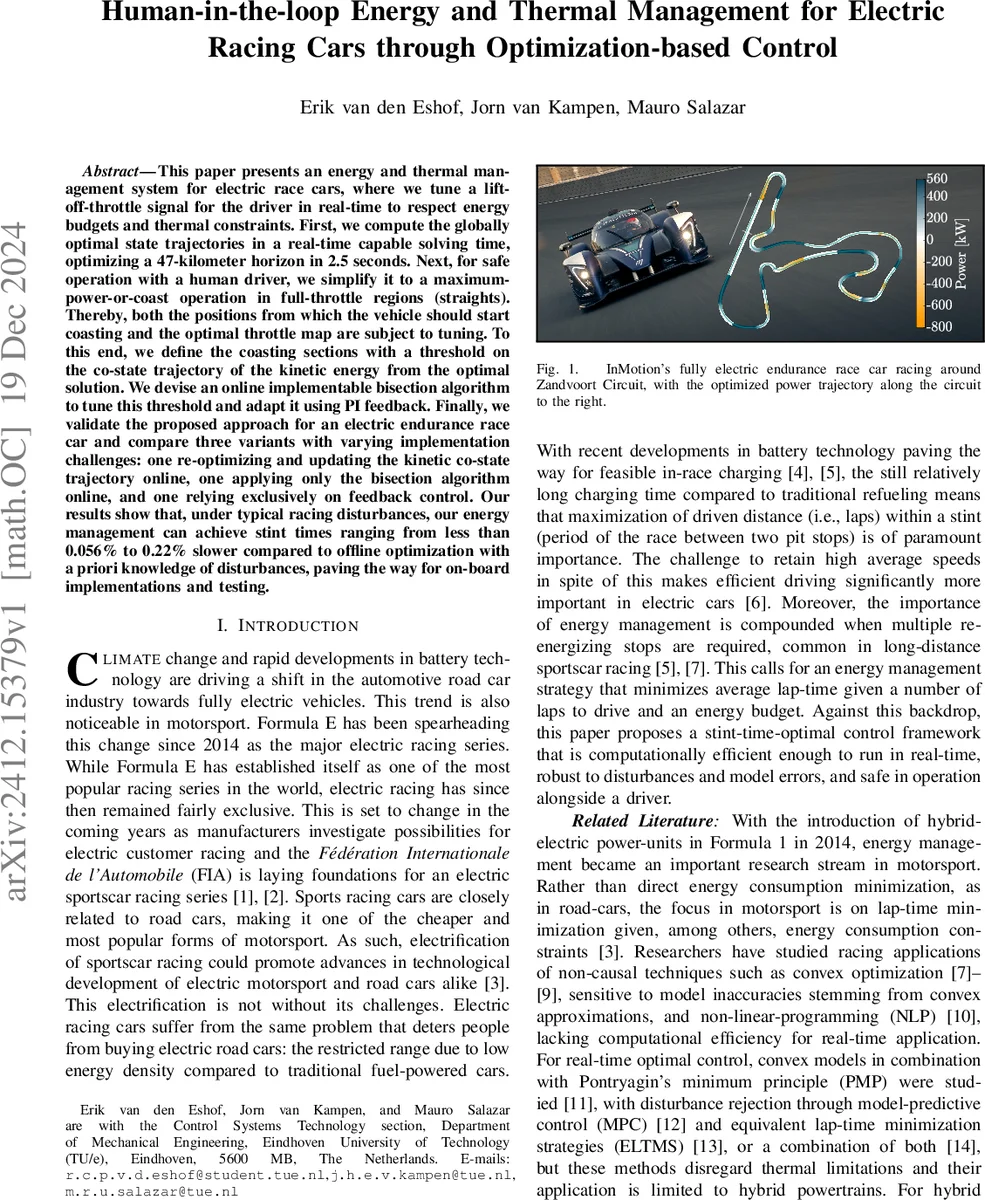
This paper presents an energy and thermal management system for electric race cars, where we tune a lift-off-throttle signal for the driver in real-time to respect energy budgets and thermal constraints. First, we compute the globally optimal state trajectories in a real-time capable solving time, optimizing a 47-kilometer horizon in 2.5 seconds. Next, for safe operation with a human driver, we simplify it to a maximum-power-or-coast operation in full-throttle regions (straights). Thereby, both the positions from which the vehicle should start coasting and the optimal throttle map are subject to tuning. To this end, we define the coasting sections with a threshold on the co-state trajectory of the kinetic energy from the optimal solution. We devise an online implementable bisection algorithm to tune this threshold and adapt it using PI feedback. Finally, we validate the proposed approach for an electric endurance race car and compare three variants with varying implementation challenges: one re-optimizing and updating the kinetic co-state trajectory online, one applying only the bisection algorithm online, and one relying exclusively on feedback control. Our results show that, under typical racing disturbances, our energy management can achieve stint times ranging from less than 0.056% to 0.22% slower compared to offline optimization with a priori knowledge of disturbances, paving the way for on-board implementations and testing.
💡 Research Summary
The paper addresses the challenge of managing energy and thermal constraints in electric racing cars while keeping a human driver in the control loop. The authors first formulate a convex optimal control problem that minimizes total stint time (the time to complete a predefined distance between pit stops) subject to constraints on kinetic energy, battery state of charge, motor temperature, and battery temperature. By simplifying the full vehicle dynamics to a longitudinal, space‑domain model and using second‑order‑cone programming (SOCP), they solve a 47 km horizon in 2.5 seconds, obtaining a globally optimal trajectory that includes smooth throttle variations.
Because racing regulations forbid overwriting the driver’s throttle request except for fixed throttle maps, the smooth optimal trajectory is not directly usable. The authors therefore introduce a “lift‑and‑coast” strategy: the driver either holds the throttle fully open (100 % command) or fully released (0 % command) when the car is not grip‑limited. The key insight is that the optimal solution provides the kinetic‑energy co‑state λₖᵢₙ(s), the Lagrange multiplier associated with the kinetic‑energy dynamics. λₖᵢₙ(s) quantifies how sensitive the total stint time is to changes in kinetic energy at each point along the track.
Using λₖᵢₙ(s), the authors replace the mixed‑integer constraint with a simple threshold rule: if λₖᵢₙ(s) ≥ λ* the driver should coast, otherwise the driver should stay at full throttle. The threshold λ* is determined online by a bisection search that simulates the entire stint with the simplified model, checking whether the maximum‑kinetic‑energy and thermal limits are respected. If a candidate λ* leads to a violation, the search moves to a lower λ*; otherwise it moves higher, converging to the largest feasible λ*. This process is computationally cheap because the underlying model is linear‑quadratic and the integration is performed with an explicit second‑order Adams‑Bashforth scheme using a dense sampling grid.
The overall control architecture is a shrinking‑horizon model predictive controller (MPC). At each MPC update, the remaining distance and measured states (kinetic energy, battery energy, motor and battery temperatures) initialize the problem, the SOCP is solved to obtain the latest λₖᵢₙ(s) profile, and the bisection routine yields a fresh λ*. A proportional‑integral (PI) feedback loop then adjusts λ* based on the error between predicted and actual state trajectories, providing robustness against driver‑induced deviations and external disturbances such as friction changes or voltage fluctuations.
Three implementation variants are evaluated on a high‑fidelity simulation of an electric endurance prototype racing at the Zandvoort circuit: (1) full re‑optimization with online λₖᵢₙ(s) updates, (2) only the bisection search applied online (λₖᵢₙ(s) fixed from the initial solve), and (3) a pure feedback controller that updates λ* without re‑solving the SOCP. All variants run within a real‑time budget (<10 ms per cycle). Under realistic disturbances, the online methods achieve stint times only 0.056 % to 0.22 % slower than an offline optimal solution that has perfect a‑priori knowledge of the disturbances. The pure feedback variant, while the simplest to implement, incurs a modest 0.12 % performance loss, demonstrating that even a minimal online adaptation can preserve near‑optimal efficiency.
The contributions of the work are threefold: (i) a principled reduction of a mixed‑integer optimal control problem to a single‑parameter threshold rule based on the kinetic co‑state, (ii) an efficient bisection‑based online tuning algorithm combined with PI feedback for disturbance rejection, and (iii) the first demonstration of a complete energy‑and‑thermal management scheme that respects driver‑centric throttle constraints and is viable for on‑board deployment in electric race cars. By quantifying the performance gap between the global SOCP solution and the real‑time approximations, the paper provides concrete benchmarks for future ECU implementations, paving the way for practical, driver‑friendly energy management in high‑performance electric motorsport.
Comments & Academic Discussion
Loading comments...
Leave a Comment