A symbolic computational approach to the generalized gambler's ruin problem in one and two dimensions
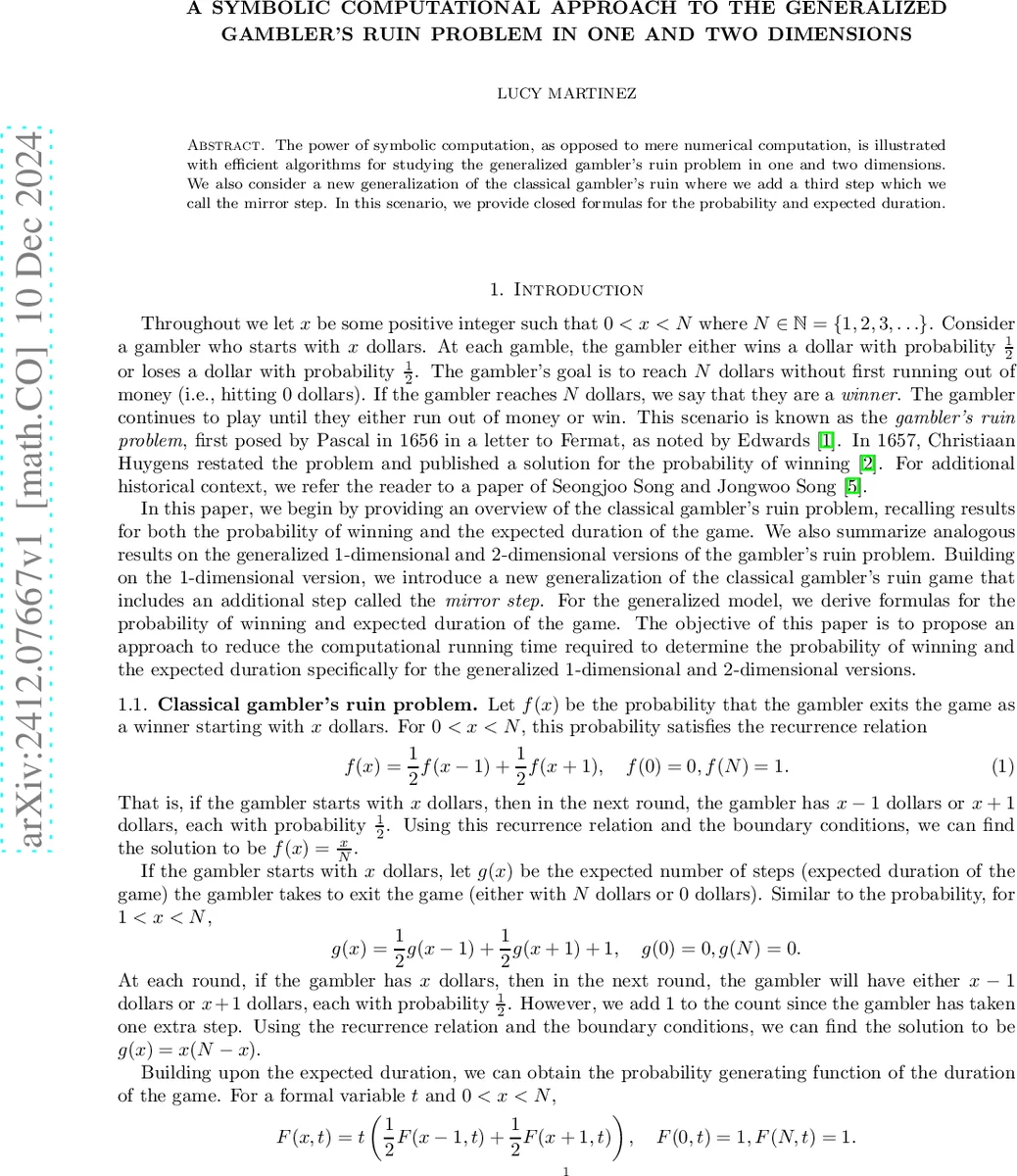
The power of symbolic computation, as opposed to mere numerical computation, is illustrated with efficient algorithms for studying the generalized gambler’s ruin problem in one and two dimensions. We also consider a new generalization of the classical gambler’s ruin where we add a third step which we call the mirror step. In this scenario, we provide closed formulas for the probability and expected duration.
💡 Research Summary
The paper demonstrates how symbolic computation can outperform purely numerical methods when tackling the generalized gambler’s ruin problem in both one and two dimensions. It begins with a concise review of the classical gambler’s ruin, deriving the well‑known winning probability f(x)=x/N and expected duration g(x)=x(N−x) from simple recurrences. The authors then extend the model to asymmetric win/loss probabilities p and q=1−p, obtaining the closed‑form f(x)=1−(q/p)^x /
Comments & Academic Discussion
Loading comments...
Leave a Comment