The Prompt Canvas: A Literature-Based Practitioner Guide for Creating Effective Prompts in Large Language Models
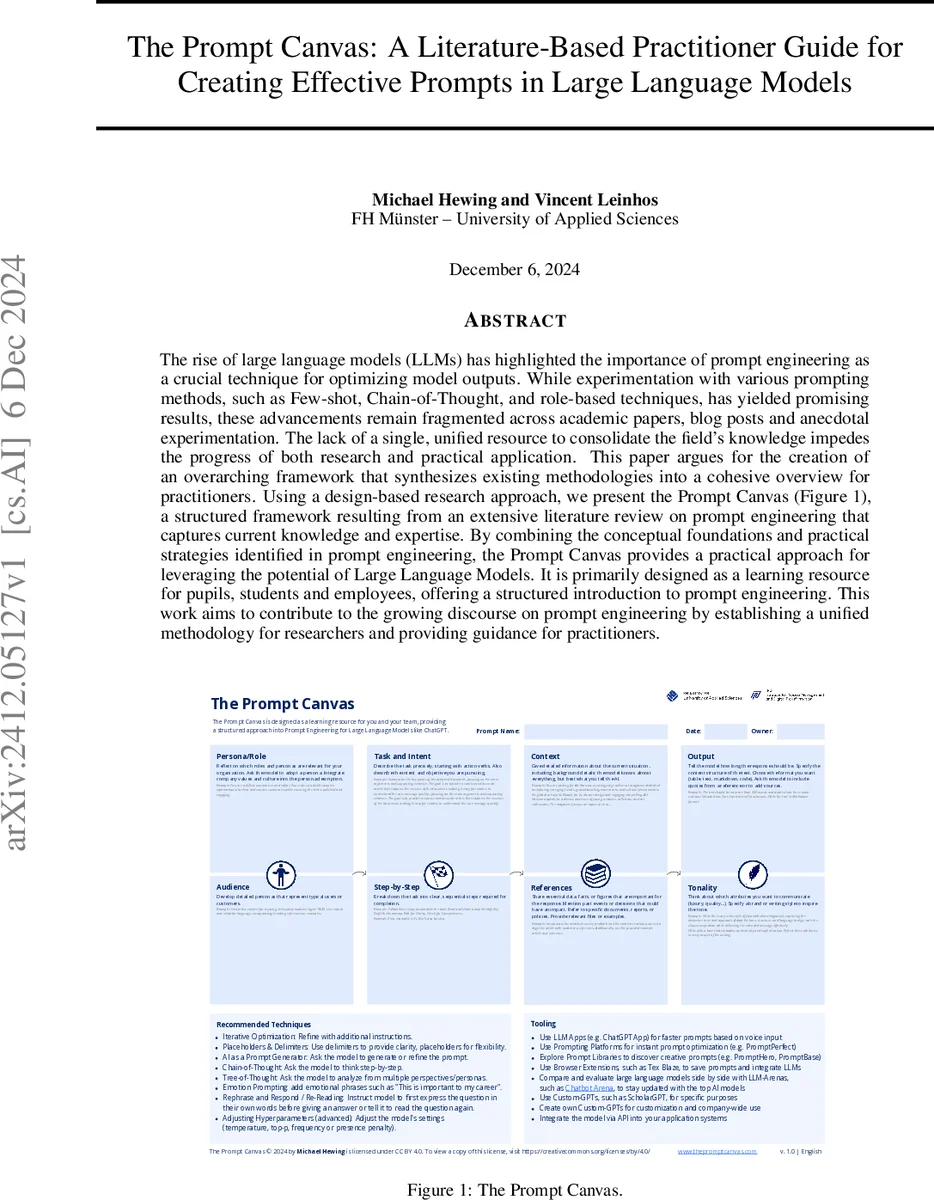
The rise of large language models (LLMs) has highlighted the importance of prompt engineering as a crucial technique for optimizing model outputs. While experimentation with various prompting methods, such as Few-shot, Chain-of-Thought, and role-based techniques, has yielded promising results, these advancements remain fragmented across academic papers, blog posts and anecdotal experimentation. The lack of a single, unified resource to consolidate the field’s knowledge impedes the progress of both research and practical application. This paper argues for the creation of an overarching framework that synthesizes existing methodologies into a cohesive overview for practitioners. Using a design-based research approach, we present the Prompt Canvas, a structured framework resulting from an extensive literature review on prompt engineering that captures current knowledge and expertise. By combining the conceptual foundations and practical strategies identified in prompt engineering, the Prompt Canvas provides a practical approach for leveraging the potential of Large Language Models. It is primarily designed as a learning resource for pupils, students and employees, offering a structured introduction to prompt engineering. This work aims to contribute to the growing discourse on prompt engineering by establishing a unified methodology for researchers and providing guidance for practitioners.
💡 Research Summary
The paper “The Prompt Canvas: A Literature‑Based Practitioner Guide for Creating Effective Prompts in Large Language Models” addresses a growing problem in the field of prompt engineering: while a wealth of techniques such as few‑shot learning, Chain‑of‑Thought (CoT), Tree‑of‑Thought, role‑based prompting, and emotion‑infused prompts have been reported across academic articles, blogs, GitHub repositories, and YouTube tutorials, this knowledge remains fragmented and difficult for practitioners to access and apply consistently.
To bridge this gap, the authors adopt a design‑based research methodology combined with a systematic literature review (SLR) following PRISMA guidelines. They define a clear research question—what is the current state of prompt‑engineering techniques for text‑to‑text tasks?—and then conduct a structured search across major databases, applying inclusion criteria that focus strictly on “prompt engineering” terminology. The resulting corpus (approximately 50 high‑impact papers and conference contributions) is analyzed and synthesized into a taxonomy of techniques, each annotated with its typical use‑cases, strengths, and weaknesses.
The core contribution is the “Prompt Canvas,” a visual, six‑section framework that consolidates the taxonomy into a single, practitioner‑friendly template. The sections are:
- Persona/Role – Define the target user, organizational values, and any role the model should assume.
- Task & Intent – Use action verbs to state the exact task, clarify the underlying intent, and provide contextual background.
- Tonality – Specify desired voice, style, or brand tone (e.g., casual, sophisticated, authoritative).
- References – List source documents, data points, or citations that the model should incorporate.
- Recommended Techniques – Offer a curated toolbox (Iterative Optimization, Place‑holders & Delimiters, AI‑as‑Prompt‑Generator, CoT, Tree‑of‑Thought, Emotion Prompting, Re‑reading, Hyper‑parameter tuning).
- Output Specification – Define length, format (Markdown, table, code), and structural layout of the final answer.
Each canvas cell includes concrete prompts, examples, and optional checklists, making it easy for novices and experts alike to construct high‑quality inputs. The authors also map the canvas to existing tooling ecosystems: PromptPerfect or PromptHero for instant optimization, Tex Blaze browser extensions for saving and reusing prompts, LLM‑Arena for model comparison, and custom GPT deployments (e.g., ScholarGPT) for domain‑specific use. By integrating these tools, the canvas supports the entire prompt lifecycle—from ideation through testing to deployment via APIs.
Illustrative use‑cases are provided, such as generating a concise, 200‑word blog post for a tech‑savvy 18‑25 audience. The example walks through persona definition, task articulation, tone selection, inclusion of a reference survey, and the application of CoT plus emotion prompting to produce a polished Markdown output. Similar scenarios demonstrate how the canvas can guide summarization, code generation, and creative writing tasks.
The discussion acknowledges limitations: the current version focuses on text‑to‑text interactions and does not yet cover multimodal prompting (image, audio, video). Moreover, the evaluation of the canvas is primarily anecdotal; systematic quantitative benchmarking against baseline prompts is left for future work. The authors propose extending the canvas to multilingual contexts, developing automated metrics for prompt quality (e.g., faithfulness, relevance, readability), and building a UI‑based web application that lets teams collaboratively fill out the canvas in real time.
In conclusion, the Prompt Canvas offers a unifying visual taxonomy that consolides scattered prompt‑engineering research into a practical, actionable tool. It lowers the entry barrier for educators, students, and enterprise users, enabling more consistent and effective exploitation of large language models across a wide range of domains.
Comments & Academic Discussion
Loading comments...
Leave a Comment