Analysis, Design, and Fabrication of a High-Gain Low-Profile Metasurface Antenna Using Direct Feeding of Sievenpiper s HIS
💡 Research Summary
The paper presents a true metasurface antenna (TMA) that directly feeds a Sievenpiper high‑impedance surface (HIS) without the need for an external radiator. Conventional low‑profile planar antennas rely on a metallic ground plane or an artificial magnetic conductor (AMC) to allow the radiating element to be placed close to the ground, but performance degrades when the spacing falls below a quarter wavelength. The mushroom‑type HIS introduced by Sievenpiper provides a magnetic‑wall‑like boundary condition with a reflection phase near zero over a limited band, enabling compact antenna designs.
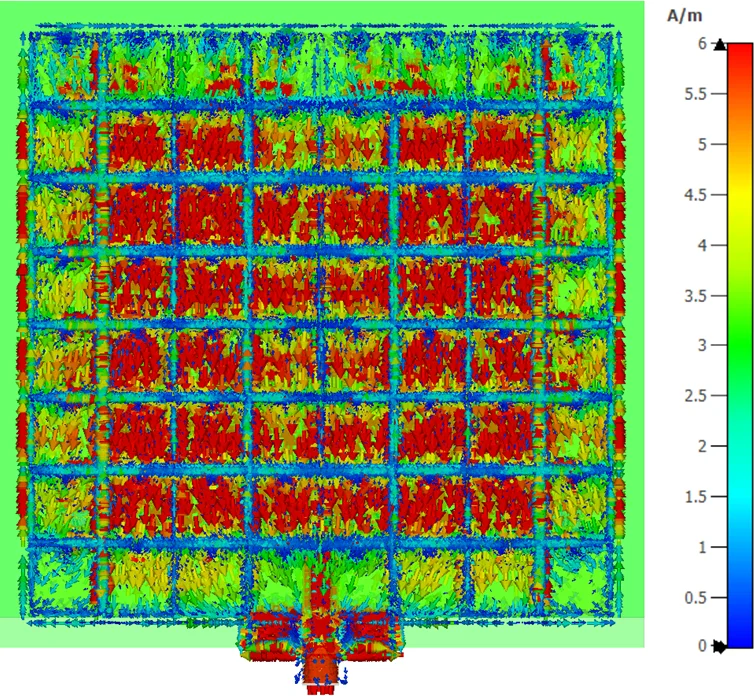
In this work the authors exploit the HIS cells themselves as radiating elements. Sixty‑four edge‑located HIS patches are arranged in a 8 × 8 array (overall size 1.84 λ × 1.84 λ × 0.032 λ at 6 GHz). Each patch is connected to a single microstrip corporate feeding network through a via that is isolated from the common ground. The feed network is a single‑port design, dramatically simplifying the layout compared with previous multi‑port or wave‑guide‑fed metasurface antennas.
A key innovation is the geometric simplification of the radiating patches. The original square patches are transformed into continuous strip‑line stubs loaded with vias. This conversion reduces the number of required vias, frees space on the top surface for additional resonant patterns, and improves the aperture efficiency to about 77 %.
To understand the electromagnetic behavior, the authors develop an equivalent circuit model for a unit cell. The model includes:
- C₀ – the capacitance between adjacent patches, estimated by an analytical expression involving patch side length L, cell spacing s, and substrate permittivity;
- L₀ – the inductance associated with the patch‑ground capacitance, proportional to the substrate thickness;
- L_v – the inductance of the vertical via, derived from its length and radius;
- C₁ – the parallel‑plate capacitance between the top patch and the bottom ground plane.
Initial component values are calculated using the formulas from Sievenpiper’s original mushroom‑structure analysis, then refined with ADS circuit simulations. The resulting S‑parameters (reflection and transmission) match full‑wave CST results closely, confirming that the simple circuit captures the essential physics of the TMA cell.
Full‑wave simulations of the complete array show a realized gain of 15.1 dBi and a half‑power beamwidth (HPBW) of 28° at 6 GHz, despite the compact footprint. The simulated aperture efficiency is 77 %. A prototype was fabricated on a two‑dielectric‑layer PCB (top frequency‑selective surface, bottom microstrip feed, with a common ground in between). Measured results exhibit a gain of 13.5 ± 0.5 dBi and an HPBW of 27°, in good agreement with the simulations.
The authors discuss scalability: the same design methodology can be scaled to millimeter‑wave frequencies (e.g., 54 GHz) for integration into handheld devices while preserving high gain. The single‑feed, low‑profile, and compact nature of the antenna make it attractive for emerging 6 G applications such as car‑to‑car (C2C) communication, where narrow beams reduce interference and improve signal‑to‑noise ratio.
Overall, the paper contributes three main advances: (1) direct feeding of HIS cells to create a true metasurface radiator, eliminating the need for an external antenna; (2) a simplified patch‑to‑strip conversion that reduces via count and increases aperture efficiency; (3) a validated equivalent‑circuit model that offers a fast design tool complementary to computationally intensive full‑wave simulations. The experimental verification confirms that the proposed TMA can deliver high gain, narrow beamwidth, and low profile simultaneously, positioning it as a promising candidate for future high‑frequency, high‑density wireless systems.
Comments & Academic Discussion
Loading comments...
Leave a Comment