Random dynamics of solutions for three-dimensional stochastic globally modified Navier-Stokes equations on unbounded Poincaré domains
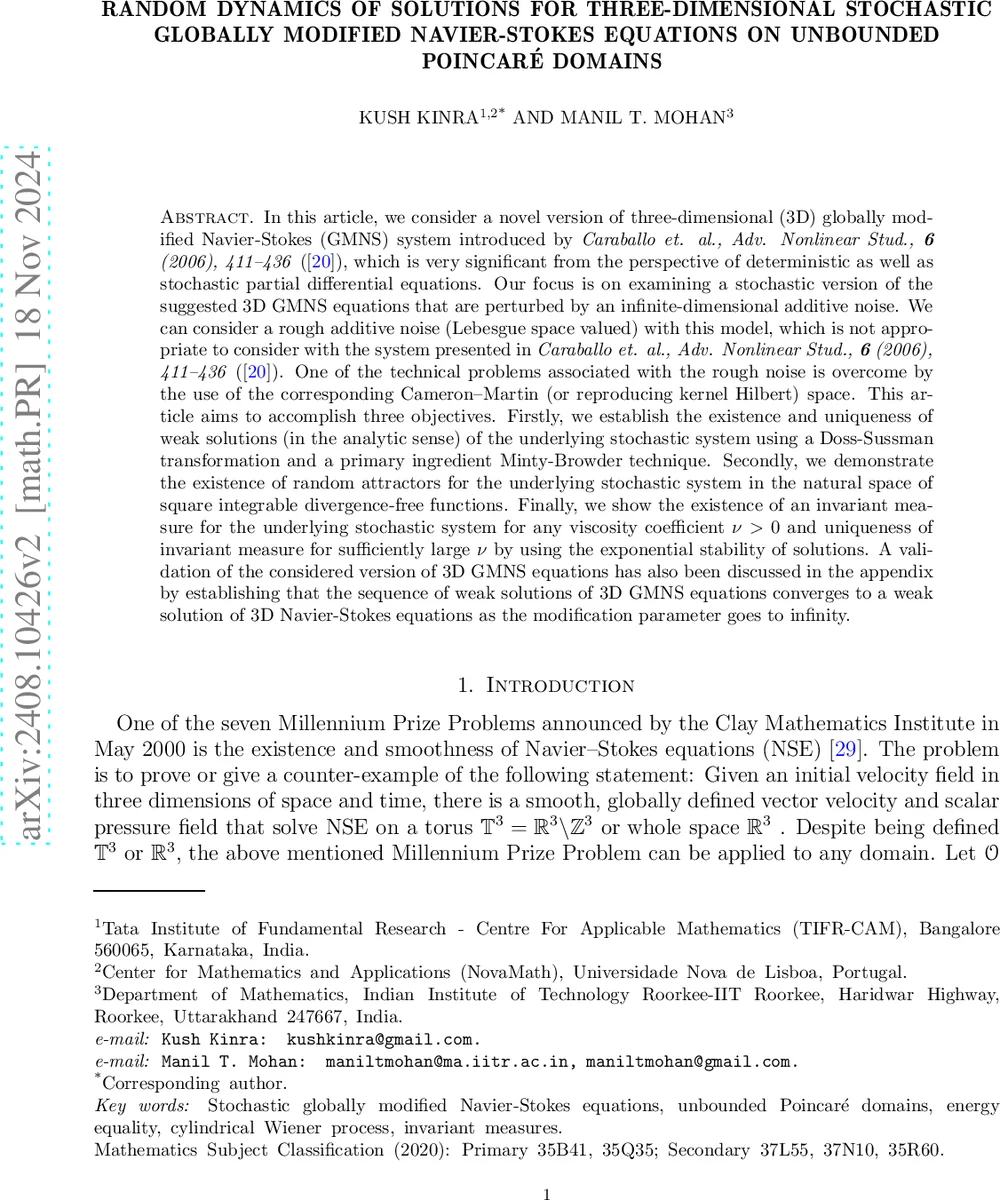
In this article, we consider a novel version of three-dimensional (3D) globally modified Navier-Stokes (GMNS) system introduced by [Caraballo et. al., Adv. Nonlinear Stud. (2006), 6:411-436], which is very significant from the perspective of deterministic as well as stochastic partial differential equations. Our focus is on examining a stochastic version of the suggested 3D GMNS equations that are perturbed by an infinite-dimensional additive noise. We can consider a rough additive noise (Lebesgue space valued) with this model, which is not appropriate to consider with the system presented in [Caraballo et. al., Adv. Nonlinear Stud. (2006), 6:411-436]. One of the technical problems associated with the rough noise is overcome by the use of the corresponding Cameron-Martin (or reproducing kernel Hilbert) space. This article aims to accomplish three objectives. Firstly, we establish the existence and uniqueness of weak solutions (in the analytic sense) of the underlying stochastic system using a Doss-Sussman transformation and a primary ingredient Minty-Browder technique. Secondly, we demonstrate the existence of random attractors for the underlying stochastic system in the natural space of square integrable divergence-free functions. Finally, we show the existence of an invariant measure for the underlying stochastic system for any viscosity coefficient $ ν> 0 $ and uniqueness of invariant measure for sufficiently large $ν$ by using the exponential stability of solutions. A validation of the proposed version of 3D GMNS equations has also been discussed in the appendix by establishing that the sequence of weak solutions of 3D GMNS equations converges to a weak solution of 3D Navier-Stokes equations as the modification parameter goes to infinity.
💡 Research Summary
The paper investigates a stochastic version of the three‑dimensional globally modified Navier‑Stokes (GMNS) equations on unbounded Poincaré domains, where the nonlinear term is multiplied by a global cut‑off function depending on the L⁴‑norm of the velocity field. The stochastic forcing is an infinite‑dimensional additive noise taking values in a Lebesgue space, i.e., a “rough” noise that cannot be handled by the classical framework used for the original GMNS model. To overcome this difficulty, the authors assume that the Cameron‑Martin (reproducing kernel Hilbert) space K of the Wiener process is continuously embedded in H∩L⁴(O) and that the operator A^{‑δ}:K→H∩L⁴(O) is γ‑radonifying for some δ∈(0,½). This condition guarantees that the associated Ornstein‑Uhlenbeck process lives in H∩L⁴(O), which is essential for the subsequent analysis.
Using a Doss‑Sussman transformation, the stochastic equation is rewritten as a deterministic pathwise system driven by the Ornstein‑Uhlenbeck process. The transformed system features a monotone operator G_N(v)=νAv+B_N(v+Z) that satisfies a strong monotonicity inequality together with a coercivity term. By applying the Minty‑Browder technique, the authors prove the existence and uniqueness of weak (analytic) solutions for initial data in the natural phase space H (L² divergence‑free fields), extending previous results that required initial data in V=H¹₀.
The long‑time behavior is studied on unbounded domains where the embedding V↪H is not compact, precluding the use of the classical energy‑equality method for random attractors. Instead, a uniform‑tail estimate method is employed: the authors show that the energy of solutions becomes arbitrarily small outside large balls uniformly in time, which yields asymptotic compactness of the associated random dynamical system (RDS). Consequently, a random attractor exists in H and attracts all trajectories in the pull‑back sense.
For invariant measures, the paper first establishes existence for any viscosity ν>0 via the Krylov‑Bogoliubov procedure. Moreover, when ν is sufficiently large, exponential stability of solutions is proved, leading to the uniqueness of the invariant measure. This result is obtained by constructing a suitable Lyapunov functional and demonstrating exponential decay of the mean‑square norm.
An appendix validates the modified model by showing that, as the cut‑off parameter N→∞, the sequence of weak solutions of the GMNS equations converges (in the weak topology) to a weak solution of the classical three‑dimensional Navier‑Stokes equations.
Overall, the work combines several sophisticated tools—Cameron‑Martin space analysis, Doss‑Sussman transformation, Minty‑Browder monotonicity, uniform‑tail estimates, and Lyapunov methods—to treat a stochastic fluid model with rough noise on unbounded domains. It extends the theory of stochastic Navier‑Stokes type equations, provides a rigorous foundation for incorporating spatially irregular random forcing, and opens avenues for further research on infinite‑dimensional SPDEs with non‑compact phase spaces.
Comments & Academic Discussion
Loading comments...
Leave a Comment