Subgroupoids and Quotient Theories
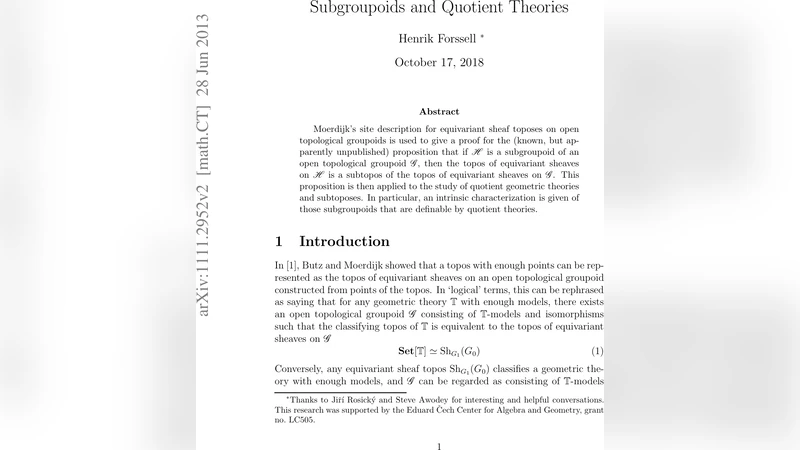
Moerdijk’s site description for equivariant sheaf toposes on open topological groupoids is used to give a proof for the (known, but apparently unpublished) proposition that if H is a strictly full subgroupoid of an open topological groupoid G, then the topos of equivariant sheaves on H is a subtopos of the topos of equivariant sheaves on G. This proposition is then applied to the study of quotient geometric theories and subtoposes. In particular, an intrinsic characterization is given of those subgroupoids that are definable by quotient theories.
💡 Research Summary
The paper investigates the relationship between an open topological groupoid G and a strictly full subgroupoid H, using the site description introduced by I. Moerdijk for equivariant sheaf toposes. An open topological groupoid consists of a space of objects G₀ and a space of arrows G₁ equipped with continuous source, target, composition and inversion maps; the associated site has objects given by open subsets of G₀ and covering families given by G‑invariant open covers. Moerdijk showed that the category of G‑equivariant sheaves on this site, denoted Sh(G), is a Grothendieck topos.
The first technical contribution of the paper is to revisit Moerdijk’s site in detail, emphasizing how the covering sieves are defined and how representable presheaves are already sheaves. This groundwork is essential because the later construction of geometric morphisms relies on the exact preservation of covering families under inclusion of subgroupoids.
Assuming H is a strictly full subgroupoid of G—i.e. H₀⊆G₀ is an open subspace and H₁ consists of all arrows of G whose source and target lie in H₀—the authors show that H inherits the structure of an open topological groupoid and therefore has its own equivariant sheaf topos Sh(H). The central question is whether the inclusion H↪G induces a subtopos embedding Sh(H)↪Sh(G).
To answer this, the authors construct two adjoint functors between the two toposes. The restriction functor
Res : Sh(G) → Sh(H)
simply forgets the G‑action outside H₀, while the left Kan extension
Lan : Sh(H) → Sh(G)
extends an H‑sheaf to a G‑sheaf by left Kan extending along the inclusion of sites and then sheafifying. The crucial observation is that because the inclusion of object spaces is open, any covering sieve in the H‑site is also a covering sieve in the G‑site. Consequently, the left Kan extension already yields a sheaf, so Lan is exact and preserves finite limits. Moreover, Res is fully faithful: a G‑sheaf is determined uniquely by its restriction to H when H is strictly full. Hence (Res ⊣ Lan) is a geometric morphism with Res an embedding, establishing that Sh(H) is a subtopos of Sh(G).
Having secured the subtopos relationship, the paper turns to quotient geometric theories. For a geometric theory T, its classifying topos Set
Comments & Academic Discussion
Loading comments...
Leave a Comment