Energy Consumption Optimization in Mobile Communication Networks
This work addresses the challenge of minimizing the energy consumption of a wireless communication network by joint optimization of the base station transmit power and the cell activity. A mixed-integer nonlinear optimization problem is formulated, f…
Authors: Florian Bahlke, Marius Pesavento
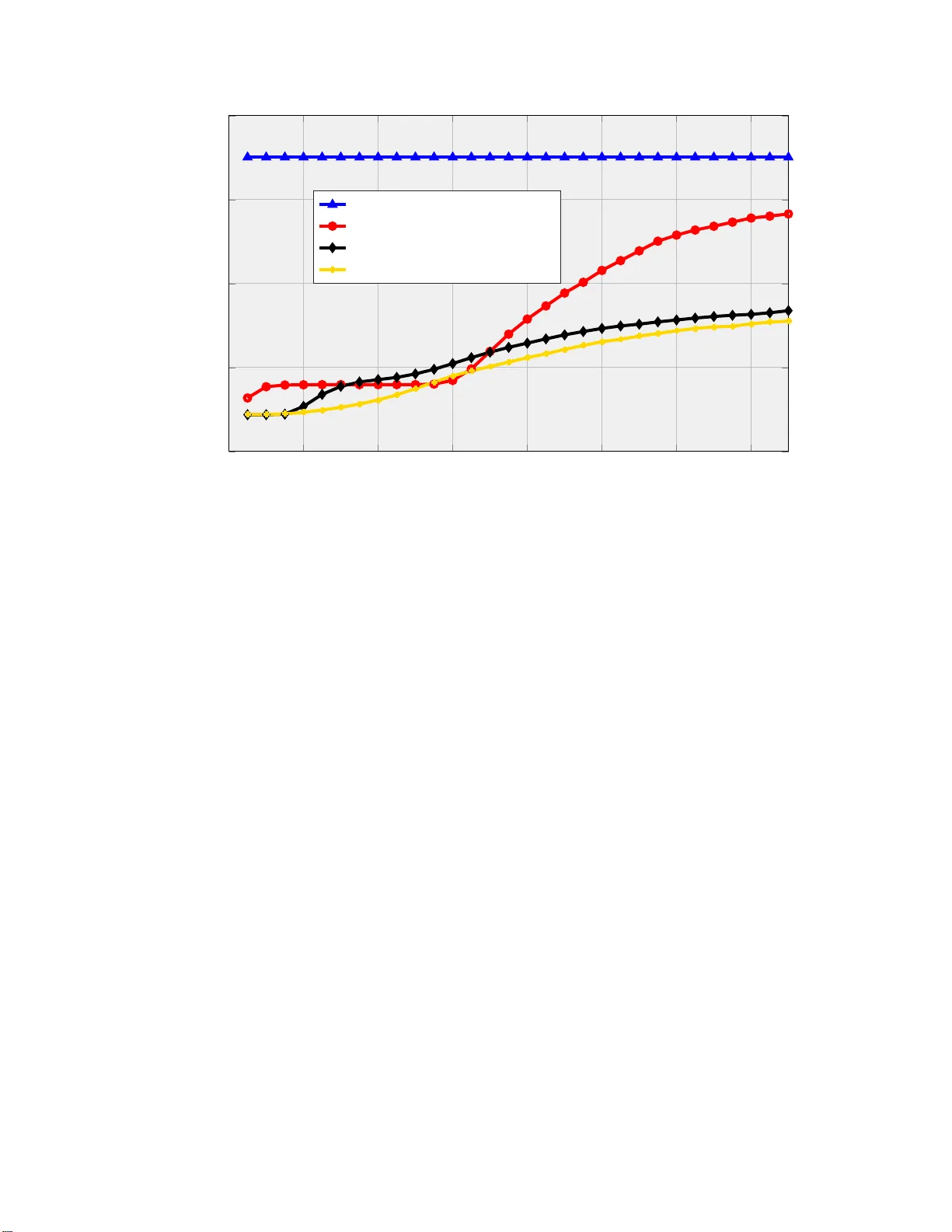
1 Ener gy Consumption Optimiza tion in Mobile Communication Netw orks Florian Bahlke and Marius Pesav ento Abstract This work addresses the challenge of minimizing the energy consumption of a wireless communi- cation network by joint optimization of the base station transmit power and the cell activity . A mixed- integer nonlinear optimization p roblem is form u lated, for wh ich a comp u tationally tractable linear inner approx imation algorithm is provided. The prop osed method offers great flexibility in op timizing the network operation by consider in g multiple s y stem param eters j o intly , which mitigates a major drawback of existing state-of-the -art schemes that are mostly based on h euristics. Simulation results show that the pro posed method exhibits high perform a nce in decreasing the e n ergy con su mption, and p rovides implicit load b alancing in difficult h igh deman d scenar io s. I . I N T R O D U C T I O N In the evolution of wireless commu n i cation networks over the recent years, ne w techno l o- gies ha ve been proposed t o ful fill t h e increasing performance requirements for the upcoming fifth generation (5G) and subsequent generations of mobile com munication networks [1]–[3]. In addition to serving users with e ver increasing data rates, novel applications require very low latency connections and extreme reliability . Amo n g the mos t pro m ising technologies for 5G are Massive-MIMO s y stems, Mi llimeter-W a ve communi cations and heterogeneous network structures with dense cell deployments. Between t hese t h ree opti o ns, the latt er one arguably poses the lowest technological ris ks and lev el of com mitment from network providers. F o r such dense and heterogeneous networks, the existi n g cell architecture is supplement ed with addi t ional cells containin g base stations of v ariable size, both i n t ransm it power and coverage area. This densification of th e network has been identified as a promising and scalabl e approach for the next decades of wireless comm unications [4]–[6]. Due to the increase in intercell interferences lim iting the achiev abl e data throughp u t, novel control schemes for such networks need to be devised that supersede th e establis hed strategy of deploying addi t ional cells without increasing the amount 2 of coordination between them [7]–[9]. The wireless commun ication networks of the future are en visioned to hav e a sig n ificantly higher energy efficienc y in terms of ener gy consumpti o n per transmitted bit of data. In the 5G stand ard, this will be achieved trough i ntelligent s witching of each cell ’ s operatio n between active phases and sleep mo des - abandonin g the always-on and alwa ys-connected concept of contemporary base s t ations - a dynamic scaling o f the transmit power , and an ener gy-focused des i gn of multi -antenna syst ems [8], [10]–[12]. W e propose a method for m inimizing the energy consumpti on of the wireless com munication network, subject to cell load constraints t hat prevent cells from being unabl e to serve t he demand of associated users wit h their av ail able time-frequency resources. This approach i s suitable for the planning the network parameters ahead of operation, and complements ener gy efficient transceiv er techniques comm only applied in-operatio n for example t o maximize inst ant aneous data rates. In previous research, extensi ve ef fort has been in vested int o the analysi s and optimiza- tion of cell loads for heterogeneous mobil e comm u nication networks [13]–[18 ]. The cell load has been used in v ariou s schemes t o optimize the transm i t p owers [19], [20], in the d esign of ener gy -efficient beamformers for multi-antenna syst ems [21], [22], and to optim ize the cell on-off status to enable schedulin g for sl eep mode and activity periods [23], [24]. These met h ods share one fundamental disadvantage, whi ch is that they cannot jo i ntly optimize the transmit power and the cell activity status. Switching cells of f is just considered implicitly , as the transmit power being scaled down to zero [19], [25]. The transmit power in a practical system howe ver might be lower -bo u nded by a nonzero le vel, for example due to transmit power independent los s es and nonlinearities in the power amplifiers [26]–[28]. Heuristic approaches also heavily rely on the cell lo ad being a strictly decreasing continuo us function of its transmit power , w h ich requires multiple sim plifications in the way how the network is modeled, particularly regarding the used adaptiv e modulation and coding schemes. For example, t he load a user adds to a cell needs to be a s trictly decreasing function of the user’ s sig n al -t o -interference-and-noise ratio (SINR), th e assignment of users to cell s needs to be constant and the operable transmi t power range n eeds to be lower -bound by zero, wh ich all do no t necessarily apply in practical s y stems. In this work, we propose an approach for minim izing the n et work’ s energy consu m ption based on M ixed-Integer Li near Programming (MILP), which expands upon state o f the art so l utions in the following aspects: • The transmit power and the activity status of the cell (on or of f) are jointly optimized. This 3 leads to a mixed-integer problem as, e.g. the transmit p owe r is optim i zed on a cont inuous scale and the cell acti vit y indicator is bi n ary . • While the origi n al optim i zation problem is n o nlinear and com putationally intractable to solve, we propose a linear inner approxim ation. The solu tion of this approx imate problem is always feasib l e for the original probl em. • The propo sed m eth od easil y incorpo rates additi onal con vex constraints such as m inimum transmit power and minimum SINR threshold constraints as well as upper boun d s on the user rates due to finite m odulation and coding schemes. • The assignment of users t o cells is one of the desi g n parameters, and changes dynam i cally according t o whi ch cell provides the strongest signal. The proposed scheme als o allows t h e incorporation of other user allocation rules. The remainder of the paper is structured as follows: In Section II we introd uce t he system model for the w i reless commu nication network. A mi xed-integer nonlinear programming (MINLP) approach to minim ize the network’ s ener gy consum ption is in t roduced in Section III, for whi ch we provide an inner linear approximation (MILP). Sim u lation results for different ener gy con- sumption models and a comparative analys is bet w een the proposed and alternativ e m et h ods are provided in Section IV. Final l y , we su m marize the results and provide an ou t look onto fut u re work in Section V. I I . S Y S T E M M O D E L W e consider a d ownlink wireless communication network with K cells, each equipped with a single antenna base station (BS). Th e t ransm it powe r of th e BS in cell k = 1 , . . . , K is denoted as p k , and the vector o f all transm i t powers as p = [ p 1 , p 2 , . . . , p K ] T . In the following we assum e that each cell is defined as t h e coverage area of the BS, and therefore we u se the terms interchangeably . In practical networks the transmit power p k is generally confined to lie in a the int erv al 0 < P MIN k ≤ p k ≤ P MAX k , (1) where, due t o physical hardware limitations, such as linearity constraints in the power amplifiers and radiati on efficienc y requirements of the antenna the th resholds P MIN k and P MAX k are p o sitive (excluding P MIN k = 0 ) and finite [26]–[28]. T he network contai n s M demand poi nts (DP) with DP m = 1 , . . . , M having t he data dem and D m . A DP may represent a single mobil e node, 4 or in case of a clu ster of closel y spaced mobi l e nodes with sim ilar channel characteristics t o the con nected BS, the accumul ation of multiple nodes. The gain of BS k is denoted by ˜ g BS k , correspondingly we use ˜ g DP m as th e antenna gain of the DP m . The large-sca l e path attenuation factor of signals transmit ted from the BS in cell k to DP m are denoted as ˜ g P A TH mk . Small scale fading parameters will be neglected because the proposed method is assumed to be appli ed on a network planning ti m escale, and on av eraged rather t han instantaneous channel i n formation. Combining the aforementioned factors, we denote as g k m = ˜ g BS k ˜ g P A TH mk ˜ g DP m the attenuation factor for transmiss i ons between BS k and DP m . The SINR of cell k serving DP m can be modeled as γ k m = p k g k m P j =1 ,...,K \{ k } p j g j m + σ 2 , (2) where σ 2 represents the v ariance of addit iv e white Gaussian noise (A WGN). This corresponds to an ortho gonal frequency di vi sion mu l tiple access (OFDMA) system wit h full frequency reus e between cells. The bandwidth ef ficiency o f BS k serving DP m is denoted as η B W k m [29], and the total a vailable sy s tem b andwidth is W . G ai n s in data rate achiev able in mu lti-antenna sys t ems can also be accounted for through the b andwidth effi ciency parameter η B W k m . The achiev ed radio downlink bandwidt h [30] of cell k in DP m can, e.g., be determin ed as B k m = η B W k m W log 2 (1 + γ k m ) (3) where the interferences are treated as noise. T o satis fy the data demand D m in DP m , cell k needs to allo cate t he fraction D m /B k m of its resources. In order to m odel the allocation of DPs to BSs, we us e the binary parameter A k m = 1 if DP m is allocated to cell k 0 otherwise , (4) and we denote as A ∈ { 0 , 1 } K × M the com bined allocation m atrix. W e assume that each DP is allocated to a single BS, so that P K k =1 A k m = 1 . T o determine the fraction of av ailable resources required by a cell in order to satisfy the data d emand D m of all it s allocated DPs m , as specified by A k m , we compu t e the t otal load factor ρ k of cell k [29], [31] as ρ k = M X m =1 A k m D m B k m = M X m =1 A k m D m W η B W k m 1 log 2 (1 + γ k m ) . (5) W e further define the vector of load fa ctors ρ = [ ρ 1 , ρ 2 , . . . , ρ K ] T . It is obs erv able that ρ k > 0 holds and that cell k i s not overloaded if ρ k ≤ 1 . An overloaded cell, with ρ k > 1 , cannot serve 5 the m inimum data demands D m of its allocated DPs under the present SINR condi tions. Under these circumstances, new connections cannot be establis h ed, and existing conn ections hav e to be dropped. Let f ( γ ) = 1 log 2 (1 + γ ) (6) denote, for later reference, the i nv erse rate, measured in t ime per t ransmitted bi t, corresponding to a link with SINR γ . The interference term P j =1 ,...,K \{ k } p j g j m + σ 2 in Eq. (2) can be weig hted with t he load factors ρ j of i n terfering cells, t o account for the fact that lightly loaded cells do not need to fully use their a vailable time-frequency resources and therefore generate on av erage lower l evels o f interference than hea vi ly l oaded ones [14], [29], [31]. Because even lightly loaded cells might fully interfere with each oth er if there are no coordination m echanis ms em ployed, we will use, without loss of generality , the "worst-case" assumption of full interference between activ e cells in our simu lations. T o indicate the on-of f acti vit y stat u s of cells, we introdu ce t h e binary model parameter x k = 1 if cell k is activ e 0 otherwise . (7) and the vector x = [ x 1 , x 2 , . . . , x K ] T representing the activity st atus of all cells i n t he network. W e define the ener gy consumption of cell k as E k = Γ ( x k , p k , ρ k ) (8) where Γ ( x k , p k , ρ k ) is an arbitrary linearly increasing functio n of the cell’ s on-off status x k , transmit power p k and l o ad ρ k . For example, the energy consu mption function us ed in Eq. (8) can be defined as Γ ( x k , ˜ p k , ρ k ) = T 0 P MAX k κ 1 x k + κ 2 ˜ p k P MAX k + κ 3 ˜ ρ k (9) where the parameters κ 1 , κ 2 and κ 3 are weightin g factors for the cell ’ s energy consumptio n based on t he on-off status, t ransm it power , and load factor , respective l y , and T 0 is a time cons tant. The load factor of a cell can imp act its power consumption because it reflects the amount of its utilization [32]. Recent network models therefore h a ve established th at, especiall y for sm all cells, the power cons umption is best modeled as a function of the cell load in addition to th e transmit power [20], [25]. Not e that the terms x k , ˜ p k /P MAX k and ˜ ρ k cannot exceed t he value 1 , for 6 each cell k . For mo re so phisticated m o dels for the power consum ption of mobi le comm unication BSs, which i n corpo rate energy consump tion of wired backhaul, and individual factors for all components of t he BS we refer to [27], [33]–[35]. Since our model can use any combination of the three factors i n Eq. (8) , we obtain a highly flexible approach for energy minimizati o n, which is shown in the following Section III. I I I . E N E R G Y C O N S U M P T I O N O P T I M I Z A T I O N In th i s section, we formulate an optimizati o n problem to minimi ze the ener gy consumpti on of the wireless n etwork as defined in Eq. (8) , subject to D P to BS allocation-, mi nimum SINR- and cell lo ad constraints. Physical layer requirement s of the w i reless com m unications standard, such as the used mod u l ation and coding s cheme in L TE-A, impose a minimum SINR l e vel γ MIN > 0 for the transmissio n link to provide a non-zero rate, and define τ MAX = f ( γ MIN ) . The load term ( D m τ MAX ) / ( W η B W k m ) th erefore is the highest load DP m contributes to the overall load (5) of cell k . The SINR thresho l d γ MAX denotes the SINR-le vel where, for γ ≥ γ MAX , the hi g hest av ailable modulation - and coding scheme is used su ch that t h e maxim um rate is achiev ed, and a further increase in SINR is not ass ociated with an addit i onal i ncrease in rate. T h e in verse of the log-t erm in Eq. (5) for SINR-le vels γ ≥ γ MAX is denoted as τ MIN = f γ MAX . W e further define f + τ MIN ( γ ) = max f ( γ ) , τ MIN . (10 ) For the allocatio n of DPs to cells , we assume that cell range expansion is being util ized [14], [36], with θ k denoting th e bias value o f cell k . DP m is allocated t o the cell k that provides the highest product of recei ved signal power p k g k m and bias value θ k . Us ing as optim ization parameters the binary cell activity indi cator x ∈ { 0 , 1 } K × 1 and allocation i n dicator A ∈ { 0 , 1 } M × K , the continuous transmit power parameter p ∈ R K × 1 0+ and the cell load ρ ∈ R K × 1 0+ , the energy 7 minimizati on problem can be formulated as following: minimize x , p , A , ρ K X k =1 Γ ( x k , p k , ρ k ) (11a) sub j ect to P MIN k ≤ p k ≤ P MAX k ∀ k (11b) K X k =1 A k m = 1 ∀ m (11c) K X k =1 A k m ≤ x k ∀ k , m (11d) K X k =1 A k m θ k p k g k m ≥ x j θ j p j g j m ∀ j, m (11e) K X k =1 A k m p k g k m − γ MIN X j x j (1 − A j m ) p j g j m + σ 2 ! ≥ 0 ∀ m (11f) ρ k = M X m =1 A k m D m W η BW k m f + τ MIN p k g k m P K j =1 x j (1 − A j m ) p j g j m + σ 2 ! ∀ k (11g) ρ k ≤ 1 ∀ k (11h) x k , A k m ∈ { 0 , 1 } ∀ k , m (11i) p k ∈ R 0+ ∀ k (11j) In problem (11 ), the objectiv e (11a) aim s to minimize th e ov erall systems’ ener gy consum ption, which is the sum of the ener gy consumption of individual cells as defined in (8) and (9). The constraint (11b) defines t he feasible transmit po wer range of cell k restricted according to (1). Each DP m is served by exac t ly one cell k , and only activ e cells { k | x k = 1 } can serve any DP , as specified by (11 c) and (11d), respectively . Constraint (11e) enforces that, each DP m is allocated t o t h e cell k that provides highest produ ct of recei ved si gnal power and bias value 1 . The load constraint th at cell k has to satis fy , as defined in (5), is sp ecified in (11h). Problem (11) is a com binatorial and noncon vex M INL P , and th us generally very diffic u l t to solve. Whi le si gnificant advancements have been m ade for conv ex MINLPs [37], [38], it i s univ ersall y agreed upon that noncon vex M INLPs pos e a significant computation al chall enge 1 T ypically the DP is allocated to the cell providing the highest receiv ed signal power , bu t this leads to an underutilization of the low-p ower small cells. If so-called "range expansion" is utili zed, the signal power from small cell s is weighted wi th a bias v alue, which corresponds to an increased cov erage area [36]. 8 where the chances of finding an op t imal solution t o any given problem highly depend on th e problem size and structure [39], [40]. T o maint ai n robustness and scalability for schemes based on network opti m ization problems, it is therefore advisable to find an MILP t hat represents a linear inner approxim ation or a linear reformulation of the original MINLP . The objective function (11a) and cons traints (11e), (11f) and (11h) contain the bil i near term x k p k . W e introd u ce a new var i able ˜ p k , p k x k and reformulate (11) as t h e following equiv al ent problem: minimize x , ˜ p , A , ρ K X k =1 Γ ( x k , ˜ p k , ρ k ) (12a) sub j ect to x k P MIN k ≤ ˜ p k ≤ x k P MAX k ∀ k (12b) (11c) − (11d) K X k =1 A k m θ k ˜ p k g k m ≥ θ j ˜ p j g j m ∀ j, m (12c) K X k =1 A k m ˜ p k g k m − γ MIN X j (1 − A j m ) ˜ p j g j m + σ 2 ! ≥ 0 ∀ m (12d) ρ k = M X m =1 A k m D m W η BW k m f + τ MIN ˜ p k g k m P K j =1 (1 − A j m ) ˜ p j g j m + σ 2 ! ∀ k (12e) ρ k ≤ 1 ∀ k (12f) x k , A k m ∈ { 0 , 1 } ∀ k , m (12g) ˜ p k ∈ R 0+ ∀ k (12h) Using a lifting s t rategy , we will i n the following introduce auxiliary parameters to represent bilinear products of opti mization variables, w h ich a more t ractable, linear problem structure at the cost of i n creased problem dimension ality . T ow ards thi s aim, the bilinear products of binary allocation parameters A k m and cell transmit powers ˜ p k in Eqs. (12c), (12d) and (12e) ha ve to be linearized. W e define the set L : = { ( r , r , b, a ) ∈ R 0+ × R + × { 0 , 1 } × R 0+ : a ≥ r − (1 − b ) r , a ≤ r , a ≤ br } (13) with the bin ary parameter b and the real parameter r with 0 ≤ r ≤ r . The inequalities defining L in (13) are affine in r , b and a , and ( r , r, b, a ) ∈ L enforces a = r b , which wil l be used in the following reformulations t o linearize bilinear products of binary and conti n uous o ptimization parameters [41]. 9 W e introduce an ne w variable Ω k m and the corresponding matrix Ω ∈ R K × M 0+ . For the proposed lifting approach, we install ˜ p k , P MAX k , A k m , Ω k m ∈ L ∀ k , m in problem (12), which enforces that Ω k m = ˜ p k A k m , such that we can reformulate (11) as: minimize x , p , A , ρ , Ω K X k =1 Γ ( x k , ˜ p k , ρ k ) (14a) sub j ect to (11c) − (11d) , (12b) , (13) K X k =1 Ω k m θ k g k m ≥ x j θ j ˜ p j g j m ∀ j, m (14b) K X k =1 Ω k m g k m − γ MIN X j (1 − Ω j m ) g j m + σ 2 ! ≥ 0 ∀ m (14c) ρ k = M X m =1 A k m D m W η BW k m f + τ MIN ˜ p k g k m P j =1 ,...,K ( ˜ p j − Ω j m ) g j m + σ 2 ! ∀ k (14d) ρ k ≤ 1 ∀ k (14e) ˜ p k , P MAX k , A k m , Ω k m ∈ L ∀ k , m (14f) x k , A k m ∈ { 0 , 1 } ∀ k , m (14g) ˜ p k , Ω k m ∈ R 0+ ∀ k (14h) From (11) to (14), the auxi liary parameter Ω has been used in constraint s (14 b ), (14c) and (14d) to replace Ω k m = ˜ p k A k m , whereas the remaining optimization parameters remain unchanged. The sol ution of problem (14) can therefore be us ed to easily obt ain the correspondin g solutions for problem (11) and vice-versa. Thus, both form u lations can be considered equivalent. Problem (14) is an integer linear program except for constraint (14d), which is nonlin ear due to the log-term in the function f + τ MIN ( γ ) as defined in (10), the fractional SINR-term and the allocation factor A k m . In the following, we propose an affine inner approxim ation of (14d)- (14e). W e define a set of I lin ear functi ons u i ( γ ) = α i γ + β i , i = 1 , . . . , I , (15) which satisfy the upp er bound property max i u i ( γ ) ≥ f + τ MIN ( γ ) ∀ γ ≥ γ MIN , (16) as illustrated in Fig. 1. Since f ( γ ) in (6) is s t rictly decreasing, we conclude that all u i ( γ ) can be designed su ch that α i ≤ 0 ∀ i . T o approxi mate the load for γ ≥ γ MAX , as depicted i n Fig. 1, 10 γ f ( γ ) , u i ( γ ) b 1 τ MAX b I = τ MIN γ MIN γ MAX u 1 u 2 u ... u I Fig. 1. Illustration of the piece wise linear over -approximation of the cell load function f ( γ ) with the linear functions u i ( γ ) in the SINR interval γ MIN ≤ γ ≤ γ MAX . a constant function can be used wit h u I ( γ ) = β I = τ MIN . The issue of designin g a sui table set of u i that keep the maxim um absolu t e approximation error below a selectabl e threshold ǫ is discussed in Appendix A. W e introduce the optimization parameter µ k m designed to be an upper bound o f the load term in Eq. (14d), such that µ k m ≥ u i ( γ ) ∀ i, γ ≥ γ MIN (17) and the corresponding matrix µ ∈ R K × M 0+ . For the interval γ MIN ≤ γ ≤ γ MAX , we reformulate the log-term contain ed in the function f + τ MIN ( γ ) in the const raint (14d ) as ρ k = M X m =1 A k m D m W η BW k m µ k m (18) where for (15)-(17) µ k m ≥ α i ˜ p k g k m P j =1 ,...,K (1 − Ω j m ) g j m + σ 2 + β i ∀ i, k , m (19) W e further denote the produ ct of µ k m and allocation parameter A k m as Λ k m = µ k m A k m and the corresponding matrix as Λ ∈ R K × M 0+ . This bilinear product formulation for Λ is replaced b y a linear reformulation using (13) by adding the constraint that ( µ k m , β 1 , A k m , Λ k m ) ∈ L . In order t o approxi mate t h e interference levels i n the denominator of the SINR term Eq . (2), we 11 introduce the scalar interference levels Ψ nk m with int erference scenario index n = 1 , . . . , N , and the corresponding three-dimensio nal scalar tensor Ψ ∈ R N × K × M 0+ . W e also i ntroduce a binary interference s cenario selection parameter φ nk m and t h e correspondin g three-dimensional binary tensor φ ∈ { 0 , 1 } N × K × M . T o ensure that the solution of the approxim ate probl em is alw ays feasible for the origin al, we add the constraint that th e selected discrete interference level is alwa ys an over -approximati on of the actual interference: N X n =1 φ nk m Ψ nk m ≥ X j =1 ,...,K (1 − Ω j m ) g j m + σ 2 ∀ k , m (20) When implementi ng the selection parameter φ in Eq. (19), we replace the bili near product ˜ p k g k m φ nk m with an auxiliary parameter , for wh ich we introduce the lifting variable Φ nk m = ˜ p k g k m φ nk m with th e corresponding tensor variable Φ ∈ R N × K × M 0+ . Again, the product com- putation of Φ will be replaced by an auxiliary parameter using (13 ) by adding the constraint ˜ p k g k m , P MAX k g k m , φ nk m , Φ nk m ∈ L ∀ n, k , m . The proposed linear i nner approximation of (14) is th e following: minimize x , ˜ p , A , ˜ ρ , Ω , µ , Λ , φ , Φ K X k =1 Γ ( x k , ˜ p k , ˜ ρ k ) (21a) sub j ect to (11c) − (11d) , (12b) , (13) , (14b) − (14c) , (14f) , (2 0) ˜ ρ k = M X m =1 d m W η BW Λ k m ∀ k (21b) ˜ ρ k ≤ 1 ∀ k (21c) N X n =1 φ nk m = 1 ∀ k , m (21d) µ k m ≥ α i N X n =1 Φ nk m Ψ nk m + β i ∀ i, k , m (21e) ( µ k m , β 1 , A k m , Λ k m ) ∈ L ∀ k , m (21f) ˜ p k g k m , P MAX k g k m , φ nk m , Φ nk m ∈ L ∀ n, k , m (21g) x k , A k m , φ nk m ∈ { 0 , 1 } ∀ n, k , m (21h) ˜ p k , Ω k m , µ k m , Λ k m , Φ nk m ∈ R 0+ ∀ n, k , m (21i) Pr oposition 1. Pr o blem (21 ) is an inner appr o ximation o f pr oblem (14) , i.e. for every point { x , p , A } sol ving (21) a feasible point o f (14) can be constructed. 12 Pr oof. The transmit power const raints (12b), th e allocation const raints (11c)-(11d) and the signal power constraints (14b)-(14c) are i dentical in problem (14 ) and (21 ). The prop o sition therefore holds if th e load in (21b) is an inner approxim ation of t hat in (14 d), specifically if M X m =1 D m W η BW Λ k m ≥ M X m =1 A k m D m W η BW k m 1 log 2 1 + ˜ p k g km P j =1 ,...,K (1 − Ω j m ) g j m + σ 2 ∀ k . (22 ) Due to (21f), we h ave Λ k m = µ k m A k m , therefore (22) is sat i sfied if µ k m ≥ 1 log 2 1 + ˜ p k g km P j =1 ,...,K (1 − Ω j m ) g j m + σ 2 ∀ k , m, (23) from which, with (21e) and (16) appli ed to th e l eft- and right-hand side of Eq. (23), respectively , we obtain α i N X n =1 Φ nk m Ψ nk m + β i ≥ α i N X n =1 ˜ p k g k m P j =1 ,...,K (1 − Ω j m ) g j m + σ 2 + β i ∀ i, k , m. (24) Due to the constraints (21g), which implem ent t he bil inear const raint Φ nk m = ˜ p k g k m φ nk m , and due to φ nk m ∈ { 0 , 1 } ∀ n, k , m , we have N X n =1 Φ nk m Ψ nk m = ˜ p k g k m P N n =1 φ nk m Ψ nk m ∀ n, k , m. (25) Substitutin g (25) in th e l eft-hand side of (24), we obtain the inequality α i N X n =1 ˜ p k g k m P N n =1 Ψ nk m + β i ≥ α i N X n =1 ˜ p k g k m P j =1 ,...,K (1 − Ω j m ) g j m + σ 2 + β i ∀ i, k , m, (26) which holds due t o t h e constraint (20) for α i ≤ 0 ∀ i , thus proving the propos i tion. The tight n ess of the approxi mating problem (21) with regards to problem (14 ) depends on two factors. The first factor is related to how closely the linear functions u i approximate th e load fun ction as in Eq. (16). The second factor is how closely the discrete interference levels Ψ nk m approximate the actual interference le vel P j =1 ,...,K (1 − Ω j m ) g j m + σ 2 . Proposition 1 holds irrespectiv ely the choice of th e discrete i n terference lev els Ψ nk m . Certain changes in interference lev els, specifically the removal of strongest interferers, cause large di fferences in the l oad caused by a DP . The le vels Ψ nk m can be chosen in such a way t hat th ese changes can be reflected by the selection of a differe nt i nterference scenario. The accurac y of the inner approximation can be improved by using a larger number of interference lev els , at the cost of increased problem complexity . 13 T ABLE I W E I G H T I N G FAC T O R S F O R C O M P U TA T I O N O F I N T E R F E R E N C E S C E N A R I O S Ψ nkm , U S E D F O R A N O V E R - A P P R O X I M A T I O N O F T H E A C T U A L I N T E R F E R E N C E L E V E L . n = 1 2 3 4 5 6 7 l P n 1 0 . 75 0 . 5 0 . 25 0 0 0 l S n 1 1 1 1 1 0 0 l R n 1 1 1 1 1 1 0 W e propose to construct, for each pair ( m, k ) o f DP m allocated to cell k , interference lev els Ψ nk m that mainly reflect transmit powe r changes of the first- and second-strongest int erferers [42]–[44]. W ith v = a rg max j \{ k } ( p j g j m ) (27) and w = ar g max j \{ k,v }} ( p j g j m ) (28) we compute our i nterference le vels as Ψ nk m = l P n p v g vm + l S n p w g w m + l R n X j \{ k,v ,w } p j g j m + σ 2 , (29) where the parameters l P n , l S n and l R n denote the weighting factors for primary-, secondary- and remaining in t erferers, respectively . K eeping in mind th at we focus on transm it power changes for the first- and second strongest interferers, a suitabl e set of weightin g fac t ors to com pute the interference levels Ψ nk m is shown, for example, in T abl e I. I V . S I M U L A T I O N R E S U LT S T o ev aluate the performance of the propos ed method, we simulate a heterogeneous wireless communication network cont aining 4 m acro- and 4 pico cells as ill ustrated in Fig. 2. The s elected system parameters are summarized in T abl e II. The selectable transmit powe r range and antenna gains are chosen as 3 6dBm − 46dBm with 15dB ant enna gain for macro cells and 26dBm − 36dBm with 5dB antenna gain for small cells. A b ias value of θ k = 2dB is used for s mall cells to slightl y increase their coverage area. The p rop osed method u sing Problem (21) was solved using CVX for MA TLAB [46], [47] and Gurobi as a M ILP solver [48]. For the ener g y 14 0 200 400 600 800 1 , 00 0 0 200 400 600 800 1 , 000 range (m) crossrange (m) macro BS pico BS demand poin t Fig. 2. Illustration of the network scenario with 4 macro- and 4 small cells and an examp l e distribution of 20 DPs. The network area is 1000m times 1000m and path loss between cells and DPs is modeled according to 3GPP TS 36.814 specification. consumption m odeling of cells we use Eq. (9) with κ 1 = 0 . 5 , κ 2 = 0 . 5 and κ 3 = 0 . This implies that the power consumption of cell k depends on its on-off status indicator x k and i t s transmit power p k . The power consum p tion is mo deled th is way in order to allow comp arabil i ty of th e proposed MILP with an established heuristi c method proposed in [19] that focuses on transmit power minim ization. As a performance benchmark for our energy m inimization algorithm we use the power scaling method in troduced in [19], which we extended in the foll owing ways to m ake it appl icable to ou r problem : power scaling is used for all possible configurations of all cells’ on -off status x . Resulting transmi t power s obtained by the algorithm of [19] that lie below or above the bou nds s pecified in T abl e II are projected to the lower - and upper bound respectiv ely . Then, the best configuration that does not violate load constraints is selected as the solution. This algorith m therefore combin es an exhausti ve search ove r all configurations for x with po wer scaling being used in each configuration. It is in the following in all figures denoted as "power scaling + exh. search". The second approach we use for comparison is an exhausti ve search over all com binations of cells b ei n g switched on or of f, with t he transm it powers being 15 T ABLE II S I M U L AT I O N PA R A M E T E R S O F A D OW N L I N K LT E N E T W O R K . T H E T R A N S M I T P OW E R O F T H E C E L L S I S O P T I M I Z E D I N S I D E A 10dB I N T E RV A L . R E S U LT S A R E A V E R AG E D OV E R 5 0 0 0 S I M U L AT I O N S W I T H FI X E D B A S E S TA T I O N P O S I T I O N S A N D R A N D O M LY D I S T R I B U T E D D P S . Area size 1000 × 1000 m Noise power -145 dBm/Hz System bandwidth W 20 MHz Position of macro BS MBS1 at [200m, 200m] MBS2 at [150m, 850m] MBS3 at [800m, 230m] MBS4 at [780m, 820m] MBS transmit power range P MIN . . . P MAX 36dBm . . . 46dBm MBS antenna gain ˜ g BS 15dB MBS bias value θ k 0dB Position of pico BS PBS1 at [500m, 700m] PBS2 at [520m, 310m] PBS3 at [320m, 500m] PBS4 at [690m, 490m] PBS transmit power r ange P MIN . . . P MAX 26dBm . . . 36dBm PBS antenna gain ˜ g BS 5dB PBS bias value θ k 3dB DP antenna gain ˜ g DP 0dB Propagation loss ˜ g P A TH 3GPP TS 36.814 [45] Bandwidth efficienc y η BW 0.8 SINR requirement γ MIN − 10dB SINR threshold γ MAX 20dB fixed to P MAX , which we in the following indicate as "max power cell switching". The solution of the origi nal M INLP in (11) is unsuitable as a lower bound sol ution even for sm all problem sizes, b ecause even for fixed binary opti mization parameters the resulti ng continuo u s problem is still nonconv ex. Deploying M = 20 DPs randomly in the network area illu strated in Fig. 2, 5000 network scenarios are generated and each DPs dat a demand in each scenario is scaled between d m = 0 . 25 Mbit/ s and d m = 7 . 5 Mbit/s . The propos ed energy-minimized solution obtained from solving 16 0 1 2 3 4 5 6 7 0 0 . 2 0 . 4 0 . 6 0 . 8 1 user demand in Mbit/s probability of obtaini ng a feasible solution max. power cell swi t ching pow . scaling + exh. search proposed MILP Fig. 3. P robability of obtaining a feasible solution over increasing user demand, ev aluated ov er 5000 simulations of M = 20 randomly distributed demand points. The proposed MILP -based scheme achie ves the highest solution percentage. problem (21) is compared to the soluti o n s of th e aforementioned max. power cell switching and com bined power scaling and exhaustive search methods [19]. The probability of obtaini n g a feasible solutio n with no overloaded cells is i l lustrated in Fig.3. The proposed MILP based method is much more likely to find a feasible and power -mi n imized solution ev en in high demand scenarios. In the following we discuss the performance indi cators : energy consum ption, cell load, and num ber of active cells. T o ensure a fair comparison, the respectiv e average s were computed only from t hose scenarios th at were sol ved by all metho d s. Fig. 4 shows the av erage power consum p t ion achieved by each o f the three considered energy m inimization schemes. The p roposed MILP-based approach achiev es lower power cons u mption levels t h an both the cell sw i tching and the heuristi c approach. T h e cell switching metho d noticeably achieves go od performance up unti l about 3 Mbit/s , with t he performance significantly deteriorating for hi gher demands. In Fig . 5, the ave rage number of active cells is shown. For very low d em ands, it can be observed that the number of cells is not i ncreasing cont i nuously with th e demand, as the prop o sed 17 0 1 2 3 4 5 6 7 0 50 100 150 200 user demand in Mbit /s ener gy consumption in W/T 0 full power max. power cell swi t ching pow . scaling + exh. search proposed MILP Fig. 4. Energy consumption for energy minimization schemes ov er increasing user demand, averaged over 5000 simulations of M = 20 randomly distr i buted demand points. The proposed scheme achiev es the lowest average energy consumption lev els of the ev al uated schemes. algorithm for som e scenarios serves all users exclusively wi th p ico cells, ins tead of using a single macro cell. In practice thi s does not pose a problem since for these low load levels of floading is not required. On a verage howe ver less than 4 cells are being used, showing that small cells are only used sporadically or for lo w demand lev els . For very high demand lev el s , the proposed method utili zes the l owe s t number of cells. The average load factor of active cells is shown in Fig . 6. It is observ abl e that the cell load does not con verge to 1 e ven for high loads . It was shown in [19] that for mini m um ener gy consumption , the load would be equal to 1. This howe ver only hold s i f the transmit power can be increased or decreased without bounds (i.e. for P MIN = 0 and P MIN = ∞ ), and if the cell load is a st ri ctly d ecreasing function of the transmi t power . W it h the upper- and lower bounds on t he transmit power , the discontin uities we introduced in th e load computation, and t h e user allocation changing dynam ically wit h t he t ransm it powers, we observe from Fig. 6 that this property no longer hold s. 18 0 1 2 3 4 5 6 7 1 2 3 4 user demand in Mbit/s a verage numb er of active cells max. power cell swi t ching pow . scaling + exh. search proposed MILP Fig. 5. N umber of activ e cells f or ener gy minimization schemes over increasing user demand, av eraged ov er 5000 simulations of M = 20 randomly distributed demand points. For high demand, the proposed scheme on average util i zes the lowest number of cells. V . C O N C L U S I O N In th i s paper we propo s ed a n ovel method for min imizing the energy consumpti on of a wireless communication network, subject to cell load constraints. Th e t ransmit powe r and the cell activity are joint ly o p timized in a m ixed integer linear prob lem. Multiple sim plifications used in other state of the art methods to allow t he application of heuristic schemes are n o t required in the proposed method. The simul ation results show t hat the propo s ed approach achieved a further decrease in energy consumption relative t o both an optimization of the cell acti vi ty and a comparable heuristi c method. Add i tionally , it achiev es a hi gher success rate in finding an operable so lution for high- demand network scenarios. Even though the proposed method the p rop osed m ethod consists i n li near approximations of the originally mixed int eger nonlinear program with bi l inear and noncon vex const rain t s, it st ill yields very hig h com plexity , making it impractical for t h e o ptimization of large networks. Further work 19 0 1 2 3 4 5 6 7 0 . 2 0 . 4 0 . 6 0 . 8 1 user demand in Mbit /s a verage load level of active cells max. power cell switching pow . scaling + exh. search proposed MILP Fig. 6. Load of acti ve cells for energy minimization schemes over increasing user demand, averaged over 5000 simulations of M = 20 randomly distr i buted demand points. could be d edi cated to comb i ning existing heuristic methods with an utilization of the proposed approach to optim i ze s maller clusters of the net work, to allow for better scalabilit y . A P P E N D I X As illustrated in Fig. 1, we aim to find lin ear fun ctions u i ( γ ) = α i γ + β i , (30) indicated with i = 1 , . . . , I , whi ch satisfy the condition max i u i ( γ ) ≥ 1 log 2 (1 + γ ) ∀ γ ≥ γ MIN . (31) with α i ≤ 0 ∀ i . T h e problem of finding s u itable linear functions u i ( γ ) is equiv alent to findin g a set of breakpoints on f ( γ ) where the linear function s u i are the lines connecting each two respectiv ely neighboring break point s. As discuss ed in [49 ], [50], a good breakpoint selection strategy is to start with the function values of the interval endpoints as th e first two breakpoints. Assuming the line connecting th ese two p o i nts to b e the linearization soluti o n, we com p ute 20 the position γ where the maximum approximation error occurs. If that error is larger t han a predefined threshold ǫ , we add a breakpoint at that position, and we again determi n e t he linear functions bet w een neighboring breakpoints. The procedure i s then cont inued unti l in each interval between two breakpoints the maximu m approxim ation error is lower than ǫ . Assuming u ( γ ) ≥ f ( γ ) , we define the approximati on error fun cti on ξ ( γ ) = u ( γ ) − f ( γ ) (32) = αγ + β − 1 log 2 ( γ + 1) (33) and the deriv ative d ξ ( γ ) d γ = α + log(2) ( γ + 1) lo g 2 ( γ + 1) . (34) There is d ξ ( γ ) d γ = 0 for γ = δ ( α i ) = e 2 W 1 2 q − log(2) α ∀ α i < 0 (35) where W is the Lambert W -Function defined as y = f − 1 ( y e y ) = W ( y e y ) . (36) Algorithm 1 Breakpoint selection algorith m 1: procedur e B P S ( γ 1 , γ 2 ) 2: α ← f ( γ 2 ) − f ( γ 1 ) γ 2 − γ 1 3: if | ξ ( δ ( α ) ) | ≤ ǫ then 4: r eturn {} 5: else 6: r eturn { BPS( γ 1 , δ ( α )) , f ( δ ( α )) , BPS( δ ( α ) , γ 2 ) } 7: end if 8: end pr ocedur e T o determine t he set of breakpoints we define the procedure BPS (Algorithm 1) which returns a set of breakpoi nts necessary between given in terva l endpoints ( γ 1 , γ 2 ) . T h is way a set of γ -positions of the breakpoints on f ( γ ) can be obtained, and by connecting each respectively neighboring pair of poi nts in thi s set, the linear functi ons u i ( γ ) can b e determined and used in Problem (21). 21 R E F E R E N C E S [1] J. G. Andrews, S. Buzzi, W . Choi, S. V . Hanly , A. Lozano, A. C. K. Soong, and J. C. Zhang, “What W i ll 5G Be?” IEE E J ournal on Selected Areas i n C ommunications , vol. 32, no. 6, pp. 1065–108 2, June 2014. [2] F . Boccardi, R. W . Heath, A. Lozano, T . L. Marzetta, and P . Popovski, “Fi ve Disruptiv e T echnology Directions for 5G, ” IEEE Communications Magazine , vol. 52, no. 2, pp. 74–80, February 2014. [3] M. Iwamura, “NGMN V i ew on 5G Architecture, ” in 2015 IEE E 81st V ehicular T echnolog y Confer ence ( VTC Spring) , May 2015, pp. 1–5. [4] N. Bhushan, J. Li , D. Malladi, R. Gilmore, D. Brenner , A. Damnjano vic, R. T . Sukhav asi, C. Patel, and S. Geirhofer , “Network Densification: The Dominant Theme for Wireless Evolution Into 5G, ” IEEE Communications Magazine , vol. 52, no. 2, pp. 82–89 , February 2014. [5] X. Ge, S. T u, G. Mao, C. X. W ang, and T . Han, “5G Ultra-Dense Cellular N et works, ” IEEE W ir eless Communications , vol. 23, no. 1, pp. 72–79, February 2016. [6] L . W ang, K. K. W ong, R. W . Heath, J. Y uan, and J. Y uan, “Wireless Powered Dense Cell ular Networks: Ho w Many Small Cells Do W e Need?” IEE E Journal on Selected Ar eas in Communications , vol. P P , no. 99, pp. 1–1, 2017. [7] J. G . Andre ws, X. Z hang, G. D. D urgin, and A. K. Gupta, “Are w e approaching the fundamental limits of wi reless network densification?” IEEE Communications Magazine , vol. 54, no. 10, pp. 184–190, October 2016. [8] R. Cav alcante, S . Stanczak, M. S chubert, A. Eisenblaetter , and U. Tuerk e, “T ow ard E nergy - E fficient 5G Wireless Communications T echnologies: Tools for Decoupling the Scaling of Net works from the Growth of Operating P o wer, ” Signal Pr ocessing Magazine, IEEE , vol. 31, no. 6, pp. 24–34, Nov 2014. [9] C. L . I, C. Rowe ll, S. Han, Z. Xu, G. Li , and Z . Pan, “T oward Green and S oft: A 5G P erspecti ve, ” IE EE Communications Maga zine , vol. 52, no. 2, pp. 66–73, February 2014. [10] C. Lange, D. K osianko wski, A. Betker , H. Simon, N. Bayer , D. von Hugo, H. Lehmann, and A. Gladisch, “Energ y Efficienc y of L oad-Adaptiv ely Operated T elecommunication Networks, ” J ournal of Lightwave T echno l ogy , vol. 32, no. 4, pp. 571–590, Feb 2014. [11] L. M. Correia, D. Zeller , O. Blume, D. Ferli ng, Y . Jading, I. Gódor , G. Auer , and L . V . D. Perre, “Challenges and Enabling T echnologies for E nergy A ware Mobile Radio Networks, ” IEEE Communications Magazine , vol. 48, no. 11, pp. 66–72, Nov ember 2010. [12] W . V ereecken, W . V . Heddeg hem, M. Deruyck, B. Puype, B. Lannoo, W . Joseph, D. Colle, L. Martens, and P . Demeester , “Powe r Consumption i n T elecommunication Networks: Overview and Reduction Strategies, ” IEE E C ommunications Maga zine , vol. 49, no. 6, pp. 62–69, June 2011. [13] L. Y ou and D. Y uan, “Load Optimization W ith User Association in Cooperativ e and L oad-Coupled L TE Networks, ” IE EE T ransactions on W ireless Communications , vol. 16, no. 5, pp. 3218–3231, May 2017. [14] I. Siomina and D. Y uan, “Load Balancing in Heterogeneous L TE: Range Optimization V ia Cell Offset and Load-coupling Characterization, ” in 2012 IEEE International Confer ence on Communications (IC C) , June 2012, pp. 1357–1361. [15] ——, “Optimization Approaches for Planning Small Cell Locations in Load-Coupled Heterogeneous L TE N etworks, ” in P ersonal I ndoor and Mobile Radio Communications (PIMRC), 2013 I EEE 24th International Symposium on , Sept 2013, pp. 2904–2908 . [16] F . Bahlke, O. D. Ramos-Cantor , and M. P esav ento, “Budget C onstrained Small Cell Deployment Planning for Het- erogeneou s L TE Networks, ” in 2015 IEEE 16th International W orkshop on Signal Pr ocessing A dvances in W i r eless Communications (SP A WC) , June 2015, pp. 1–5. 22 [17] F . Bahlke, O. D. Ramos-Cantor , S. Hennebe rger , and M. Pesaven to, “Optimized Cell Planning for Network Slicing in Heterogeneou s Wireless C ommunication Networks, ” IEEE Communications Letters , pp. 1–1, 2018. [18] Z. H. Y ang, Y . J. Pan, M. Chen, H. Xu, and J. F . S hi, “Cell Load Coupling W i th Power Control for L TE Network P lanning, ” in 2015 International Confer ence on W ireless C ommunications Signal Proc essing (WCSP) , Oct 2015, pp. 1–5. [19] C. K. Ho, D. Y uan, L. L ei, and S . Sun, “Power and Load Coupling in Cellular Networks for E nergy Optimizati on, ” IEE E T ransactions on W ireless Communications , vol. 14, no. 1, pp. 509–519, Jan 2015. [20] L. Y ou, L. Lei, and D. Y uan, “Optimizing Power and User Association for Energy Saving In L oad-Coupled Cooperativ e L TE, ” in 2016 IEEE International Confere nce on Communications (ICC) , May 2016, pp. 1–6. [21] J. Chen, H. Zhuang, and Z. L uo, “Energy Optimization in Dense OFDM Networks, ” IEEE Communications Letters , vol. 20, no. 1, pp. 189–1 92, Jan 2016 . [22] G. Miao, N. Himayat, G. Y . Li , and S. T alwa r , “Di stributed Interference-A ware Energy-Ef fi cient Power Optimizati on, ” IEEE T ransactions on W ir eless Communications , vol. 10, no. 4, pp. 1323– 1333, April 2011. [23] H. Celebi and . Güvenç, “Load Analysis and Sleep Mode Optimization for Energy-Ef ficient 5G Small Cell Networks, ” in 2017 IEEE International Conferen ce on Communications W orkshops (ICC W orkshops) , May 2017, pp. 1159–1164. [24] L. Lei, D. Y uan, C. K. Ho, and S. Sun, “Optimal Cell Clustering and Act iva t ion for Energy Saving in Load-Coupled W ireless Network s, ” I EEE T ransactions on W ir eless Communications , vol. 14, no. 11, pp. 6150–6163 , Nov 2015. [25] Q. Kuang and W . Utschick, “Energy Managemen t in Heterogeneous Networks With Cell Activ ation, User Association, and Interference Coordination, ” IEEE T ransactions on W ireless Communications , vol. 15, no. 6, pp. 3868–3 879, June 2016. [26] S. Kandukuri and S. Boyd, “Optimal Po wer Control in Interference-Limited Fading Wireless Channels with Outage- Probability Specifications, ” IEEE T ransa cti ons on W ireless Communications , v ol. 1, no. 1, pp. 46–55, Jan 2002. [27] C. Desset, B. Debaillie, V . Giannini, A. F ehske , G. Auer, H. Holtkamp, W . W ajda, D. Sabella, F . Richter , M. J. Gonzalez, H. Kl essig, I. Gódor , M. Olsson, M. A. Imran, A. Ambrosy , and O. Blume, “Flexible Power Modeling of L TE Base Stations, ” in 2012 IEEE W ir eless Communications and Networking Confer ence (WCNC) , April 2012, pp. 2858–28 62. [28] O. Arnold, F . Richter, G. Fettweis, and O. Bl ume, “Po wer Consumption Modeling of Differen t Base Station T ypes in Heterogeneou s Cellular Networks, ” in 2010 Futur e Network Mobile Summit , June 2010, pp. 1–8. [29] K. Majewsk i and M. K oonert, “Conserv ative Cell L oad Approximation for Radio Networks with Shannon Channels and its Application t o L TE Network P lanning, ” i n T elecommunications ( AICT), 2010 Sixth Advanced International Confer ence on , May 2010, pp. 219–22 5. [30] P . Mogensen , W . Na, I. K ov acs, F . Frederiksen, A. Pokhariyal, K. P edersen, T . Kolding, K. Hugl, and M. Kuu sela, “L TE Capacity Compared to the Shannon B ound, ” in V ehicular T echnolo gy C onfer ence, 2007. VTC2007-Spring. IEEE 65th , April 2007, pp. 1234–1238. [31] I. Siomina and D. Y uan, “ Analysis of Cell L oad Coupling for L TE Network Planning and Optimization, ” W i r eless Communications, IEE E Tr ansactions on , vol. 11, no. 6, pp. 2287–22 97, June 2012. [32] K. Son, H. Kim, Y . Y i, and B. Krishnamachari, “Base St at i on Operation and User Association Mechan i sms for Energy- Delay T radeoffs in Green Cellular Network s, ” IEEE Jo urnal on Selected Are as in Communications , vol. 29, no. 8, pp. 1525–1 536, S eptember 2011. [33] Z. Hasan, H. Boostanimehr , and V . K. Bharga va, “Green Cellular Networks: A S urve y , S ome Research Issues and Challenges, ” I EEE Communications Survey s T utorials , vol. 13, no. 4, pp. 524–540, 4 2011. [34] H. Bogucka and A. Conti, “Degrees of Freedom for Energy Savings in Practical Adapti ve W ireless Systems, ” IEE E Communications Magazine , vol. 49, no. 6, pp. 38–45, June 2011. [35] M. Deruyck, W . Joseph, and L. Martens, “Power Consumption Model for Macrocell and Microcell Base Stations, ” 23 T ransactions on Emerging T elecommunications T echnolo gies , vol. 25, no. 3, pp. 320–333, 2014. [Online]. A vailable: http://dx.doi.org/10 . 1002/ett.2565 [36] Q. Y e, B. Rong, Y . Chen, M. A l -Shalash, C. Caramanis, and J. G. Andrews, “User Association for Load Balancing in Heterogeneou s Cellular Networks, ” IEEE T ransactions on W ireless Communications , vol. 12, no. 6, pp. 2706–271 6, June 2013. [37] H. Hijazi, P . Bonami, G. Cornuéjols, and A. Ouorou, “Mixed-Integ er Nonlinear Programs F eaturing On/Off Constraints, ” Computational Optimization and Applications , vol. 52, no. 2, pp. 537–558, 2012. [38] P . Belotti , C. Kirches, S. Leyf fer, J. L inderoth, J. L uedtke , and A. Mahajan, “Mixed-integ er Nonlinear Optimization, ” Acta Numerica , vol. 22, p. 1 ˝ U131, 2013. [39] C. A. Flouda s, A. Aggarw al, and A. R. Ciric, “Global Optimum Search for Noncon vex NLP and MINLP Problems, ” Computers & Chemical Engineering , vol. 13, no. 10, pp. 1117 – 1132, 1989 . [O nli ne]. A vailable: http://www . sciencedirect.com/science / article/pii/00981354 89870164 [40] F . T respalacios and I. E. Grossmann, “Revie w of Mixed - Integer Nonlinear and Generalized Disjunctiv e Programming Methods, ” Chemie Ingen i eur T echnik , vol. 86, no. 7, pp. 991–1012, 2014. [41] L. Liberti and C. C. Pantelides, “An Exact Reformulation Algorithm for Large Noncon vex NLPs Inv olving Bilinear T erms, ” Jou rnal of Global Optimi zation , v ol. 36, no. 2, pp. 161–189, Oct 2006. [Online]. A vailable: https://doi.org/10.10 07/s10898- 006- 9005- 4 [42] H.-L . Määttänen, K. Hämäläinen, J. V enäläinen, K. Schober , M. Enescu, and M. V alkama, “System-Lev el Performance of L TE-Advanced with Joint T ransmission and Dynamic Point S election Schemes, ” EURASIP Jo urnal on Advances in Signal Pro cessing , vol. 2012, no. 1, p. 247, Nov 2012. [Online]. A vailable: http://dx.doi.org/10.118 6/1687- 6180- 201 2- 247 [43] O. D. Ramos-Cantor, J. Belschner, G. Hegde , and M. P esav ento, “Centralized Coordinated S cheduling in L TE-Advan ced Networks, ” ArX iv e-prints , Feb . 2017. [44] S. Gulati, S. Kalyanasundaram, P . Nashine, B. Natarajan, R. Agrawal, and A. Bedekar , “Performance Analysis of Distributed Multi-Cell Coordinated Scheduler, ” in 2015 IEEE 82nd V ehicular T echno logy Confer ence (VT C2015-F all) , Sept 2015, pp. 1–5. [45] “3GPP TS 36.814 E volved Univ ersal Terrestrial Radio Access (E-UTRA); F urther advanceme nts for E -UTRA physical layer aspects v9.0.0. ” [46] M. Grant and S. Boy d, “CVX: Matlab S oftware for Disciplined Conv ex P rogramming, version 2.1, ” http://cvxr .com/cvx, Mar . 2014. [47] ——, “Graph Implementations for Nonsmooth Conv ex P rograms, ” in Recent Advances in Learning and Contr ol , ser . Lecture Notes in Control and Information Sciences, V . Blondel, S. Boyd, and H. Ki mura, Eds. Springer-V erlag Limited, 2008, pp. 95–110. [48] “Gurobi Optimizer 6.0, ” www .gurobi.com. [49] M.-H. Li n, J. Carlsson, D. Ge, J. Shi, and J.-F . Tsai, “A Revie w of Piecewise Linearization Methods, ” Mathematical Pr oblems in Engineering , 2013. [50] M.-H. Lin and J.-F . Tsai, “Comparisons of Break Points Selection Strategies for Piecewise Linear Approximation, ” International Journ al of Mechanical Engineering and R obotics Resear ch , vol. 4, no. 3, pp. 247–250, July 2015.
Original Paper
Loading high-quality paper...
Comments & Academic Discussion
Loading comments...
Leave a Comment