Distributed and Multi-layer UAV Network for the Next-generation Wireless Communication
Unmanned aerial vehicles (UAVs) for wireless communications has rapidly grown into a research hotspot as the mass production of high-performance, low-cost, intelligent UAVs become more practical and feasible. In the meantime, fifth generation (5G) wi…
Authors: Yiming Huo, Xiaodai Dong, Tao Lu
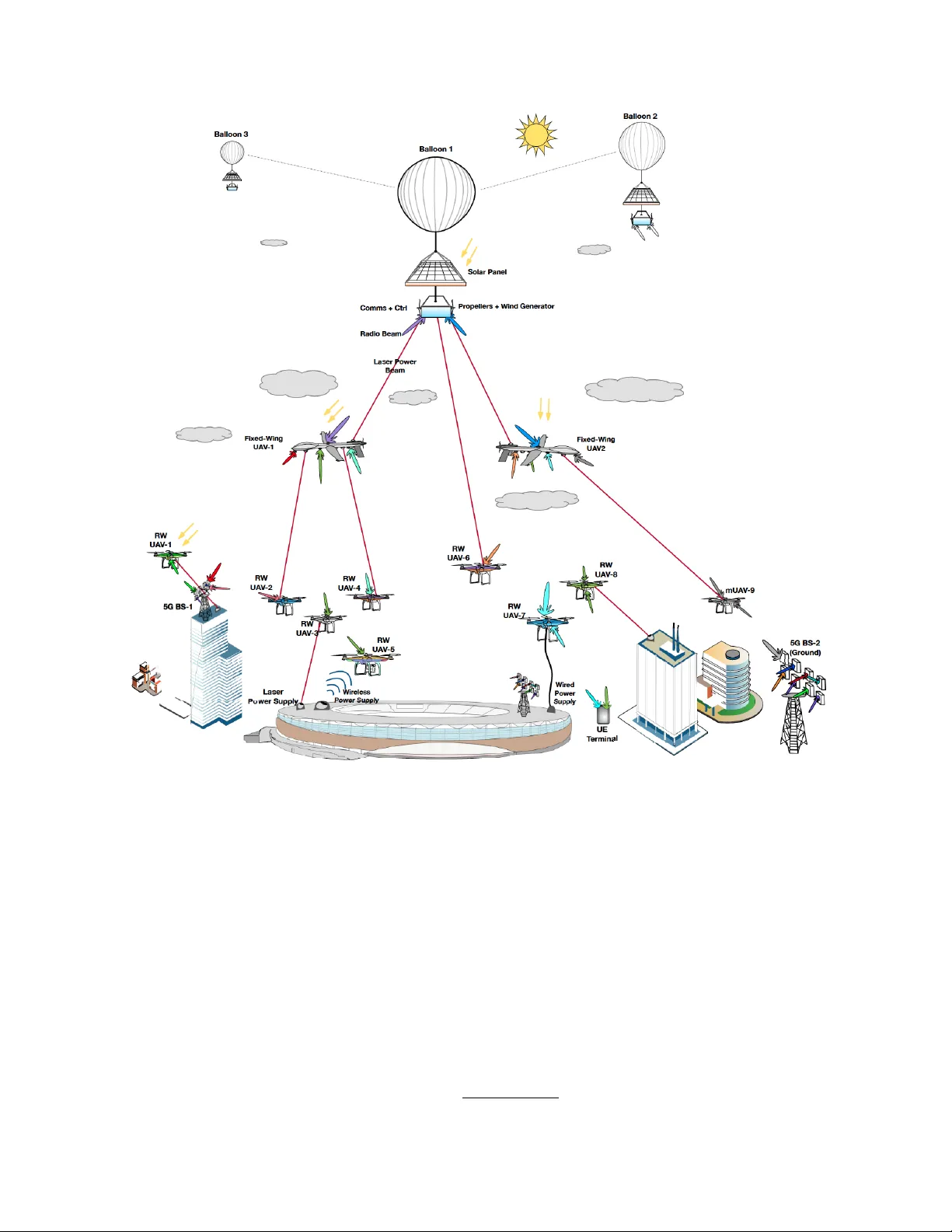
Distrib uted and Multi-layer U A V Network for the Ne xt-generation W ireless Communication Y iming Huo 1 (ymhuo@uvic.ca), Xiaodai Dong 1 (xdong@ece.uvic.ca), T ao Lu 1 (taolu@uvic.ca), W ei Xu 1 , 2 (wxu@seu.edu.cn), Marvin Y uen 3 (marvinyu@usc.edu), 1 Department of Electrical and Computer Engineering Univ ersity of V ictoria, BC V8P 5C2, Canada 2 National Mobile Communications Research Laboratory Southeast Univ ersity , Nanjing 210096, China 3 V iterbi School of Engineering, Univ ersity of Southern California, Los Angeles, California 90089, U.S.A Abstract Unmanned aerial v ehicles (U A Vs) for wireless communications has rapidly grown into a research hotspot as the mass production of high-performance, lo w-cost, intelligent U A Vs become more practical and feasible. In the meantime, fifth generation (5G) wireless communications is being standardized and planned for deployment globally . During this process, U A Vs are gradually being considered as an important part of 5G and expected to play a critical role in enabling more functional diversity for 5G communications. In this article, we conduct an in-depth in vestigation of mainstream U A V designs and state-of-the-art U A V enabled wireless communication systems. W e propose a hierarchical architecture of U A Vs with multi-layer and distributed features to facilitate a smooth integration of different mainstream UA Vs into the next-generation wireless communication networks. Furthermore, we unv eil the critical comprehensive design tradeoffs, in light of both communication and aerodynamic principles. Empirical models and satellite measurement data are used to conduct numerical analysis of the meteorological impacts of U A V enabled, 5G high bands communications. This work has been submitted to the IEEE for possible publication. Copyright may be transferred without notice, after which this version may no longer be accessible. 2 I . I N T RO D U C T I O N In recent years, unmanned aerial vehicles (UA Vs) hav e experienced a rapid transition from the initial military exploitation and a viation industry , to current fast-gro wing civilian applications such as industrial inspection, scientific research, agricultural practice, security surveillance, emer gency rescue, entertainment, etc. In the meantime, the fifth generation (5G) wireless network is being planned for rapid deployment, and many research and industry communities have been seeking div erse paradigms to accelerate this progress and enrich application scenarios. U A V -aided 5G wireless has sparked a large interest as it can facilitate various use cases such as those speculated in the three key principle application scenarios of the International T elecommunication Union (ITU) [1]. They are namely enhanced mobile broadband (eMBB), ultra reliable low latency communications (uRLLC), and massi ve machine type communications (mMTC). For example, U A V can play a critical role in providing network service recov ery in a disaster -stricken re gion, enhancing public safety networks, or handling other emergenc y situations when uRLLC is required. In particular , U A V -assisted eMBB can be considered as an important complement to the 5G cellular network where a 1000 times comprehensiv e performance improv ement ov er 4G is expected. Since July 2016, when the Federal Communication Committee (FCC) adopted a new Upper Microw ave Flexible Use Service 1 , millimeter wa ve (mmW ave) bands for cellular services has become an immediate reality . Ho wever , alongside promising opportunities, e.g., larger bandwidths and faster speed, mmW ave cellular communications face significant challenges, particularly for terrestrial en vironments which experience large propagation loss and shadowing effects. The propagation loss challenge can be overcome by adopting beamforming techniques at the cost of more hardware resources and higher power consumption. Shadowing effects are more dif ficult to cope as they are related to intrinsic microw ave characteristics. Moreov er, mmW a ve channels hold sparse nature with limited channel elements. Deploying UA V -assisted wireless networks can be an effecti ve solution to mitigate this issue as it enables more line-of-sight (LoS) communications. In the near future, U A V -satellite communications [2] can enable more div erse Earth-space communication and hereby make 5G global access more robust and reliable. As en visioned in [3], U A V -aided wireless communications can fall into three representati ve cate gories of use cases, namely UA V -aided ubiquitous cov erage, UA V -aided relaying, and UA V -aided information dissemination and data collection. The former two use cases are most likely applied to 5G base station (BS) offloading and wireless connectivity relaying. Howe ver , there are yet several major hurdles which pre vent incorporating U A Vs into 5G networks quickly and as smoothly as expected. First of all, U A Vs could cause potential safety problems [4]; the Federal A viation Administration (F AA) and many other countries’ civil aviation authorities have regulated specific laws and rules on operating (flying) commercial UA Vs [5] with consideration for the weight, the maximum altitude and speed, the minimum distance from airports, constructions, vehicles, and people, etc. Enormous joint efforts from both policymakers and priv ate industry are needed to achieve safe and efficient integration of UA Vs into airspace and 5G networks. On the other hand, the U A V design is also confronted with v arious technical bottlenecks. One of the most significant challenges lies in limited onboard power . T ake a 3-pound mainstream miniature UA Vs (mini-U A V) for 1 https://apps.fcc.gov/edocs public /attachmatch/FCC-16-89A1.pdf [Accessed: 31-Mar-2018] October 30, 2024 DRAFT 3 example, it is usually equipped with one 1-pound lithium polymer (LiPo) battery that is traditionally known to hold high power density . Although such a battery may contain a total energy of more than 80 watt-hours (Whs), it can barely support a maximum flight time of more than 30 minutes. Adding 5G wireless communication functions into UA Vs will necessitate additional payload and additional po wer-hungry wireless hardware that further limits the operation duration. In addition, adverse weather conditions can pose more serious challenges to U A V operating time and 5G wireless communication quality . In this article, we first present a brief revie w of worldwide research and dev elopment (R&D) progress of U A V - enabled next-generation wireless communications, followed by an in vestigation on sev eral main types of UA Vs and the corresponding 5G application scenarios. Next, we propose a novel design of distributed and multi-layer U A Vs (D AMU) 5G wireless network. W e perform a thorough analysis of technical challenges of D AMU 5G network and feasible solutions for both wireless communication and power transfer . Finally , we present the analysis and modeling of atmospheric attenuation for the D AMU 5G network in typical meteorological conditions. I I . UA V E N A B L E D W I R E L E S S C O M M U N I C A T I O N A N D P O W E R T R A N S F E R W idely recogonized as one of the biggest constraints of U A V -enabled wireless networks is the limited onboard en- ergy . In a so-called 5G enabled UA V system, not only should the cellular communications system be accommodated, but also an extra control and non-payload communication (CNPC) system that should hav e outstanding performance in latency and security [4]. Generally , the aircraft (either fixed-wing or rotary-wing) engine consumes much higher energy than the communication systems of a microcell or picocell. Sev eral solutions have been proposed to enhance the systematic robustness, the flight time, and the energy efficiency of a U A V system. The first type of solution is deriv ed from the wireless system design perspectiv e. In [6], the authors presented algorithms to maximize the number of users by decoupling energy-ef ficient 3D placement of a U A V -BS within the region of interest (RoI). On the other hand, U A V path planning plays a critical role in obtaining a satisfactory energy efficienc y and quality of service (QoS), and the planned paths depend on specific application scenarios. As an example, work in [7] optimized U A Vs flying direction for uplink communications by assuming a constant speed that the UA V maintains. In addition, the U A V trajectory optimization in [8] took into account the propulsion energy consumption of fixed-wing U A Vs. The second type of approach is to directly advance the energy resource technology and improve the energy management. In fact, from the energy density or specific energy (MJ/kg) perspective, both gasoline and jet fuel are at least 20 times higher than the LiPo battery widely used for mini-U A Vs. In spite of the facts that the electric motor generally demonstrates much higher ef ficiency and speed adjustment capability than the petrol engines, the energy density gap cannot be filled up easily . As predicted, petrol engines or hybrid-electric engines should play a critical role in future U A Vs used in 5G communications to achiev e longer flight duration. New energy systems and energy harvesting techniques could further accelerate the pace of implementing 5G- oriented UA V networks. For example, [9] presents a solar power management system (SPMS) for aircraft and U A V applications, with a maximum power tracking system (MPTS) to increase the operating efficienc y of solar cells. Moreov er, some other techniques for addressing energy transfer and storage challenges, such as wireless power October 30, 2024 DRAFT 4 transfer (WPT) and laser power beam techniques (dev eloped and first demonstrated by Powerlight T echnologies 2 ) can be also integrated to possibly co-enable 24-hour flight working without landing or refueling. The authors in [10] have proposed a throughput maximization scheme for balancing tradeoffs between laser energy harvesting and wireless communication performance. T ABLE I C O MPA R IS O N O F T H R E E C A T E GO R I E S O F M A I NS T R E AM UA V S T echnology Height(km) Speed Mobility and hovering Energy resource (primary first) Endurance Maximum payload(kg) 4 Balloon 1 Usually stays at the Stratosphere layer , > 20 km Slow Low mobility , hovering supported Solar cells, LiPo, petrol Longest, from weeks to indefinite Large 5 , > 1000 kg Fixed-wing U A V Sea le vel- 16 km Fast (horizontally), medium (vertically) Medium mobility , hovering not supported, minimum speed needs to be maintained Petrol, solar cells, LiPo Medium, from half day to days, or weeks 3 Medium, < 1000 kg Rotary-wing U A V Sea le vel- 6 km Medium (horizontally), fast (vertically) Highest mobility 2 , hovering supported LiPo, petrol, solar cells Low , less than 1 hour on LiPo battery . Low , < 100 kg 1 Can be Helium balloon, or Hydrogen balloon 2 Electric motor facilitates highest mobility 3 Solar po wered fixed-wing U A Vs can fly very long distance for weeks without landing 4 The maximum payload weight is for general scenarios, and it may vary in terms of specific UA V designs 5 Depends on balloon size, the altitude, temperature, wind speed, and atmospheric pressure I I I . W H E N A E R O DY NA M I C S M E E T S 5 G C O M M U N I C A T I O N S At this section, we conduct in v estigation of UA Vs communications from the aerodynamics perspectiv e. As depicted in Fig. 1, in terms of the aerodynamics characteristics, there are three mainstream categories of U A Vs: balloon, fixed-wing, and rotary-wing. A further comparison of these U A Vs is summarized in T able I. Among them, balloons have been widely used for greater than 10 km, high altitude platforms (HAPs) and ev en ultra-high altitude (UHA) applications. For example, N ASA ’ s scientific balloons inflated with helium can lift heavy instruments (hundreds of kilograms) and stay at a height over 30 km for very long durations (intended for 100 days or longer). On the other hand, Google’ s Project Loon 3 has successfully enabled a balloon network ov er 20 km high, extending the internet connectivity in rural and remote areas worldwide. In October 2017, Project Loon provided emergency long-term ev olution (L TE) service recovery to Puerto Rico in the aftermath of Hurricane Maria. W ith solar panels and advanced predictive models of the winds and other metrological information from National Oceanographic and Atmospheric Administration (NO AA), the balloons can be navigated and deployed as requested. Furthermore, a balloon-U A V can facilitate quasi-stationary communications with propellers adjusting balance and position. The second type of UA V is the fixed-wing UA V (FW -U A V); the most famous and successful example is General Atomics MQ-1 Predator first introduced in 1995. Normally , a FW -U A V can achiev e a very wide range of altitude 2 https://powerlighttech.com/ [Accessed: 31-Mar-2018] 3 https://x.company/loon/ [Accessed: 31-Mar-2018] October 30, 2024 DRAFT 5 (a) (b) (c) Fig. 1. Three main categories of U A Vs: (a) Balloon (b) Fixed-wing and (c) Rotary-wing (quadcopter). with the fastest horizontal speed due to powerful turbine engines. The maximum payload weight depends on the lift force that can be calculated using the follo wing formula [11]: L = C L × ρ × V 2 × A 2 (1) where L is the lift force which must equal the airplane’ s weight in pounds; C L is the coef ficient of lift, which is determined by the airfoil type and angle of attack (A OA); ρ is the air density and its specific value can be checked from the atmospheric model of the International Standard Atmosphere (ISA); V stands for the velocity of the airfoil; and A is the surface area. Therefore, the lift force is proportional to the wing area for the fixed-wing aircraft. T ake a medium-sized FW -U A V (with 11 m 2 effecti ve wing area) for instance, when flying with an A OA of 15 degrees, at 5 km high and 50 m/s (180 km/h), it can generate a lift force of 11800 Newtons or 1200 kg. Howe ver , if used for future 5G, a FW -U A V has to maintain a minimum speed to carry the weight of both equipment and U A V itself. On the other hand, no matter whether for functioning as a 5G aerial BS or relay , it is desirable for a FW -U A V to fly as slow as possible to minimize the Doppler effect and av oid complicating channel modeling and system design. Moreov er, hybrid-electric engines and solar panels can further improve the energy efficienc y and flight time to enable cost-effecti ve U A V enabled 5G services. The solar -powered aircraft, Solar Impulse, is b uilt with electric motors, lithium-ion (Li-ion) batteries and solar panels, and can realize very long-duration flights (118 hours) without landing. The third type of UA V is known as the rotary-wing U A V (R W -U A V) and has been popularly deployed in the consumer grade U A V market, particularly as a LiPo battery po wered quadcopter as depicted in Fig.1(c). Such a R W - U A V can achieve very high aerodynamic flexibility and mobility with reliable hov ering capability . In the U A V -based deliv ery system developed by Amazon Prime Air 4 , R W -U A V with multiple propellers is demonstrated. Howe ver , the battery significantly limits its flight time and payload, consequently , the petrol engine based R W -U A V equipped 4 https://www .amazon.com/Amazon-Prime-Air/b?ie=UTF8&node=8037720011 [Accessed: 31-Mar-2018] October 30, 2024 DRAFT 6 with 6 or 8 propellers for industrial applications are de veloped for longer flight times (generally 3-5 times), better balance, and carrying greater payload. Nev ertheless, the overall energy efficiency of R W -U A V is much lower than FW -U A V and balloon-U A V . Its application for 5G is duration and weight constrained due to the limited on-board energy until there is an ef fective solution to solve the energy puzzle. Besides the three major categories of U A Vs, there are some hybrid aircraft designs, e.g., Bell Boeing V -22 Osprey , which take advantage of the virtues of all categories to achie ve better design tradeof fs. I V . D I S T R I B U T E D A N D M U LT I - L A Y E R UA V N E T W O R K I N G From the abo ve in v estigation, a balloon-U A V may be the most suitable aircraft for carrying heavy 5G infrastructure equipment and hovering ov er the sky with the longest duration. Considering the significant height and cov erage (with a radius more than 20 km) it can achie ve, an energy-ef fectiv e balloon-UA V can serve as a 5G powerful macrocell base station that could weigh up to hundreds of kilograms. On the other hand, a FW -U A V may carry a 5G macrocell/microcell and fly within a fle xible altitude below 10 km. Moreov er , a R W -U A V is more ideal for installing lightweight 5G equipment (such as a picocell) and executing limited duration tasks that require fast deployment. Based on the characteristics of different U A Vs, we propose a distributed and multi-layer U A V (DAMU) network architecture as depicted in Fig. 2. 1) The balloon-U A V functions as a quasi-stationary cellular tower and generally stays at the stratosphere layer, most likely abov e 20 km. In theory , the balloon can be recycled and relaunched before or after a re gular maintenance. 2) The fixed-wing UA Vs are generally deployed belo w 10 km and above 1 km. In order to minimize the Doppler shift and the associated system design challenges, FW -U A Vs need to cruise at the slowest speed possible. 3) The rotary-wing U A Vs are normally dispatched below 1 km, serving as microcell/picocell base stations. Low cruise altitudes can enable R W -UA Vs to be frequently and quickly recharged or replenished. V . D A M U W I R E L E S S C O M M U N I C A T I O N S A N D P OW E R T R A N S F E R Based on the D AMU network architecture, a comprehensi ve solution for 5G wireless communications and power transfer heterogeneous networks is hereby proposed and depicted in Fig. 3. 1) The solar-powered balloon-UA Vs are equipped with solar panels, batteries, and wind generators to realize a self sustaining energy system. Staying at stratosphere layer facilitates efficient solar energy harvesting as no weather occurs. 5G macrocell communications and CNPC systems are integrated and enabled in the ballon-U A Vs. The balloons provide both 5G new radio (NR) facility and backwards compatibility to legac y 3GPP standards; in addition, the balloons communicate with other aerial or ground base stations, as well as ground terminals. In a typical line-of-sight (LoS) communication scenario for 5G mmW a ve bands, Balloon 1 operates its phased arrays to form multiple beams to align with the beams from FW -U A V -1 and FW -U A V -2, respectiv ely . 2) Fixed-wing U A Vs serve as either a macrocell or a microcell. In a representati ve 5G usage scenario, a FW -U A V may communicate with both a balloon-UA V macrocell and multiple R W -U A Vs based picocells. As depicted October 30, 2024 DRAFT 7 Balloon-UA V layer Fixed-wing UA Vs layer Rotary-wing UA Vs layer 80 pt 20 KM 1 KM 10 KM Stratosphere T roposphere* T roposphere * T roposphere depths depend on the latitude. In tr opics, the depths are 20 km; In the mid latitudes, they are 17 km; In polar r egions during winter , they ar e 7 km. Macrocell Macrocell / Microcell Microcell / Picocell Fig. 2. Distributed and multi-layer U A Vs (D AMU) network architecture. in Fig. 3, R W -U A V -5 is liv e-streaming a sport event over the stadium and uploading the ultra-high resolution (UHD) video to R W -UA V -3 that further communicates with FW -U A V -1 using beamforming. A FW -U A V can generate multiple mmW a ve beams to increase spatial multiplexing gain and channe capacity , and mitigate the inteference as well, by adopting a distributed phased array MIMO (DP A-MIMO) reconfigruable architecture in [12]. 3) Rotary-wing U A Vs are dispatched and deployed mainly for microcell/picocell applications below an altitude of 1 km. They can enable fast 5G access and services whenev er or wherever there is such a need. A R W -U A V can be connected to either aerial/ground base stations or aerial/ground user terminals. 4) Under specific conditions, each layer of UA Vs should be able to work independently to sustain a full-function 5G network when other layers of U A Vs are not av ailable. 5) When a FW -U A V based aerial BS enables 5G communications, its velocity should be well maintained at the October 30, 2024 DRAFT 8 Fig. 3. W ireless communications and power transfer in a DAMU enabled 5G wireless communication and power transfer network. lowest possible speed, and its flight path needs to be well planned. Assume that a FW -U A V is needed to provide 5G service coverage for some area of interest with a radius of 2 km, we need to dispatch it to fly at least 2 km high. In order to build a reliable and easy-approaching communication tunnel, we first program the FW -U A V fly with a (pre-defined) specific pattern that is known and easy to follo w by other aerial/ground BSs and terminals, at its minimum speed. Moreover , this pattern needs to enable good energy efficienc y from aerodynamics perspective. For example, the cruising path can be a simple circle with a small radius of turn which can be calculated as [11] R = V 2 11 . 26 × tan( θ ) (2) October 30, 2024 DRAFT 9 FW-UAV h B h F α β d B R O O B Balloon-UAV (quasi-stationary) RW-UAV (quasi-stationary) α Fig. 4. FW -U A V circular cruising mode in a D AMU system. where R is in the unit of feet, V is the velocity in the unit of knot, and θ is the bank angle. According to emerging medium-sized FW -U A V ( > 100 kg of extra payload) designs, a minimum velocity can be maintained at 10 m/s (19.4 knot) at the sea le vel. Demonstrating circular cruising as depicted in Fig. 4, we assume the FW -U A V flies 2 km high with a speed of 20 m/s (38.8 knot). If the bank angle is 30 ◦ , the radius of turn, R , is calculated to be 232.4 feet or 70.8 meters. Furthermore, assume a balloon-UA V that hovers 20 km high is 5 km horizontally aw ay from the center of circle, while a quasi-stationary R W -U A V is precisely 1.9 km v ertically beneath the center of circle, or 100 m abov e the ground level. α and β are calculated to be 0.42 ◦ and 2.13 ◦ , respectively . In other words, the proposed circular cruising can conditionally minimize the spatial angle. This scheme leads to sev eral benefits; first, pre-defined cruise path mitigates the localization; second, the challenges of mmW ave October 30, 2024 DRAFT 10 beamforming, beam tracking, and beam alignment are significantly mitigated, between FW -U A V and other BSs or terminals. 6) In order to enable longer flight time, FW -U A Vs and R W -U A Vs may adopt solar energy harvesting and laser power transfer strategies. As depicted in Fig. 3, high power is beamed to FW -U A V -1 and FW -U A V -2 from Balloon 1 which may have harvested and accumulated significant solar energy . It is en visioned that the laser beam power transfer technique can address emergent airborne recharging requests for the 5G aerial base stations. Howe ver , one of the prominent challenges of laser power transfer stems from the atmospheric losses that depend on the visibility and weather conditions. T ak e 1550 nm laser for instance, during a clear day with 23 km visibility , the loss is only 0.2 dB/km, whereas the loss will be up to 4 dB/km when encountering haze weather [13]. Moreov er, a heavy fog with 0.05 km visibility can result in a loss as large as 272 dB/km. Subsequently , using laser power transfer is, to a large extent, weather and distance dependent. Additionally , laser safety is another major concern of the D AMU network design since the laser power can be up to hundreds of watts. Machine-learning aided computer vision and sensor techniques, as well as distributed laser beam charging may help achiev e safe laser energy harvesting. 7) Some other alternativ e power supply methods are also critical complements of a D AMU network. F or example, as shown in Fig. 3, R W -U A V -5 is charged through conv entional microw ave when it is not far apart from the charger . Alternati vely , R W -U A V -3 is wired through a power cable to a power source, and the cable length can be more than 100 meters according to experimental practice. V I . UA V C O M M U N I C A T I O N S A N D M E T E O RO L O G I C A L C O N D I T I O N S For U A V communications, air-to-ground (A2G) channel characteristics are significantly different from terrestrial ones. In order of blockage, there are mainly three classes of links; namely line-of-sight (LoS), obstructed line-of- sight (OLoS), and non-line-of-sight (NLoS). In A2G communications, the probability of occurrence (LoS or NLoS) is a function of environments and the channel modeling has been thoroughly re viewed in [14]. In our proposed D AMU network, air-to-air (A2A) communications among dif ferent layers and U A Vs abo ve ground level are the application scenarios of interest. As previously discussed, weather conditions play a critical role in D AMU 5G networks by having apparent impact on wireless communications, power transfer , and UA V working status. It should be noted that global weather and climate patterns are dramatically div erse. Therefore, in this section, we focus on A2A attenuation modeling for frequency below 100 GHz with weather factors taken into account. First, atmospheric humidity largely af fects gaseous attenuation, particularly at mmW a ve bands and abov e. The quantitativ e analysis of gaseous attenuation ov er frequency as a variable of water v apor density , is given in prediction models recommended by ITU [15]. Generally , gaseous attenuation due to water v apor increases over frequency . At sea lev el and under standard atmosphere (7.5 g/m 3 water vapor density), the total gaseous attenuation (dry air plus water vapor) grows to more than 1 dB/km from 53 to 67 GHz and sharply peaks at 15 dB/km for 61 GHz. This is attributed, to a large extent, by oxygen absorption. October 30, 2024 DRAFT 11 From the meteorological perspectiv e, precipitation can be in the forms of drizzle, rain, sleet, sno w , and hail. According to ITU rain attenuation models, heavy rainfall can cause significant attenuation at 5G mmW ave bands. When the weather gets cloudy and foggy , there are two methodologies to calculate attenuation [15]. The first one is to obtain the specific attenuation (dB/km) within a cloud or fog, which can be written as γ c = K l M (3) where K l is the specific attenuation coefficient ((dB/km)/(g/m 3 )), and it is a function about frequency and dielectric permittivity of water; M is the liquid water density (L WD) in cloud or fog (g/m 3 ). For medium and thick fog, the L WD is around 0.05 g/m 3 and 0.5 g/m 3 , respecti vely [16]. Additionally , advection fog can be vertically thick more than 2 km above ground lev el. Furthermore, the second methodology is to calculate attenuation due to clouds for a given probability . This attenuation is correlated with the statistics of the total columnar content of cloud liquid water L (kg/m 2 ) for a giv en geographic location, and it is expressed as A = LK l sin( θ ) (4) where K l is the specific attenuation coefficient, and θ is the elev ation angle within a range from 5 to 90 degrees. The value L can be checked from map based data files [15]. For example in some regions of Southeast Asia, L can be as high as 2 for a yearly exceedance probability of 1%. Howe ver , the second method is not able to directly estimate the worst-case A2A communications scenarios, especially before heavy rainfall. Out of many forms and types of clouds in the Earths atmosphere, cumulonimbus clouds are a dense, to wering vertical clouds that can be very tall and thick with the highest L WD. According to cloud thickness estimation from GOES-8 satellite data [16], precipitating cumulus clouds (precursor of cumulonimbus cloud) hav e a mean thickness of 9.32 km. Using these variables, we can plot the atmospheric attenuation over frequency , with v arious meteorological conditions introduced. Assuming the elev ation angle between a balloon-UA V (at 20 km) and FW -U A V (hovering at 1 km) is 90 degrees, a LoS channel normally exists during a clear day . As depicted in Fig. 5, if a very thick cumulonimbus cloud with high L WD (12 km, 3 g/m 3 ) exists, it causes the highest attenuation for frequencies o ver 40 GHz. Moreov er , if a 2 km v ertically thick advection fog emerges, the resulting attenuation is 0.68 and 1.28 dB at 28 GHz and 40 GHz, respectively . If the precipitation happens, the attenuation caused by medium rain, heavy rain, and violent rain dramatically v aries. F or example, a violent rain (100 mm/hour) can result in a 38.3 dB attenuation at 40 GHz, compared to a 3.4 dB attenuation caused by medium rain. Therefore, a dense cumulonimbus cloud before or during precipitation will lead to the most significant attenuation. The effects of weather should be carefully and thoroughly considered with other types of propagation loss when conducting the D AMU 5G network design and link budget calculation. October 30, 2024 DRAFT 12 Fig. 5. Attenuation due to typical meteorological conditions for 5G high frequency bands. V I I . C O N C L U S I O N U A V enabled 5G communications is promising to become an immediate reality bringing both opportunities and challenges. In this article, in vestigations were first conducted of the most recent R&D progress of U A Vs and UA V - enabled wireless communication technologies. Facts were un veiled that the design challenges of UA V enabled 5G communications are more pressing than terrestrial 5G communications. This is mainly because a U A V enabled 5G system necessitates more comprehensi ve system designs by considering sev eral major critical factors, namely wireless communication system, aerodynamic constraints, and meteorological variables. Next, a novel distrib uted and multi-layer U A Vs (D AMU) networking architecture was presented for 5G wireless communication and beyond. The D AMU networking architecture is hierarchical, flexible, and can be reconfigured in terms of specific deployment and application scenarios. In addition, we hav e taken into account se veral key technical enablers such as the practical aerodynamic design rules for dif ferent types of U A V designs, energy harvesting techniques, and po wer transfer techniques. Furthermore, we have conducted numerical analysis of the attenuation introduced by typical meteorological conditions to giv e the guidelines for an overall link budget calculation and system robustness design analysis. R E F E R E N C E S [1] Rec. ITU-R M.2083-0, “IMT V ision - Framework and overall objectives of the future development of IMT for 2020 and beyond, ” Sep. 2015. [2] J. Zhao, F . Gao, Q. W u, S. Jin, Y . W u, and W . Jia, “Beam tracking for U A V mounted SatCom on-the-move with massive antenna array , ” IEEE J . Sel. Areas Commun. , vol. 36, no. 2, pp. 363–375, Feb. 2018. October 30, 2024 DRAFT 13 [3] Y . Zeng, R. Zhang, and T . J. Lim, “W ireless communications with unmanned aerial vehicles: Opportunities and challenges, ” IEEE Commun. Mag. , vol. 52, no. 2, pp. 122–130, Feb. 2014. [4] S. F . Y unas, M. V alkama and J. Niemela, “Spectral and energy efficienc y of ultra-dense networks under different deployment strategies, ” IEEE Commun. Mag. , V ol. 53, V ol. 1, pp. 90–100, Jan. 2015. [5] Federal A viation Administration, “Unmanned aircraft systems, ” [Online]. A vailable: https://www .faa.gov/uas/ [6] M. Alzenad, A. El-keyi, F . Lagum, and H. Y anikomeroglu, “3D placement of an unmanned aerial vehicle base station (UA V -BS) for energy-ef ficient maximal coverage, ” IEEE W ireless Commun. Lett. , vol. 6, no. 4, pp. 434–437, Aug. 2017. [7] F . Jiang and A. L. Swindlehurst, “Optimization of UA V heading for the ground-to-air uplink, ” IEEE J. Sel. Areas Commun. , vol. 30, no. 5, pp. 993–1005, Jun. 2012. [8] Y . Zeng and R. Zhang, “Energy-ef ficient U A V communication with trajectory optimization, ” IEEE T rans. W ireless Commun. , vol. 16, no. 6, pp. 3747–3760, Jun. 2017. [9] J. K. Shiau, D. M. Ma, P . Y . Y ang, G. F . W ang, and J. H. Gong, “Design of a solar power management system for an experimental UA V , ” IEEE T rans. Aerosp. Electr on. Syst. , vol. 45, no. 4, pp. 1350–1360, Oct. 2009. [10] J. Ouyang, Y . Che, J. Xu, and K. Wu, “Throughput maximization for laser-po wered UA V wireless communication systems, ” to appear in IEEE ICC 2018 , [Online]. A vailable: https://arxiv .or g/abs/1803.00690 [11] Federal A viation Administration, “Pilot’ s handbook of aeronautical knowledge: F AA-H-8083-25B, ” Ne wcastle, W A, USA: A viation Supplies and Academics, Inc., 2016. [12] Y . Huo, X. Dong, and W . Xu, “5G Cellular User Equipment: From Theory to Practical Hardware Design, ” IEEE Access , vol. 5, pp. 13992–14010, 2017. [13] I. I. Kim, B. McArthur, and E. Kore vaar , “Comparison of laser beam propagation at 785 nm and 1550 nm in fog and haze for optical wireless communications, ” in Pr oc. SPIE, Opt. W ir eless Commun. III , Boston, MA, USA, Nov . 2001, vol. 4214, pp. 26–37. [14] M. Mozaffari, W . Saad, M. Bennis, Y .-H. Nam, and M. Debbah, “ A tutorial on U A Vs for wireless networks: Applications, challenges, and open problems, ” [Online]. A vailable: https://arxiv .or g/abs/1803.00680 [15] Recommendation ITU–R P .840-7, “ Attenuation due to clouds and fog, ” 2017. [16] V . Chakrapani, D. R. Doelling, A. D. Rapp, and P . Minnis, “Cloud thickness estimation from GOES-8 satellite data over the ARM-SGP site, ” in Proc. 12th ARM Science T eam Meeting , St. Petersburg, FL, U.S.A., Apr . 2002, pp. 1–7. October 30, 2024 DRAFT
Original Paper
Loading high-quality paper...
Comments & Academic Discussion
Loading comments...
Leave a Comment