Structural focalization
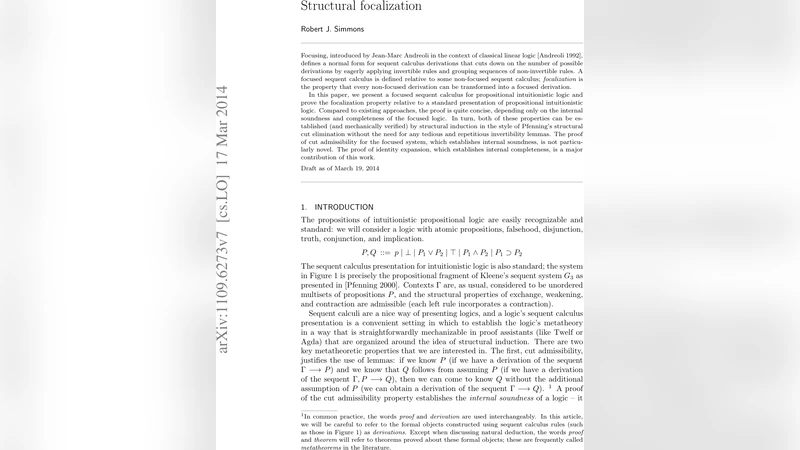
Focusing, introduced by Jean-Marc Andreoli in the context of classical linear logic, defines a normal form for sequent calculus derivations that cuts down on the number of possible derivations by eagerly applying invertible rules and grouping sequences of non-invertible rules. A focused sequent calculus is defined relative to some non-focused sequent calculus; focalization is the property that every non-focused derivation can be transformed into a focused derivation. In this paper, we present a focused sequent calculus for propositional intuitionistic logic and prove the focalization property relative to a standard presentation of propositional intuitionistic logic. Compared to existing approaches, the proof is quite concise, depending only on the internal soundness and completeness of the focused logic. In turn, both of these properties can be established (and mechanically verified) by structural induction in the style of Pfenning’s structural cut elimination without the need for any tedious and repetitious invertibility lemmas. The proof of cut admissibility for the focused system, which establishes internal soundness, is not particularly novel. The proof of identity expansion, which establishes internal completeness, is a major contribution of this work.
💡 Research Summary
The paper presents a focused sequent calculus for propositional intuitionistic logic and establishes the focalization property—that every unfocused derivation can be transformed into a focused one—through a concise and mechanically verifiable proof. The authors begin by recalling the standard unfocused sequent calculus (Kleene’s G3 fragment) and motivate the need for focusing: unfocused proofs admit many syntactically different derivations of the same formula, which creates unnecessary branching points for proof search.
To obtain a disciplined proof search, the paper adopts the polarity discipline introduced by Andreoli and later refined by Girard. Each logical connective is classified as either synchronous (positive) or asynchronous (negative) based on its outermost connective. The authors make this classification explicit by polarizing formulas: a formula is annotated with a polarity tag (+ for positive, – for negative) and may be wrapped with up‑shift (↑) or down‑shift (↓) operators that embed positive formulas into negative contexts and vice‑versa. This polarized syntax makes the polarity of a formula syntactically visible and determines which rules are invertible.
The focused calculus is organized into two alternating phases. In an inversion phase all invertible rules are applied eagerly: right‑rules for asynchronous connectives and left‑rules for synchronous ones. When no further invertible rule applies, the system enters a focus phase by selecting a single formula to be in focus. While a formula is in focus, only non‑invertible rules are applied to it (right‑rules for synchronous connectives, left‑rules for asynchronous ones). Once the focused formula is fully decomposed, the system returns to an inversion phase. This alternation yields a normal form for proofs and dramatically reduces the search space.
The core metatheoretic results are three theorems.
-
Cut admissibility (Theorem 2, Section 3). The authors prove that the cut rule is admissible in the focused system. The proof follows the classic structural cut‑elimination style but, thanks to polarization, it does not require a plethora of auxiliary invertibility lemmas. Instead, a uniform “cut‑propagation” argument is given, and the propagation respects polarity, allowing a simple structural induction on the shape of formulas.
-
Identity expansion (Theorem 3, Section 4). This is a novel generalization of the usual identity theorem. It shows that for any polarized formula A⁺, the sequent Γ, A⁺ ⊢ A⁺ is derivable even when A⁺ is “suspended” (i.e., placed in a context without being immediately focused). The proof proceeds by structural induction on A⁺, providing explicit η‑expansion‑like rules for each connective. This theorem supplies the internal completeness of the focused calculus.
-
Focalization (Theorem 4, Section 5). By composing the cut admissibility and identity expansion results, the authors obtain the focalization property: every unfocused derivation can be reorganized into a sequence of inversion‑focus‑inversion phases, yielding a focused derivation of the same sequent. Crucially, the proof avoids the traditional “invertibility‑lemma explosion” that plagues earlier focalization proofs for linear and intuitionistic logics.
All four theorems (including the soundness of the unfocused system, which is proved but omitted from the main dependency graph) are mechanized in both Twelf and Agda. The mechanization is linear in the number of connectives: each connective contributes a constant‑size set of propagation and expansion rules, unlike earlier approaches where the number of auxiliary lemmas grew quadratically.
The paper also discusses the relationship with the LJF calculus of Liang and Miller. While LJF is essentially equivalent, LJF leaves the order of applying invertible rules nondeterministic, which forces focalization proofs to reason about all permutations of those rules. The present system fixes a deterministic order for the inversion phase, simplifying the metatheory.
In the related‑work section, the authors compare their approach to Andreoli’s original focusing, Chaudhuri’s cut‑plus‑identity method for linear logic, and the natural‑deduction‑to‑focused‑proof isomorphisms of Cervesato and Pfenning. They argue that their contribution lies in (i) a clean polarized presentation of intuitionistic logic, (ii) a proof of internal soundness and completeness that relies only on structural induction, (iii) a mechanizable development, and (iv) a reduction of proof‑search overhead by fixing the inversion order.
In summary, the paper delivers a compact, mechanically verified focalization proof for propositional intuitionistic logic. By leveraging polarity, introducing identity expansion, and avoiding tedious invertibility lemmas, it provides a practical foundation for implementing focused proof search in proof assistants and for extending the technique to other substructural logics.
Comments & Academic Discussion
Loading comments...
Leave a Comment