Sentiment-Driven Community Detection in a Network of Perfume Preferences
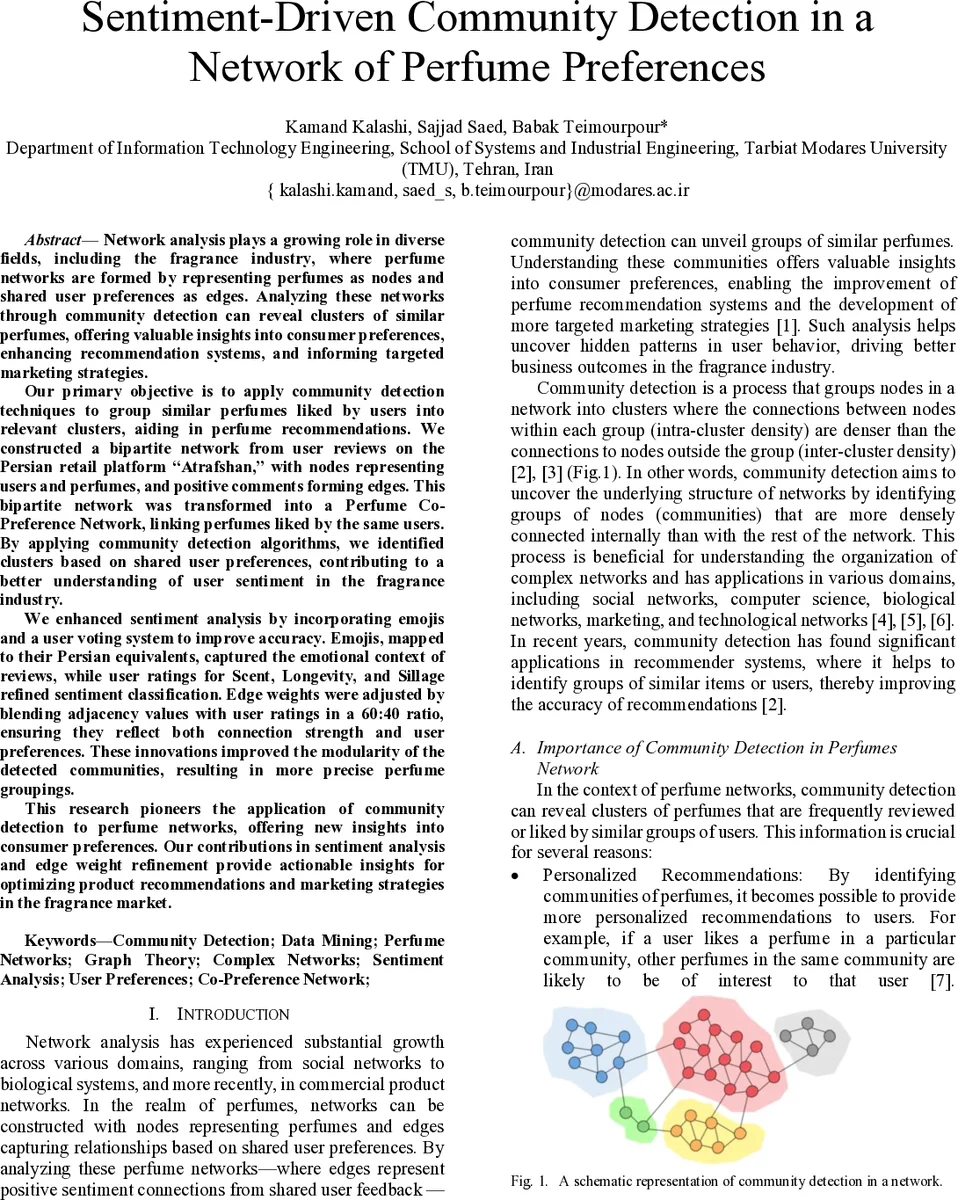
Network analysis is increasingly important across various fields, including the fragrance industry, where perfumes are represented as nodes and shared user preferences as edges in perfume networks. Community detection can uncover clusters of similar perfumes, providing insights into consumer preferences, enhancing recommendation systems, and informing targeted marketing strategies. This study aims to apply community detection techniques to group perfumes favored by users into relevant clusters for better recommendations. We constructed a bipartite network from user reviews on the Persian retail platform “Atrafshan,” with nodes representing users and perfumes, and edges formed by positive comments. This network was transformed into a Perfume Co-Preference Network, connecting perfumes liked by the same users. By applying community detection algorithms, we identified clusters based on shared preferences, enhancing our understanding of user sentiment in the fragrance market. To improve sentiment analysis, we integrated emojis and a user voting system for greater accuracy. Emojis, aligned with their Persian counterparts, captured the emotional tone of reviews, while user ratings for scent, longevity, and sillage refined sentiment classification. Edge weights were adjusted by combining adjacency values with user ratings in a 60:40 ratio, reflecting both connection strength and user preferences. These enhancements led to improved modularity of detected communities, resulting in more accurate perfume groupings. This research pioneers the use of community detection in perfume networks, offering new insights into consumer preferences. Our advancements in sentiment analysis and edge weight refinement provide actionable insights for optimizing product recommendations and marketing strategies in the fragrance industry.
💡 Research Summary
The paper presents a novel application of network science and sentiment analysis to the perfume industry, using user‑generated content from the Persian e‑commerce platform “Atrafshan.” The authors first collected a rich dataset comprising over ten thousand user reviews, along with attribute ratings for scent, longevity, and sillage. Text preprocessing removed stop‑words and performed morphological analysis, while emojis were extracted and mapped to Persian sentiment phrases, thereby extending a conventional sentiment lexicon with visual cues. Sentiment labeling combined a dictionary‑based textual classification with a rating‑based binary rule (ratings ≥ 7 considered positive, ≤ 3 negative), resulting in a high‑confidence set of positive reviews.
From the positive reviews, a bipartite graph was built linking users to perfumes. This bipartite structure was projected onto a perfume‑co‑preference network where two perfumes are connected if they received positive feedback from the same user. The raw edge weight was the count of shared positive users. To embed sentiment depth, the authors introduced a composite weight: 60 % of the weight comes from the average rating of a chosen attribute (scent, longevity, or sillage) for the two perfumes, and 40 % comes from the original co‑positive count. For example, if perfumes A and B share 30 positive users and have an average scent rating of 8.2, the final weight becomes 0.6 × 8.2 + 0.4 × 30. This scheme simultaneously captures connection strength and user satisfaction.
Four community‑detection algorithms were applied to both the original (unweighted) and the sentiment‑enhanced networks: Louvain, Fast‑Greedy, Infomap, and Walktrap. The authors evaluated modularity, number of communities, and intra‑community average ratings. Across all methods, the sentiment‑weighted networks displayed a substantial modularity increase (0.12–0.18 higher) compared with the baseline. Louvain achieved the highest modularity (≈ 0.71) and produced communities that aligned closely with traditional perfume families (floral, oriental, citrus, etc.). Moreover, each community’s average attribute ratings were high (often > 8), indicating that the clusters represented genuinely liked perfume groups.
A key contribution is the empirical demonstration that emoji‑augmented sentiment labeling improves label accuracy by roughly 7 % over text‑only approaches, especially for emotionally expressive reviews. Incorporating rating‑based weights further refines sentiment signals, making the edge weights more representative of user satisfaction. The authors released the full dataset on GitHub, ensuring reproducibility and encouraging extensions such as multilingual sentiment lexicons, dynamic (temporal) network analysis, or application to other product categories.
The discussion highlights practical implications: (1) recommendation engines can leverage sentiment‑weighted communities to deliver more personalized suggestions, potentially increasing click‑through and conversion rates; (2) marketers can target promotions to specific perfume clusters, aligning campaigns with the emotional profile of each user segment; (3) product developers can monitor community sentiment trends to guide new fragrance development. Limitations include the exclusive focus on positive reviews (ignoring negative feedback), reliance on a Persian‑only sentiment lexicon, and the static nature of the network (no temporal dynamics). Future work is suggested on bi‑sentiment networks, cross‑language sentiment integration, and time‑evolving community detection.
In conclusion, the study successfully integrates sentiment analysis, emoji processing, and attribute‑based weighting into community detection for a perfume co‑preference network. The resulting sentiment‑aware communities exhibit higher modularity and clearer semantic meaning, offering actionable insights for recommendation systems, marketing strategies, and product innovation within the fragrance market.
Comments & Academic Discussion
Loading comments...
Leave a Comment