An Influence Network Model to Study Discrepancies in Expressed and Private Opinions
In many social situations, a discrepancy arises between an individual's private and expressed opinions on a given topic. Motivated by Solomon Asch's seminal experiments on social conformity and other related socio-psychological works, we propose a no…
Authors: Mengbin Ye, Yuzhen Qin, Alain Govaert
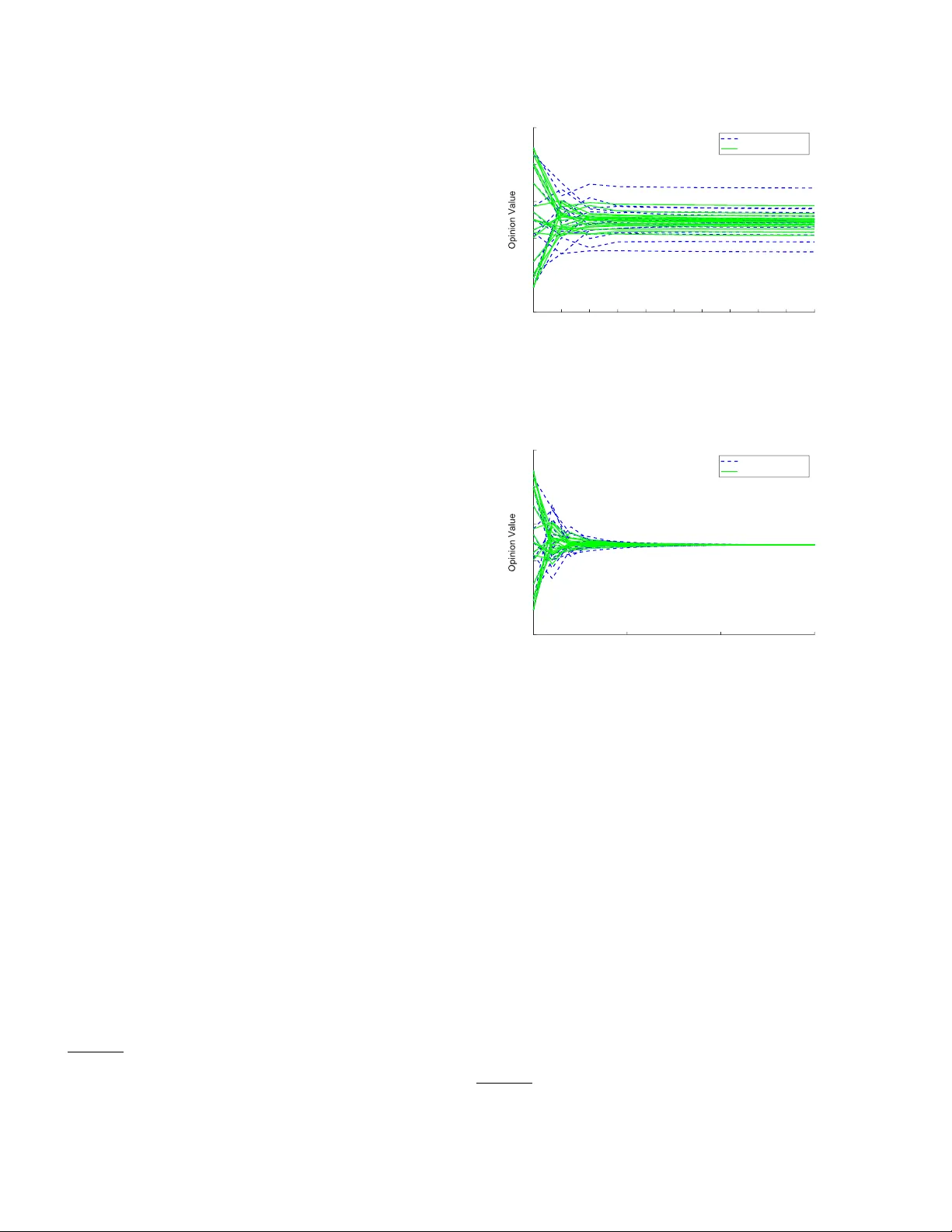
An Influence Net w ork Mo del to Study Discrepancies in Expressed and Priv ate Opinions ? Mengbin Y e a , Y uzhen Qin b , Alain Go v aert b , Brian D.O. Anderson a , c , d , Ming Cao b a R ese ar ch School of Engine ering, the Austr alian National University, Canb err a, A.C.T. 2601, Austr alia b F aculty of Mathematics and Natur al Scienc es, University of Gr oningen, The Netherlands c Scho ol of Automation, Hangzhou Dianzi University, Hangzhou 310018, China d Data61-CSIRO, Canb err a, A.C.T. 2601, Austr alia Abstract In man y so cial situations, a discrepancy arises b et w een an individual’s priv ate and expressed opinions on a given topic. Motiv ated by Solomon Asch’s seminal exp eriments on so cial conformit y and other related so cio-psychological works, w e prop ose a nov el opinion dynamics mo del to study how such a discrepancy can arise in general so cial netw orks of interpersonal influence. Each individual in the netw ork has both a private and an expr esse d opinion : an individual’s priv ate opinion evolv es under so cial influence from the expressed opinions of the individual’s neighbours, while the individual determines his or her expressed opinion under a pressure to conform to the av erage expressed opinion of his or her neighbours, termed the lo c al public opinion . General conditions on the netw ork that guarantee exp onentially fast conv ergence of the opinions to a limit are obtained. F urther analysis of the limit yields sev eral semi-quan titative conclusions, whic h ha ve insigh tful social in terpretations, including the establishing of conditions that ensure every individual in the netw ork has such a discrepancy . Last, we show the generalit y and v alidit y of the mo del by using it to explain and predict the results of Solomon Asch’s seminal exp eriments. Key words: opinion dynamics; so cial netw ork analysis; netw orked systems; agent-based mo del; so cial conformity 1 In tro duction The study of dynamic mo dels of opinion ev olution on so cial net w orks has recently become of interest to the systems and control comm unity . Most models are agen t- based, in which the opinion(s) of each individual (agent) ev olv e via interaction and comm unication with neigh- b ouring individuals. This pap er aims to develop a no vel opinion dynamics mo del as a general theoretical frame- w ork to study how discrepancies arise in individuals’ pri- v ate and expressed opinions, and thus bridge the curren t gap b etw een so cio-psychological studies on conformity and dynamic mo dels of interpersonal influence. In ter- ested readers are referred to [1,2,3] for surv eys on the man y works on opinion dynamics mo dels. ? This pap er was not presented at any IF AC meeting. Cor- resp onding author: M. Y e. Email addresses: m.ye@rug.nl (Mengbin Y e), y.z.qin@rug.nl (Y uzhen Qin), a.govaert@rug.nl (Alain Go v aert), brian.anderson@anu.edu.au (Brian D.O. Anderson), m.cao@rug.nl (Ming Cao). Discrepancies in priv ate and expressed opinions of in- dividuals can arise in many situations, with a v ariety of consequential phenomena. Over one third of jurors in criminal trials w ould ha v e priv ately voted against the final decision of their jury [4]. Large differences b e- t w e en a population’s priv ate and expressed opinions can create discon tent and tension, a factor asso ciated with the Arab Spring mov ement [5] and the fall of the So- viet Union [6]. Access to the public action of individu- als, without b eing able to observe their thoughts, can create informational cascades where all subsequent in- dividuals select the wrong action [7]. Other phenom- ena link ed to such discrepancies include pluralistic igno- rance, where individuals priv ately reject a view but b e- liev e the ma jority of other individuals accept it [8], the “spiral of silence” [9,10], and enforcement of unp opular so cial norms [11,12]. Whether o ccurring in a jury panel, a company b oardro om or in the general population for a sensitiv e p olitical issue, the potential societal ramifi- cations of large and persistent discrepancies in priv ate and expressed opinions are clear, and serve as a k ey mo- tiv ator for our inv estigations. Preprin t submitted to Automatica 25 Octob er 2024 1.1 Existing Work Conformity: Empiric al Data and Static Mo dels. One common reason suc h discrepancies arise is a pressure on an individual to conform in a group situation; formal study of such phenomena go es bac k ov er six decades. In 1951, Solomon E. Asch’s seminal paper [13] show ed an individual’s public support for an indisputable fact could b e distorted due to the pressure to conform to a unanimous group of others opp osing this fact. Asch’s w ork w as among the many studies examining the ef- fects of pressures to conform to the group standard or opinion, using b oth controlled lab oratory exp eriments and data gathered from field studies. Many of the lab exp erimen ts fo cus on Asch-lik e studies, p erhaps with v arious mo difications. A meta-analysis of 125 suc h studies was presented in [14]. Pluralistic ignorance is often associated with pressures to conform to so cial norms [8,15,16]. With a fo cus on the seminal Asch ex- p erimen ts, a num b er of static mo dels were prop osed to describ e a single individual conforming to a unanimous ma jorit y [17,18,19], with obvious common limitations in generalisation to dynamics on so cial netw orks. Opinion Dynamics Mo dels. Agent-based models (ABMs) hav e prov ed to b e b oth versatile and p ow erful, with simple agent-lev el dynamics leading to interesting emergen t netw ork-level so cial phenomena. The seminal F renc h–DeGro ot model [20,21] sho wed that a net w ork of individuals can reac h a consensus of opinions via w eigh ted a veraging of their opinions, a mechanism mod- elling “social influence”. Indeed, the term “influence net w ork” arose to reflect the social influence exerted via the interpersonal net w ork. Since then, the roles of ho- mophily [22,23], bias assimilation [24], so cial distancing [25], and antagonistic interactions [26,27] in generating clustering, p olarisation, and disagreement of opinions in the social netw ork ha ve also b een studied. Individuals who remain somewhat attached to their initial opin- ions w ere in tro duced in the F riedkin–Johnsen model [28] to explain the p ersistent disagreemen ts observed in real comm unities. How ever, a key assumption in most existing ABMs (including those ab ov e), is that e ach individual has a single opinion for a given topic. These mo dels are unable to capture phenomena in which an individual holds, for the same topic, a priv ate opinion differen t to the opinion he or she expresses. A few complex ABMs do exist in whic h each agent has b oth an expressed opinion and a priv ate opinion for the same topic. The work [11] studies norm enforcement and assumes that each agent has t wo binary v ariables rep- resen ting priv ate and public acceptance or rejection of a norm. W e are motiv ated to consider opinions as con- tin uous v ariables to b etter capture discr ep ancies in ex- pressed and priv ate opinions, since an individual’s opin- ion may range in its in tensit y . The mo del in [29] do es as- sume the expressed and priv ate opinions tak e v alues in a con tin uous interv al, but is extremely complex and non- linear. The properties of the mo dels in [11,29] ha ve only b een partially characterised by simulation-based analy- sis, which is computationally exp ensive if detailed anal- ysis is desired. W e seek to expand from [11,29] to build an ABM of lo wer complexit y that is still p ow erful enough to capture how discrepancies in expressed and priv ate opinions might ev olv e in so cial net works, and to allow study by theoret- ical analysis, as opp osed to only by sim ulation. Imp or- tan tly also, a minimal num b er of parameters p er agent mak es data fitting and parameter estimation in exp eri- men tal inv estigations a tractable process, as highligh ted b y the successful v alidations of the F riedkin–Johnsen mo del [30,31,32], whereas exp eriments for more compli- cated mo dels are rare. 1.2 Contributions of This Pap er In this pap er, w e aim to bridge the gap b etw een the liter- ature on conformity and the opinion dynamics mo dels, b y proposing a model where eac h individual (agen t) has b oth a priv ate and an expressed opinion. Inspired b y the F riedkin–Johnsen mo del, we prop ose that an individ- ual’s priv ate opinion evolv es under social influence ex- erted b y the individual’s net work neigh b ours’ expressed opinions, but eac h individual remains attac hed to his or her initial opinion with a level of stubbornness. Then, and motiv ated by existing w orks on the pressures to con- form in a group situation, w e prop ose that eac h individ- ual has some resilience to this pressure, and each individ- ual expresses an opinion alter e d from his or her priv ate opinion to b e closer to the av erage expressed opinion. Rigorous analysis of the mo del is given, leading to a n um b er of semi-quantitativ e conclusions with insightful so cial interpretations. W e show that for strongly con- nected net works and almost all parameter v alues for stubb ornness and resilience, individuals’ opinions con- v erge exp onentially fast to a steady-state of p ersistent disagreemen t. W e identify that the com bination of (i) stubb ornness, (ii) resilience, and (iii) connectivit y of the net w ork generically leads to every individual having a discrepancy b etw een his or her limiting expressed and priv ate opinions. W e giv e a metho d for underbounding the disagreemen t among the limiting priv ate opinions giv en limited knowledge of the netw ork, and sho w that a c hange in an individual’s resilience to the pressure has a propagating effect on ev ery other individual’s expressed opinion. Last, we apply our mo del to the seminal exp eri- men ts on conformit y by Asc h [13]. Asch recorded 3 differ- en t t ypes of resp onses among test individuals who must c ho ose betw een expressing supp ort for an indisputable fact and siding with a unanimous ma jority claiming the fact to b e false. W e identify stubbornness and resilience parameter ranges for all 3 responses; this capturing of all 3 responses is a first among ABMs, and underlines 2 our mo del’s strength as a general framework for study- ing the evolution of expressed and priv ate opinions. Our work extends from (i) the static mo dels of confor- mit y , by generalising to opinion dynamics on arbitrary net w orks, and (ii) the dynamic agent-based mo dels, b y in tro ducing mec hanisms inspired b y socio-psychological literature to model the expressed and priv ate opinions of eac h individual separately . The result is a general mo d- elling framework, which is shown to b e consisten t with empirical data, and ma y b e used to further the study of phenomena inv olving discrepancies in priv ate and ex- pressed opinions in so cial netw orks. The rest of the pap er is structured as follows. The model is presen ted in Section 2, with theoretical results detailed in Section 3. Section 4 applies the mo del to Asc h’s ex- p erimen ts, with concluding remarks given in Section 5. 2 A No vel Model of Opinion Evolution Under Pressure to Conform Before introducing the mo del, we define some notation, and introduce graphs, whic h are used to mo del the net- w ork of interpersonal influence. Notations: The n -column v ector of all ones and zeros is giv en by 1 n and 0 n resp ectiv ely . The n × n identit y matrix is given by I n . F or a matrix A ∈ R n × m (resp ec- tiv ely a vector a ∈ R n ), we denote the ( i, j ) th elemen t as a ij (resp ectiv ely the i th elemen t as a i ). A matrix A is said to be nonnegative, denoted by A ≥ 0 (resp ec- tiv ely positive, denoted b y A > 0) if all of its entries a ij are nonnegativ e (resp ectiv ely positive). A nonnega- tiv e matrix A is said to b e ro w-sto c hastic (resp ectively ro w-substo c hastic) if for all i , there holds P n j =1 a ij = 1 (resp ectiv ely P n j =1 a ij ≤ 1 and ∃ k : P n j =1 a kj < 1). Gr aphs: Given any nonnegative not necessarily symmet- ric A ∈ R n × n , we can asso ciate with it a graph G [ A ] = ( V , E [ A ] , A ). Here, V = { v 1 , . . . , v n } is the set of no des, with index set I = { 1 , . . . , n } . An edge e ij = ( v i , v j ) is in the set of ordered edges E [ A ] ⊆ V × V if and only if a j i > 0. The edge e ij is said to b e incoming with respect to j and outgoing with resp ect to i . W e allow self-loops, i.e. e ii is allo wed to be in E . The neighbour set of v i is de- noted b y N i = { v j ∈ V : ( v j , v i ) ∈ E } . A directed path is a sequence of edges of the form ( v p 1 , v p 2 ) , ( v p 2 , v p 3 ) , ..., where v p i ∈ V , e p j p k ∈ E . A graph G [ A ] is strongly con- nected if and only if there is a path from every no de to ev ery other no de [33], or equiv alen tly , if and only if A is irreducible [33]. A cycle is a directed path that starts and ends at the same v ertex, and con tains no repeated v ertex except the initial (also the final) v ertex, and a di- rected graph is ap erio dic if there exists no integer k > 1 that divides the length of every cycle of the graph [34]. W e are now ready to propose the agen t-based mo del. F or a p opulation of n individuals, let y i ( t ) ∈ R and ˆ y i ( t ) ∈ R , i = 1 , . . . , n , represent, at time t = 0 , 1 , . . . , individual i ’s priv ate and expressed opinions on a given topic, resp ec- tiv ely . In general, y i ( t ) and ˆ y i ( t ) are not the same, and we r e gar d y i as individual i ’s true opinion. Individual i ma y refrain from expressing y i ( t ) for many reasons, e.g. p olitical correctness when discussing a sensitiv e topic. F or instance, pr efer enc e falsific ation [35] o ccurs when an individual falsifies his or her view due to so cial pressure (b e it imaginary or real), or delib erately , e.g. by a p oliti- cian seeking to garner votes. In our model, an individual falsifies his or her opinion due to a pressure to conform to the group a verage opinion. The terms “opinion”, “be- lief ”, and “attitude” all app ear in the literature, with v arious related definitions Our mo del is general enough to cov er all thes e terms, since in all such instances, one can scale y i ( t ) , ˆ y i ( t ) to b e in some real interv al [ a, b ], where a and b represent the tw o extreme positions on the topic. F or consistency , we will only use “opinion ” unless explicitly stated otherwise. The individuals discuss their expressed opinions ˆ y i ( t ) o v e r a net w ork describ ed by a graph G [ W ], and as a result, their priv ate and expressed opinions, y i ( t ) and ˆ y i ( t ) ev olve in a pro cess qualitatively describ ed in Fig. 1. F ormally , individual i ’s priv ate opinion evolv es as y i ( t + 1) = λ i w ii y i ( t )+ λ i n X j 6 = i w ij ˆ y j ( t )+ (1 − λ i ) y i (0) (1) and expressed opinion ˆ y i ( t ) is determined according to ˆ y i ( t ) = φ i y i ( t ) + (1 − φ i ) ˆ y i, lavg ( t − 1) . (2) In Eq. (1), the influence weigh t that individual i ac- cords to individual j ’s expressed opinion ˆ y j ( t ) is cap- tured by w ij ≥ 0, satisfying P n j =1 w ij = 1 for all i ∈ I . The term w ii ≥ 0 represents the self-confidence (if any) of individual i in i ’s own priv ate opinion 1 . The con- stan t λ i ∈ [0 , 1] represents individual i ’s susc eptibility to interp ersonal influenc e c hanging i ’s priv ate opinion (1 − λ i is thus i ’s stubbornness regarding initial opin- ion y i (0)). Individual i is maximally or minimally sus- ceptible if λ i = 1 or λ i = 0, resp ectively . In Eq. (2), the quantit y ˆ y i, lavg ( t ) = P j ∈N i m ij ˆ y i ( t ) is sp ecific to in- dividual i , and includes only the expressed ˆ y j ( t ) of i ’s neigh b ours. W e assume that the w eight m ij ≥ 0 satis- fies w ij > 0 ⇔ m ij > 0 and P j ∈N i m ij = 1; the ma- trix M = { m ij } is therefore ro w-stochastic and G [ M ] has the same connectivity prop erties as G [ W ]. A nat- ural choice is m ij = |N i | − 1 for all j : e j i ∈ E [ W ], 1 In most situations, one can assume w ii > 0, and mo dels for studying the dynamics of w ii exist [36,37]. Presence of w ii > 0 can also ensure conv ergence of the opinions, e.g. in the DeGro ot mo del [1]. 3 while a reasonable alternative is m ij = w ij , ∀ i, j ∈ I . Th us, ˆ y i, lavg ( t ) represents the group standard or norm as view ed b y individual i at time t , and is termed the lo- c al public opinion as perceived by individual i . The con- stan t φ i ∈ [0 , 1] enco des individual i ’s r esilienc e to pr es- sur es to c onform to the local public opinion (maximally 1, and minimally 0), or r esilienc e for short. The initial expressed opinion is set to b e ˆ y i (0) = y i (0), which means Eq. (1) comes in to effect for t = 1. As it turns out, under mild assumptions on λ i , the final opinion v alues are de- p enden t on y i (0) but indep endent of ˆ y i (0); one could also select other initialisations for ˆ y i (0) with the final opin- ions unchanged (though the transient would change). So ciology literature indicates that the pressure to con- form causes an individual to express an opinion that is in the direction of the perceived group standard [13,38,10], whic h in our model is ˆ y i, lavg ( t ). Some pressures of con- formit y may derive from unsp oken traditions [39], or a fear or being differen t [13], and others arise b ecause of a desire to b e in the group, driv en by e.g. monetary incen- tiv es, status or rew ards [40]. Thus, Eq. (2) aims to cap- ture individual i expressing an opinion equal to i ’s pri- v ate opinion mo difie d or alter e d due to normative pr es- sur e (prop ortional to 1 − φ i ) to be closer to the pub- lic opinion as p erceived by individual i , which exerts a “force” (1 − φ i ) ˆ y i, lavg ( t − 1). Heterogeneous φ i captures the fact that some individuals are less inhibited/reserv ed than others when expressing their opinions. In addition, pressures are exerted (or p erceived to b e exerted), dif- feren tially for individuals, e.g. due to status [41,38]. Remark 1 Use of a lo c al public opinion ˆ y i, lavg ( t ) en- sur es the mo del’s sc alability to lar ge networks, but in smal l networks, e.g. a b o ar dr o om of 10 p e ople, one c ould r eplac e ˆ y i, lavg ( t ) with the glob al public opinion ˆ y avg ( t ) = 1 n P n j =1 ˆ y j ( t ) sinc e it is likely to b e disc ernible to every individual. It turns out that al l but one of the high-level the or etic al c onclusions, including c onver genc e, do not de- p end on the choic e of weights of the lo c al public opinion, nor on whether a lo c al or glob al public opinion is use d. However, pr eliminary observations show that the distri- bution of the final opinion values c an vary signific antly dep ending on the afor ementione d choic es, and we le ave char acterisation of the differ enc e to futur e investigations. Remark 2 A key fe atur e in our mo del, dep arting fr om most existing mo dels, is the asso ciating of two states y i , ˆ y i for e ach individual and the r estriction that only other ˆ y j (and no y j ) may b e available to individual i . Imp ortantly, note that ˆ y i ( t ) evolves dynamic al ly via Eq. (2); ˆ y i ( t ) is not simply an output variable. However, notic e that setting φ i = 1 for al l i r e c overs the F rie dkin–Johnsen mo del, while φ i = λ i = 1 for al l i , r e c overs the DeGr o ot mo del [21]. One may also notic e the time-shift in Eq. (2) of ˆ y i, lavg ( t − 1) , which ensur es that Eq. (2) is c onsistent with the qualitative pr o c ess describ e d in Fig. 1. Thus, Eq. (2) aims to c aptur e a natur al manner, widely supp orte d in the Fig. 1. The discussion pro cess. Each individual i , at time step t , expresses opinion ˆ y i ( t ) and learns of others’ expressed opinions ˆ y j ( t ) , j 6 = i . Next, the priv ately held opinion y i ( t + 1) ev olv es according to Eq. (1). After this, individual i then determines the new ˆ y i ( t + 1) to b e expressed in the next round of discussion, according to Eq. (2). so ciolo gy liter atur e, in which an individual det ermines his or her expr esse d opinion under a pr essur e to c onform. 2.1 The Networke d System Dynamics W e now obtain a matrix form equation for the dynam- ics of all individuals’ opinions on the netw ork. Let y = [ y 1 , y 2 , . . . , y n ] > and ˆ y = [ ˆ y 1 , ˆ y 2 , . . . , ˆ y n ] > b e the stack ed v ectors of priv ate and expressed opinions y i and ˆ y i of the n individuals in the influence net work, resp ectively . The influence matrix W can b e decomp osed as W = f W + c W where f W is a diagonal matrix with diagonal entries ˜ w ii = w ii . The matrix c W has entries b w ij = w ij for all j 6 = i and b w ii = 0 for all i . Define Λ = diag ( λ i ) and Φ = diag ( φ i ). Substituting ˆ y j ( t ) from Eq. (2) into Eq. (1), and recalling that ˆ y i, lavg = P j ∈N j m ij ˆ y j , yields y i ( t + 1) = λ i w ii y i ( t ) + λ i n X j 6 = i w ij φ j y j ( t ) + (1 − λ i ) y i (0) + λ i n X j 6 = i w ij (1 − φ j ) X k ∈N j m j k ˆ y k ( t − 1) . (3) F rom Eq. (3) and Eq. (2), one obtains " y ( t + 1) ˆ y ( t ) # = P " y ( t ) ˆ y ( t − 1) # + " ( I n − Λ ) y (0) 0 n # , (4) where P consists of the following blo ck matrices " Λ ( f W + c W Φ ) Λ c W ( I n − Φ ) M Φ ( I n − Φ ) M # = " P 11 P 12 P 21 P 22 # (5) As stated ab ov e, we set the initialisation as ˆ y (0) = y (0), yielding y (1) = ( Λ W + I n − Λ ) y (0). 4 3 Analysis of the Opinion Dynamical System W e now inv estigate the evolution of y i ( t ) and ˆ y i ( t ), ac- cording to Eq. (1) and Eq. (2), for the n individuals inter- acting on the influence netw ork G [ W ]. In order to place the fo cus on social in terpretations, we first present the theoretical statemen ts, and then discuss conclusions. All the proofs are deferred to the App endix, since the key fo cus of this section is to secure conclusions via analysis of Eq. (4) regarding the discr ep ancies b etwe en expr esse d and private opinions that form o ver time. Throughout this section, we mak e the following assumption on the so cial netw ork. Assumption 1 The network G [ W ] is str ongly c on- ne cte d and ap erio dic, and W is r ow-sto chastic. F urther- mor e, ther e holds λ i , φ i ∈ (0 , 1) , ∀ i ∈ I . It should be noted that for the purp ose of conv ergence analysis, almost certainly one could relax the assumption to include graphs whic h are not strongly connected, and for φ i , λ i ∈ [0 , 1], which we leav e for future work. Notice that b ecause P n j =1 w ij = 1 and λ i ∈ [0 , 1], Eq. (1) indicates that y i ( t + 1) is a con vex combination of y i (0), y i ( t ), and ˆ y j ( t ) , j ∈ N i . Similarly , ˆ y i ( t ) is a con v ex com- bination of y i ( t ) and ˆ y i, lavg ( t − 1). It follows that S = { y i , ˆ y i : min k ∈I y k (0) ≤ y i , ˆ y i ≤ max j ∈I y j (0) , i ∈ I } (6) is a positive inv ariant set of the system Eq. (4), whic h is a desirable prop erty . If y i (0) ∈ [ a, b ], where a, b ∈ R represen t the t w o extremes of the opinion sp ectrum, and S is a positive inv ariant set of Eq. (4), then the opinions are alwa ys well defined. 3.1 Conver genc e The main con vergence theorem, and a subsequent corol- lary for consensus, are now presented. Theorem 1 (Exp onential Con v ergence) Consider a network G [ W ] wher e e ach individual i ’s opinions y i ( t ) and ˆ y i ( t ) evolve ac c or ding to Eq. (1) and Eq. (2), r esp e c- tively. Supp ose Assumption 1 holds. Then, the system Eq. (4) c onver ges exp onential ly fast to the limit lim t →∞ y ( t ) , y ∗ = Ry (0) (7) lim t →∞ ˆ y ( t ) , ˆ y ∗ = S y ∗ , (8) wher e R = ( I n − ( P 11 + P 12 S )) − 1 ( I n − Λ ) and S = ( I n − P 22 ) − 1 P 21 ar e p ositive and r ow-sto chastic, with P ij define d in Eq. (5). The ab ov e shows that the final priv ate and expressed opinions depend on y (0), while ˆ y (0) are forgotten ex- p onen tially fast; one could initialise ˆ y (0) arbitrarily , though the transient will differ. The row-stochasticit y of R and S implies that the final priv ate and expressed opinions are a conv ex com bination of the initial priv ate opinions. Additionally , R , S > 0 means ev ery individ- ual i ’s initial y i (0) has an influence on every individual j ’s final opinions y ∗ j and ˆ y ∗ j , a reflection of the strongly connected netw ork. The following corollary establishes a condition for consensus of opinions, though one notes that part of the hypothesis for Theorem 1 is discarded. Corollary 1 (Consensus of Opinions) Supp ose that φ i ∈ (0 , 1) , a nd λ i = 1 , for al l i ∈ I . Supp ose further that G [ W ] is str ongly c onne cte d and ap erio dic, and W is r ow- sto chastic. Then, for the system Eq. (4), lim t →∞ y ( t ) = lim t →∞ ˆ y ( t ) = α 1 n for some α ∈ R , exp onential ly fast. 3.2 Discr ep ancies and Persistent Disagr e ement This section establishes how disagreement among the opinions at steady state may arise. In the following theo- rem, let z max , max i =1 ,...,n z i and z min , min i =1 ,...,n z i denote the largest and smallest element of z ∈ R n . Theorem 2 Supp ose that the hyp otheses in The or em 1 hold. If y (0) 6 = α 1 n for some α ∈ R , then the final opinions ob ey the fol lowing ine qualities y (0) max > y ∗ max > ˆ y ∗ max (9a) y (0) min < y ∗ min < ˆ y ∗ min (9b) and ˆ y ∗ min 6 = ˆ y ∗ max . Mor e over, given a network G [ W ] and p ar ameter ve ctors φ = [ φ 1 , . . . , φ n ] > and λ = [ λ 1 , . . . , λ n ] > , the set of initial c onditions y (0) for which pr e cisely m > 0 individuals i j ∈ { i 1 , . . . , i m } ⊆ I have y ∗ i j = ˆ y ∗ i j , i.e. m , |{ i ∈ I : y ∗ i = ˆ y ∗ i }| , lies in a subsp ac e of R n with dimension n − m . This result shows that for generic initial conditions there is a p ersisten t disagreemen t of final opinions at the steady-state. This is a consequence of individuals not b eing maximally susceptible to influence, λ i < 1 ∀ i ∈ I . One of the k ey conclusions of this pap er is that for any individual i in the netw ork, y ∗ i 6 = ˆ y ∗ i for generic initial conditions, which is a subtle but significan t dif- ference from Eq. (9). More precisely , the pr esenc e of b oth stubb ornness and pr essur e to c onform, and the str ong c onne cte dness of the network cr e ates a discr ep ancy b e- twe en the private and expr esse d opinions of an individ- ual . Without stubb ornness ( λ i = 1 , ∀ i ), a consensus of opinions is reac hed, and without a pressure to conform ( φ i = 1), an individual has the same priv ate and ex- pressed opinions. Without strong connectedness, some individuals will not b e influenced to change opinions. One further consequence of Eq. (9) is that y ∗ max − y ∗ min > ˆ y ∗ max − ˆ y ∗ min , whic h implies that the level of agr e ement is 5 gr e ater among the final expressed opinions when com- pared to the final priv ate opinions. In other w ords, indi- viduals are more willing to agree with others when they are expressing their opinions in a so cial netw ork due to a pressure to conform. Moreo ver, the extreme final ex- pressed opinions are upp er and low er b ounded by the final priv ate opin ions, which are in turn upper and lo wer b ounded by the extreme initial priv ate opinions, sho w- ing the effects of in terp ersonal influence and a pressure to conform. Remark 3 The or em 2 states that generic al ly, ther e wil l b e no two individuals who have the same final private opinions, and no individual wil l have the same final pri- vate and expr esse d opinion. L et the p ar ameters defin- ing the system ( W , φ and λ ) b e given and supp ose that one runs p exp eriments with y i (0) sample d indep endently fr om a distribution (uniform, normal, b eta, etc.) over a non-de gener ate interval 2 . If q is the numb er of those ex- p eriments which r esult in y ∗ i = ˆ y ∗ i for some i ∈ I , then lim p →∞ q /p = 0 . F r om yet another p ersp e ctive, the set of y (0) for which y ∗ i = ˆ y ∗ i for some i ∈ I b elongs in a subsp ac e of R n that has a L eb esgue me asur e of zer o. Sim- ilarly, y ∗ i = y ∗ j for i 6 = j generic al ly. 3.3 Estimating Disagr e ement in the Private Opinions W e now give a quantitativ e metho d for underb ounding the disagreement in the steady-state priv ate opinions for a sp ecial case of the mo del, where we replace the lo cal public opinion ˆ y i, lavg with the global public opinion ˆ y avg = n − 1 P n j =1 ˆ y i in Eq. (2) for all individuals. Corollary 2 Supp ose that, for al l i ∈ I , ˆ y i, lavg ( t − 1) in Eq. (2) is r eplac e d with ˆ y avg = n − 1 P n j =1 ˆ y i . L et κ ( φ ) = 1 − φ min φ max (1 − φ max ) ∈ (0 , 1) and φ max = max i ∈I φ i , φ min = min i ∈I φ i . Supp ose further that the hyp otheses in The or em 1 hold. Then, ˆ y ∗ max − ˆ y ∗ min κ ( φ ) ≤ y ∗ max − y ∗ min . (10) F or the purposes of monitoring the lev el of unv oiced dis- con ten t in a netw ork (e.g. to preven t drastic and un- foreseen actions or violence [5,6,29]), it is of interest to obtain more knowledge ab out the lev el of disagreement among the priv ate opinions: y ∗ max − y ∗ min . A fundamental issue is that such information is by definition unlik ely to b e obtainable (except in certain situations lik e the p ost- exp erimen tal in terviews conducted by Asch in his exp er- imen ts, see Section 4). On the other hand, one expects that the level of expressed disagreement ˆ y ∗ max − ˆ y ∗ min ma y 2 A statistical distribution is degenerate if for some k 0 the cum ulativ e distribution function F ( x, k 0 ) = 0 if x < k 0 and F ( x, k 0 ) = 1 if x ≥ k 0 . b e a v ailable. While one cannot exp ect to kno w ev ery φ i , w e argue that φ max and φ min migh t b e obtained, if not accurately then appro ximately . If the global public opin- ion ˆ y avg acts on all individuals, then Corollary 2 gives a metho d for computing a lower b ound on the level of priv ate disagreement given some limited knowledge. It is obvious that if κ ( φ ) is small (if φ max is small and the ratio φ min /φ max is close to 1), then even strong agree- men t among the expressed opinions (a small ˆ y ∗ max − ˆ y ∗ min ) do es not preclude significan t disagreement in the final priv ate opinions of the individuals. This might o ccur in e.g., an authoritarian gov ernment. The tigh tness of the b ound Eq. (10) dep ends on the ratio φ min /φ max ; the closer the ratio is to one (i.e. as the “force” of the pres- sure to conform felt b y each individual becomes more uniform), the tighter the b ound. 3.4 An Individual’s R esilienc e Affe cts Everyone An interesting result is no w presented, that shows how individual i ’s resilience φ i is propagated through the net- w ork. Corollary 3 Supp ose that the hyp otheses in The or em 1 hold. Then, the matrix S in Eq. (8) has p artial derivative ∂ ( S ) ∂ φ i with strictly p ositive entries in the i th c olumn and with al l other entries strictly ne gative. Recall b elow Theorem 1 that individual k ’s final ex- pressed opinion ˆ y ∗ k is a con vex com bination of all indi- viduals’ final priv ate opinions y ∗ j , with conv ex weigh ts s kj , j = 1 , . . . , n . In tuitively , increasing φ k mak es indi- vidual k more resilient to the pressure to conform, and this is confirmed b y the abov e; ∂ s kk ∂ φ k > 0 and ∂ s kj ∂ φ k < 0 for any j 6 = k and thus ˆ y ∗ k → y ∗ k as φ k → 1. More imp ortan tly , the abov e result yields a surprising and nontrivial fact; every entry of the k th column of ∂ ( S ) ∂ φ k is strictly p ositive, and all other en tries of ∂ ( S ) ∂ φ k are strictly negative. In con text, any change in individual k ’s resilience directly impacts every other individual’s final expressed opinion due to the net w ork of interpersonal influences. In particular, as φ k increases (decreases), an individual j ’s final expressed opinion ˆ y ∗ j b ecomes closer to (further from) the final priv ate opinion y ∗ k of individ- ual k , since ∂ s j k ∂ φ k > 0 (decreasing, since ∂ s j k ∂ φ k < 0). 3.5 Simulations Tw o simulations are no w presen ted to illustrate the the- oretical results. A 3-regular net work 3 G [ W ] with n = 18 3 A k -regular graph is one which ev ery no de v i has k neigh- b ours, i.e. |N i | = k ∀ i ∈ I . 6 is generated. Self-lo ops are added to each no de (to en- sure G [ W ] is ap erio dic), and the influence weigh ts w ij are obtained as follo ws. The v alue of each w ij is dra wn randomly from a uniform distribution in the in terv al (0 , 1) if ( v j , v i ) ∈ E , and once all w ij are determined, the w eigh ts are normalised b y dividing all entries in row i b y P n j =1 w ij . This ensures that W is row-stochastic and nonnegativ e. F or i 6 = j , it is not required that w ij = w j i (whic h would result in an undirected graph), but for sim- plicit y and conv enience the simulations imp ose 4 that w ij > 0 ⇔ w j i > 0. The v alues of y i (0), φ i , and λ i , are selected from beta distributions, whic h hav e t wo param- eters α and β . F or α, β > 1, a b eta distribution of the v ariable x is unimo dal and satisfies x ∈ (0 , 1), which is precisely what is required to satisfy Assumption 1 re- garding φ i , λ i . The b eta distribution parameters are (i) α = 2, β = 2 for y i (0), (ii) α = 2, β = 2 for φ i , and (iii) α = 2, β = 8 for λ i . In the sim ulation, we use the global public opinion mo del (see Remark 1) to also show case Corollary 2. The temporal evolution of opinions is sho wn in Fig. 2. Sev eral of the results detailed in this s ection can b e ob- serv ed. In particular, it is clear that Eq. (8) holds. That is, there is no consensus of the limiting expressed or pri- v ate opinions. Moreo v er, the disagreement among the final expressed opinions, ˆ y ∗ max − ˆ y ∗ min , is strictly smaller than the disagreement among the final priv ate opinions, y ∗ max − y ∗ min . Separate to this, the final priv ate opinions enclose the final expressed opinions from ab ov e and b e- lo w. F or the given simulation, the largest and smallest resilience v alues are φ max = 0 . 9437 and φ min = 0 . 1994, resp ectiv ely . This implies that κ ( φ ) = 0 . 9881. One can also obtain that ˆ y ∗ max − ˆ y ∗ min = 0 . 1613. F rom Eq. (10), this indicates that y ∗ max − y ∗ min ≥ 0 . 163. The sim ula- tion result is consisten t with the lo wer b ound, in that y ∗ max − y ∗ min = 0 . 3455. Also, the b ound is not tigh t, since φ min /φ max is far from 1 (see Section 3.3). F or the same G [ W ], with the same initial conditions y i (0) and resilience φ i , a second sim ulation is run with λ 1 = 1 , ∀ i ∈ I . As sho wn in Fig. 3, the opinions con verge to a consensus y ∗ = ˆ y ∗ = α 1 n , for some α ∈ R , which illustrates Corollary 1. 4 Application to Asc h’s Experiments W e now use the mo del to revisit Solomon E. Asch’s sem- inal exp eriments on conformity [13]. There are at least t w o ob jectives. F or one, successfully capturing Asch’s empirical data constitutes a form of soft v alidation for the mo del. Second, w e aim to identify the v alues of the 4 Suc h an assumption is not needed for the theoretical re- sults, but is a simple wa y to ensure that all directed graphs generated using the MA TLAB pack age are strongly con- nected. 0 1 2 3 4 5 6 7 8 9 10 Time step, t 0 0.2 0.4 0.6 0.8 1 Private Opinions Expressed Opinions Fig. 2. T emp oral ev olution of opinions for 18 individuals in an influence netw ork. The green and dotted blue lines rep- resen t the expressed and priv ate opinions of the individuals, resp ectiv ely . 0 5 10 15 Time step, t 0 0.2 0.4 0.6 0.8 1 Private Opinions Expressed Opinions Fig. 3. T emp oral ev olution of opinions for 18 individuals in an influence netw ork. The green and dotted blue lines rep- resen t the expressed and priv ate opinions of the individuals, resp ectiv ely . The lack of stubb ornness, λ i = 1 , ∀ i , means that all opinions reach a consensus. individual’s susceptibility λ i and resilience φ i that de- termine the individual’s reaction to a unanimous ma jor- it y’s pressure to conform, and thus give an agent-based mo del explanation of the recorded observ ations. In or- der for the reader to fully appreciate and understand the results, a brief ov erview of the exp eriments and its re- sults are no w giv en, and the reader is referred to [13] for full details on the results. In summary , the exp eriments studied an individual’s resp onse to “t w o con tradictory and irreconcilable forces” [13] of (i) a clear and indis- putable fact, and (ii) a unanimous ma jority of the others who take p ositions opp osing this fact. In the exp eriment, eight individuals are instructed to judge a series of line lengths. Of the eigh t individuals, one is in fact the test sub ject, and the other seven “con- federates” 5 ha v e b een told a priori ab out what they 5 These other individuals hav e b ecome referred to as “con- federates” in later literature. 7 Fig. 4. Example of the Asch exp eriment. The individuals op enly discuss their individual b eliefs as to which one of A, B , C has the same length as the green line. Clearly A is equal in length to the green line. The test individual is the red no de. The confederates (seven blue no des) unanimously express b elief in the same wrong answer, e.g. B . should do. An example of the line length judging exp eri- men t is shown in Fig. 4. There are three lines of unequal length, and the group has op en discussions concerning whic h one of the lines A, B , C is equal in length to the green line. Each individual is required to indep endently declare his choice, and the confederates (blue individ- uals) unanimously select the same wrong answer, e.g. B . The reactions of the test individual (red no de) are then recorded, follow ed by a p os t-exp erimen t interview to ev aluate the test individual’s priv ate b elief 6 . In order to apply our mo del, and with Fig. 4 as an il- lustrativ e example, w e frame y i , ˆ y i ∈ [0 , 1] to b e indi- vidual i ’s b elief in the statement “the green line is of the same length as line A.” Sp ecifically , y i = 1 (resp ec- tiv ely y i = 0) implies individual i is maximally certain the statemen t is true (resp ectively , maximally certain the statement is false). Asch found close to 100% of indi- viduals in control groups had y i (0) = 1. Without loss of generalit y , we therefore denote the test individual as in- dividual 1 and set y 1 (0) = ˆ y (0) = 1. Confederates are set to ha v e y i (0) = ˆ y i (0) = 0, for i = 2 , . . . , n , with λ i = 0 and φ i = 1. That is, they consistently express maximal certain t y that “the green line of the same length as line A” is a false statemen t. It should b e noted that in the exp eriments, Asch never assigned v alues of susceptibility λ i , and resilience φ i to the individuals b ecause the quantitativ ely measured data by Asch was the num b er of incorrect answers ov er 12 iterations p er group, and the behaviour of the indi- vidual being tested. Ho wev er, based on his written de- scription of individuals (including excerpts of the in ter- views), it w as clear to the authors of this pap er what the approximate range of v alues of the parameters λ i , φ i should b e for each type of individual. (Some of these descriptions and excerpts will b e provided immediately b elo w). Also, the exp eriments did not attempt to de- termine the influence matrix W (at the time, influence net w ork theory in the sense of DeGroot etc. had not y et 6 In this section, w e refer to y i , ˆ y i as beliefs, as the v ariables represen t individual i ’s certain t y on an issue that is prov ably true or false. As noted in Section 2, our mo del is general enough to cov er b oth sub jective and intellectiv e topics. b een developed). The qualitativ e observ ations made in this section are inv ariant to the weigh ts w ij , and fo cus is instead placed on examining Asch’s exp erimental re- sults from the p ersp ective of our mo del. In the follow- ing Section 4.2, the impact of W (and in particular the w eigh t w 11 ), and parameters φ 1 and λ 1 , are sho wn using analytic calculations. 4.1 T yp es of Individuals Asc h observed three broad types of individuals. In par- ticular, he divided the test individuals as: (i) indep en- den t individuals, (ii) yielding individuals with distortion of judgment, and (iii) yielding individuals with distor- tion of action. The assigned v alues for the parameters λ 1 and φ 1 for eac h t yp e of individual are summarised in T able. 1. V alues of φ 1 , λ 1 in this neigh b ourho o d gener- ate resp onses that are qualitativ ely the same at a high lev el; the differences lie in the exact v alues of the final opinions. Indep endent individuals can b e divided further into dif- feren t subgroups depending on the reasoning b ehind their indep endence, but this will not b e considered be- cause we focus only on the final outcome or observed result and not the reasons for indep endence. Asch iden- tified an indep endent individual as someone who was strongly confident that A was correct. This individual did not change his expressed b elief, i.e. did not yield to the confederates’ unanimous declaration that A was in- correct, despite the confederates insistently questioning the individual. Asc h’s descriptions indicate that the test individual is extremely stubb orn (i.e. closed to influence) and confident his b elief is correct, and is resilient to the group pressure. It is then obvious that one would as- sign to such individuals v alues of λ 1 close to zero and φ 1 close to one. With the framing of the exp eriments giv en ab o v e, our mo del would b e said to accurately capture an indep enden t individual if test individual 1 with param- eter v alues of λ 1 close to zero and φ 1 close to one, has final b eliefs ˆ y ∗ 1 , y ∗ 1 ≈ 1. Asc h also iden tified yielding individuals, who could b e divided into tw o groups. Those who exp erienced a distor- tion of judgment/p er c eption either (i) lack ed confidence, assumed the group was correct and th us concluded A w as incorrect, or (ii) did not realise he had b een influ- enced by the group at all and changed his priv ate b elief to b e certain that A was incorrect. This indicates that the individual is op en to influence (i.e. not stubb orn in y 1 (0) = 1) and is highly affected by the group pressure (i.e. not resilient). One concludes that for such individ- uals λ 1 is likely to b e close to one, and φ 1 to b e close to zero. As shown in the sequel, it turns out that the v alue of φ 1 pla ys only a minor role for such an individual b e- cause he is already extremely susceptible to influence. F or our model to accurately capture such an individual, then for λ 1 close to one, and φ 1 close to zero, one exp ects y ∗ 1 , ˆ y ∗ 1 ≈ 0. 8 T able 1 T yp es of test individuals and their susceptibilit y and re- silience parameters λ 1 φ 1 Indep enden t lo w high Yielding, judgment distortion high an y Yielding, action distortion lo w lo w Other yielding individuals exp erienced a distortion of ac- tion . This type of individual, on b eing interview ed (and b efore b eing informed of the true nature of the experi- men t) stated that he remained priv ately certain that A w as the correct answer, but suppressed his observ ations as to not publicly generate friction with the group. Suc h an individual has full awar eness of the differ enc e b etw een the truth and the ma jority’s position. This individual is closed to influence (i.e. stubb orn) but not resilient, and it is predicted that such individuals will hav e λ 1 and φ 1 b oth close to zero. If our mo del w ere to accurately cap- ture such an individual, then the final beliefs w ould b e exp ected to b e y ∗ 1 ≈ 1 and ˆ y ∗ 1 ≈ 0. 4.2 The or etic al Analysis This section will presen t theoretical calculations of Asc h’s exp eriments in the framework of the our mo del, sho wing how y 1 , ˆ y 1 v ary with W , λ 1 ∈ [0 , 1] and φ 1 ∈ [0 , 1]. Analysis will be conducted for n ≥ 2, to in vestigate the effects of the ma jority size on the b elief evolution. W e make the mild assumption that w 11 ∈ (0 , 1), which implies that individual 1 considers his/her own priv ate b elief during the discussions. Because λ i = 0 and φ i = 1 for all i = 2 , . . . , n , one concludes from Eq. (1) and Eq. (2) that y i ( t ) = ˆ y i ( t ) = 0 for all t . With y (0) = [1 , 0 , . . . , 0] > , it follo ws that test individual 1’s b elief evolv es as " y 1 ( t + 1) ˆ y 1 ( t ) # = V " y 1 ( t ) ˆ y 1 ( t − 1) # + " 1 − λ 1 0 # . (11) where V = " λ 1 w 11 0 φ 1 1 n (1 − φ 1 ) # . (12) F rom the fact that n ≥ 2, λ 1 ∈ [0 , 1], w 11 ∈ (0 , 1), and φ 1 ∈ [0 , 1], it follows that V has eigen v alues inside the unit circle and thus the system in Eq. (11) conv erges to limit exponentially fast. Straigh tforward calculations sho w that this limit is given by lim t →∞ y 1 ( t ) , y ∗ 1 = 1 − λ 1 1 − λ 1 w 11 (13) lim t →∞ ˆ y 1 ( t ) , ˆ y ∗ 1 = nφ 1 n − 1 + φ 1 y ∗ 1 . (14) F rom this, one concludes that the test sub ject’s final pri- v ate b elief is dep endent on his lev el of stubbornness in b elieving that A is the correct answer, i.e. λ 1 , and on his self-weigh t w 11 , i.e. how muc h he trusts his o wn b e- lief relative to the others in the group. Interestingly , y ∗ 1 do es not dep end on individual 1’s resilience φ 1 , though it must b e noted that this is a sp ecial case when the other individuals are all confederates. In general net- w orks beyond the Asch framework, y ∗ 1 will depend not only on φ 1 , but also the other φ i . F or simplicity , consider a natural selection of w ii = 1 − λ i [28]. As a result, one obtains that y ∗ 1 = (1 − λ 1 ) / (1 − λ 1 (1 − λ 1 )). Examina- tion of the function f ( λ 1 ) = (1 − λ 1 ) / (1 − λ 1 (1 − λ 1 )), for λ 1 ∈ [0 , 1], reveals ho w the test sub ject’s final pri- v ate b elief c hanges as a function of his op enness to influ- ence; the function f ( λ 1 ) is plotted in Fig. 5. Notice that f ( λ 1 ) = (1 − λ 1 ) / (1 − λ 1 (1 − λ 1 )) ≥ 1 − λ 1 for λ 1 ∈ [0 , 1] with equality if and only if λ 1 = { 0 , 1 } . This implies that the test individual’s final y ∗ 1 will alwa ys b e greater than his stubb ornness 1 − λ 1 , except if he has λ 1 = 0 (maximally stubborn) or λ 1 = 1 (maximally open to in- fluence). Next, consider the final expressed b elief, which is given as ˆ y ∗ 1 = nφ 1 n − 1+ φ 1 y ∗ 1 . The relativ e closeness of ˆ y ∗ 1 to y ∗ 1 , as measured b y ˆ y ∗ 1 /y ∗ 1 , is determined by n and φ 1 . De- fine g ( φ 1 , n ) = nφ 1 n − 1+ φ 1 . The function g ( φ 1 , n ) is plotted in Fig. 6. Observ e that g ( φ 1 , n ) ≥ φ 1 for any n , for all φ 1 ∈ [0 , 1], and with equality if and only if φ 1 = { 0 , 1 } . This implies that the test individual’s final expressed b elief will alwa ys b e closer to his final priv ate be lief than his resilience level. Most interestingly , observ e that g ( φ 1 , n ) → φ 1 from abov e, as n → ∞ , but the differ- ence b etw een g ( φ 1 , n ) and φ 1 when going from n = 2 to n = 2 × 2 = 4 is m uch greater than the differences go- ing from n = 4 to n = 4 × 2 = 8. This may explain the observ ation in [13] that increasing the ma jority size did not pro duce a corresp ondingly larger distortion effect b ey ond ma jorities of three to four individuals, at least for test individuals with low λ 1 . That is, an increase in n do es not pro duce a matching increase in distortion of the final expressed opinion from the final priv ate opin- ion, represented as ˆ y ∗ 1 /y ∗ 1 = g ( φ 1 , n ) → 1 as n → ∞ . Also of note is that for individuals with λ 1 close to one, y ∗ 1 is already close to zero, and bounds ˆ y ∗ 1 from abov e. The magnitude of the differ enc e , | y ∗ 1 − ˆ y ∗ 1 | , only changes sligh tly as φ 1 is v aried, which indicates that for individ- uals who yielded with distortion of judgment, the v alue of φ 1 pla ys only a minor role in the determining the absolute (as opp osed to relative) difference b etw een ex- pressed and priv ate b eliefs. This is in contrast to indi- viduals with low susceptibility , where the behaviour of an individual can v ary significantly by v arying φ 1 from 1 to 0. 9 0 0.1 0.2 0.3 0.4 0.5 0.6 0.7 0.8 0.9 1 1 0 0.2 0.4 0.6 0.8 1 f( 1 ) 1- 1 Fig. 5. The function f ( λ 1 ) and 1 − λ 1 plotted against λ 1 . The analytical calculations sho w that y ∗ 1 = f ( λ 1 ), and thus the red line represents individual 1’s final priv ate b elief as a function of his susceptibility to influence. 0 0.1 0.2 0.3 0.4 0.5 0.6 0.7 0.8 0.9 1 1 0 0.2 0.4 0.6 0.8 1 g( 1 ,2) g( 1 ,4) g( 1 ,8) 1 Fig. 6. The function g ( φ 1 , n ), with n = 2 , 4 , 8, plotted against φ 1 . The analytical calculations sho w that ˆ y ∗ 1 = g ( φ 1 , n ) y ∗ 1 , and thus the plot sho ws how the test individual’s final expressed opinion is c hanged from his final priv ate opinion b y his resilience φ 1 , and by n . 4.3 Simulations The Asc h experiments are simulated using the prop osed mo del. An arbitrary W is generated with w eights w ij sampled randomly from a uniform distribution and nor- malised to ensure P n j =1 w ij = 1. The other parameters are described in the third paragraph of Section 4. In the follo wing plots of Fig. 7a, 7b and 7c, the v alues of λ 1 and φ 1 are given. The red lines corresp ond to test indi- vidual 1, with the solid line showing priv ate b elief y 1 ( t ) and the dotted line sho wing expressed b elief ˆ y 1 ( t ). The blue line represents the confederates k = 2 , . . . , 8, who ha v e y k ( t ) = ˆ y k ( t ) = 0 for all t . Figure 7a sho ws the evolution of b eliefs when the test individual is indep endent . It can be seen that both the priv ate and expressed b eliefs of v 1 are largely unaffected b y the confederates’ unanimous expressed b elief and the pressure exerted b y the group. Note that ˆ y ∗ 1 < y ∗ 1 , which is also rep orted in [13]; despite expressing his b elief that A is the correct answ er, one independent test individual stated “Y ou’re pr ob ably right, but you ma y b e wrong!”, whic h migh t b e seen as a concession to w ards the ma jor- it y belief. There is also a small shift a wa y from maximal certain t y of y i = 1, with y ∗ 1 ≈ 0 . 93; in [13], one indep en- den t test individual stated I would fol low my own view, though p art of my r e ason would tel l me that I might b e wr ong. Figure 7b shows the belief evolution of a yielding test individual who, under group pressure, exhibits distor- tion of judgment/p er c eption . The figure shows that b oth y ∗ 1 and ˆ y ∗ 1 are heavily influenced b y the group pressure, and thus individual 1 is no longer priv ately certain that A is the correct answer. In other words, this individ- ual is highly susceptible to interpersonal influence, and ev en his priv ate view b ecomes affected by the ma jority . Of great interest is the ev olution of b eliefs observed in Fig. 7c, which inv olves an exp eriment with a yielding test individual exhibiting distortion of action . Accord- ing to Asch, Individual 1 yields b e c ause of an overmastering ne e d to not app e ar differ ent or inferior to others, b e c ause of an inability to toler ate the app e ar anc e of defe ctiveness in the eyes of the gr oup ˜[13]. In other words v 1 ’s expressed b elief y ∗ 1 is heavily dis- torted b y the pressure to conform to the ma jority . Ho w- ev er, this individual is still able to “conclude that they [themselv es] are not wrong” [13], i.e. y ∗ i ≈ 0 . 93. Other simulations with v alues of λ 1 , φ 1 in the neigh- b ourho o d of those used also displa y similar b ehaviour as shown in Fig. 7a to 7b, indicating a robust ability for our model to capture Asch’s exp eriments is an in- trinsic prop erty of the mo del, and rather than resulting from careful rev erse engineering. All three t yp es of indi- vidual b ehaviours can b e predicted by our mo del using pairs of parameters λ i , φ i , providing a measure of v alida- tion for our mo del. At the same time, we ha ve provided an agen t-based mo del explanation of the empirical find- ings of Asch’s exp eriments; it might now b e p ossible to analyse the man y subsequen t w orks derived from Asch can be analysed common framework, whereas existing static mo dels of conformit y are tied to sp ecific empiri- cal data (see the Introduction). The F riedkin–Johnsen mo del has also b een applied to the Asc h exp eriments [30], but (unsurprisingly) was not able to capture all of the types of individuals rep orted b ecause the F riedkin– Johnsen model do es not assume that eac h individual has a separate priv ate and expressed b elief. 4.4 Thr eshold V ariant and Asch’s Se c ond Exp eriments The sim ulations ab ov e assumed that the individuals ex- press a con tinuous real-v alued b eliefs ˆ y i ( t ), whereas it is p erhaps more appropriate to set ˆ y i ( t ) as a binary v ari- able, with ˆ y i ( t ) = 1 and ˆ y i ( t ) = 0 denoting individual i 10 (a) An indep endent individual, with λ 1 = 0 . 1 , φ 1 = 0 . 9. (b) A yielding individual with distortion of judgment , with λ 1 = 0 . 9 , φ 1 = 0 . 1. (c) A yielding individual with distortion of action , with λ 1 = 0 . 1 , φ 1 = 0 . 1. Fig. 7. Fig. 7a, 7c, and 7b show the ev olution of b eliefs for all three types of reactions recorded by Asc h, as they app ear in our mo del. The red solid and dotted line denote the priv ate and expressed b elief, resp ectively , of the test individual 1 (i.e. y 1 ( t ) and ˆ y 1 ( t )). The blue line is the b elief of the unanimous confederate group, who express a b elief of ˆ y i ( t ) = 0. pic king A and not picking A as the correct answer. The prop osed model can be mo dified to accommo date situa- tions where the expressed v ariable denotes an action, or decision by replacing Eq. (2) with ˆ y i ( t ) = σ i ( φ i y i ( t ) + (1 − φ i ) ˆ y i, lavg ( t − 1)) , (15) where σ i ( x ) : [0 , 1] → { 0 , 1 } is a threshold function sat- isfying σ i ( x ) = 0 if x ∈ [0 , τ i ] and σ i ( x ) = 1 if x ∈ ( τ i , 1], for some threshold v alue τ i ∈ (0 , 1). Applying the thresh- old v ariant of the mo del with τ i = 0 . 5 yields no quali- tativ e difference for the sim ulations in Section 4.3. That is, pairs of parameter v alues λ 1 , φ 1 whic h in the original mo del w ere asso ciated with an independent, distortion of action, or distortion of judgment individual (T able 1) w ere almost alw ays also asso ciated with the same t yp e of individual in the threshold mo del. 4.4.1 Calculations Because of the highly sp ecialised setup for the Asch ex- p erimen ts, it turns out that one can theoretically cal- culate the final b eliefs of test individual 1 even under the threshold mo del. This would not b e the case for the threshold mo del in general scenarios. In fact, it is unclear if the threshold mo del will alwa ys conv erge in a general setting, esp ecially if individuals up date synchronously . W e p erform calculations for Asc h’s exp eriments (Sec- tion 4). First, we remark that the priv ate opinion dynam- ics y 1 ( t ) of test individual 1 is unchanged in the thresh- old mo del when compared to the original mo del, since the expressed b eliefs of all of individual 1’s neighbours are stationary . Thus, lim t →∞ y 1 ( t ) , y ∗ 1 = 1 − λ 1 1 − λ 1 w 11 as in the original mo del calculations in Section 4.2. One can then consider y 1 ( t ) as an input to Eq. (15). It follo ws that ˆ y 1 ( t ) con v erges. In particular, and assuming global public opinion is used, then lim t →∞ ˆ y 1 ( t ) , ˆ y ∗ 1 = 1 if φ 1 y ∗ 1 + (1 − φ 1 ) 1 n ≥ τ 1 and ˆ y ∗ 1 = 0 if φ 1 y ∗ 1 < τ 1 . There is a small interv al region τ 1 ∈ φ 1 y ∗ 1 , φ 1 y ∗ 1 + (1 − φ 1 ) 1 n of width (1 − φ 1 ) /n where ˆ y ∗ 1 dep ends on the initial condition ˆ y 1 (0). 4.4.2 Asch’s Se c ond Exp eriments Asc h conducted several v ariations to the original experi- men ts, as rep orted in [13,42]. In one particular v ariation, one confederate also told a priori to select the correct answ er; the frequency of individuals showing distortion of action or distortion of judgment decreased dramati- cally . W e now frame this v ariation of the exp eriment in our model’s framework, and call it Asc h’s Second Exp er- imen t for con venience. The parameter matrix W , and parameters λ i and φ i , i = 1 , . . . , 8 are unc hanged from the first exp erimen t describ ed in Section 4. The setup of individual 1 is also the same. How ever, differen t from Section 4, the n − 1 confederates’ b eliefs are now set to b e y 2 (0) = ˆ y 2 (0) = 1, and y i (0) = ˆ y i (0) = 0 for i = 3 , . . . , n . It should b e noted that theoretical calcula- tions of the final priv ate and expressed b eliefs of individ- ual 1 can also be completed, following the same method as in Section 4.4.1. 4.4.3 Simulations W e now provide sim ulations for Asc h’s Second Exp eri- men t, using b oth the original mo del proposed in Eq. (2), and the threshold mo del in Eq. (15). Case 1: The b ehaviour of individuals with high φ 1 and lo w λ i (indep enden t individuals in Asch’s First Exp eri- men t) are the same, qualitatively , when comparing the original mo del and the threshold mo del. W e omit the sim ulation results for such individuals. Case 2: Next, w e sim ulate a test individual that has lo w φ 1 and lo w λ i (in Asc h’s First Exp eriment, these indi- viduals were said to sho w distortion of action). Fig. 8a and 8b sho w a test individual with λ 1 = 0 . 1 , φ 1 = 0 . 1, for the original and threshold mo del, resp ectively . 11 Case 3: Last, we sim ulate a test individual that has low φ 1 and high λ i (in the original Asch setup, these individ- uals were said to sho w distortion of judgment). Fig. 9a and 9b show a test individual with λ 1 = 0 . 9 , φ 1 = 0 . 1, for the original and threshold mo del, resp ectively . Finally , Fig. 10 sho ws Case 4 , which simulates a test individual with the same parameter set of λ 1 = 0 . 9 , φ 1 = 0 . 1, but with the threshold changed from τ 1 = 0 . 5 to τ 1 = 0 . 6. Whether the original model or the threshold mo del is used, it can b een seen that introduction of an actor (con- federate) telling the truth has a ma jor impact on the b elief ev olution of the test individual in Case 2 and 3 (compare Fig. 7c with Fig. 8a and 8b, and Fig. 7b with Fig. 9a, 9b and 10). The impact is significan tly more pronounced under the threshold model, such that a test individual with λ 1 = 0 . 9 , φ 1 = 0 . 1 and τ i = 0 . 5 (Case 3) will still pic k the correct answ er when another ac- tor tells the truth. When the threshold is adjusted to τ i = 0 . 6 (Case 4), the test individual pic ks the wrong answ er along with the confederates. 5 Conclusions W e ha ve prop osed a no vel agent-based mo del of opin- ion ev olution on interpersonal influence netw orks, where eac h individual has separate expressed and priv ate opin- ions that evolv e in a coupled manner. Conditions on the net w ork and the v alues of susceptibility and resilience for the individuals were established for ensuring that the opinions conv erged exp onentially fast to a steady-state of p ersistent disagreement. F urther analysis of the fi- nal opinion v alues yielded semi-quantitativ e conclusions that led to insightful so cial interpretations, including the conditions that lead to a discrepancy betw een the ex- pressed and priv ate opinions of an individual. W e then used the mo del to study Asch’s exp eriments [13], show- ing that all 3 types of reactions from the test individual could be captured within our framework. A n um b er of in teresting future directions can b e considered. Prelim- inary simulations sho w that our mo del can also capture plur alistic ignor anc e , with netw ork structure and place- men t of extremist no des having a significant effect on the observ ed phenomena. Clearly the threshold mo del in Section 4.4 requires further study , and one could also consider the mo del in a con tinuous-time setting, or with async hronous up dating, or b oth. Ac knowledgemen ts The authors w ould like to thank Julien Hendricks for his helpful discussion on the proof of Theorem 2, and the reviewers and editor who improv ed the manuscript immeasurably with their suggestions and comments. References [1] A. V. Proskurniko v and R. T emp o, “A tutorial on mo deling and analysis of dynamic so cial netw orks. Part I,” Annual R eviews in Contr ol , vol. 43, pp. 65–79, 2017. [2] ——, “A tutorial on mo deling and analysis of dynamic social netw orks. Part I I,” Annual R eviews in Contr ol , vol. 45, pp. 166–190, 2018. [3] A. Flache, M. M¨ as, T. F eliciani, E. Chatto e-Brown, G. Deffuant, S. Huet, and J. Lorenz, “Mo dels of Social Influence: T ow ards the Next F rontiers,” Journal of Artificial So cieties & So cial Simulation , vol. 20, no. 4, 2017. [4] N. L. W aters and V. P . Hans, “A Jury of One: Opinion F ormation, Conformity , and Dissent on Juries,” Journal of Empiric al L egal Studies , vol. 6, no. 3, pp. 513–540, 2009. [5] J. Go o dwin, “Why W e W ere Surprised (Again) by the Arab Spring,” Swiss Political Scienc e R eview , v ol. 17, no. 4, pp. 452–456, 2011. [6] T. Kuran, “Sparks and prairie fires: A theory of unanticipated political rev olution,” Public Choic e , vol. 61, no. 1, pp. 41–74, 1989. [7] S. Bikhchandani, D. Hirshleifer, and I. W elch, “A Theory of F ads, F ashion, Custom, and Cultural Change as Informational Cascades,” Journal of Politic al Ec onomy , vol. 100, no. 5, pp. 992–1026, 1992. [8] F. H. Allp ort, So cial Psycholo gy . Boston: Houghton Mifflin Company , 1924. [9] E. No elle-Neumann, The Spir al of Silenc e: Public Opinion, Our Social Skin . Universit y of Chicago Press, 1993. [10] D. G. T aylor, “Pluralistic Ignorance and the Spiral of Silence: A F ormal Analysis,” Public Opinion Quarterly , vol. 46, no. 3, pp. 311–335, 1982. [11] D. Centola, R. Willer, and M. Macy , “The Emperors Dilemma: A Computational Model of Self-Enforcing Norms,” Americ an Journal of So ciolo gy , vol. 110, no. 4, pp. 1009– 1040, 2005. [12] R. Willer, K. Kuw abara, and M. W. Macy , “The F alse Enforcement of Unp opular Norms,” Americ an Journal of So ciolo gy , vol. 115, no. 2, pp. 451–490, 2009. [13] S. E. Asch, Gr oups, L eadership, and Men . Carnegie Press: Pittsburgh, 1951, ch. Effects of Group Pressure Up on the Modification and Distortion of Judgments, pp. 222–236. [14] R. Bond, “Group Size and Conformity,” Gr oup Pr oc esses & Inter gr oup Relations , vol. 8, no. 4, pp. 331–354, 2005. [15] D. A. Pren tice and D. T. Miller, “Pluralistic Ignorance and Alcohol Use on Campus: Some Consequences of Misperceiving the So cial Norm,” Journal of p ersonality and so cial psycholo gy , vol. 64, no. 2, pp. 243–256, 1993. [16] H. J. O’Gorman, “Pluralistic Ignorance and White Estimates of White Supp ort for Racial Segregation,” Public Opinion Quarterly , vol. 39, no. 3, pp. 313–330, 1975. [17] S. T anford and S. Penrod, “Social Influence Model: A F ormal Integration of Research on Ma jority and Minority Influence Processes,” Psycholo gical Bul letin , v ol. 95, no. 2, p. 189, 1984. [18] B. Mullen, “Op erationalizing the Effect of the Group on the Individual: A Self-Atten tion Perspective,” Journal of Exp erimental So cial Psycholo gy , vol. 19, no. 4, pp. 295–322, 1983. [19] G. Stasser and J. H. Davis, “Group decision making and so cial influence: A social interaction sequence mo del.” Psycholo gic al Review , vol. 88, no. 6, p. 523, 1981. 12 2 4 6 8 10 12 14 Time Step, t 0 0.2 0.4 0.6 0.8 1 Unanimous Group Test Individual Private Belief Test Individual Expressed Belief (a) Asc h’s second exp eriment: An individual with λ 1 = 0 . 1 , φ 1 = 0 . 1, original mo del. 2 4 6 8 10 12 14 Time Step, t 0 0.2 0.4 0.6 0.8 1 Unanimous Group Test Individual Private Belief Test Individual Expressed Belief (b) Asch’s second exp eriment: An individual with λ 1 = 0 . 1 , φ 1 = 0 . 1, threshold mo del. Fig. 8. Fig. 8a and 8b show the evolution of b eliefs, for tw o different mo dels, of the v ariation of the Asch exp eriment where a second actor supp orts the truth. The red dashed and dotted line denote the priv ate and expressed b elief, resp ectiv ely , of the test individual 1 (i.e. y 1 ( t ) and ˆ y 1 ( t )). The blue line is the b elief of the unanimous confederate group, who express a b elief of ˆ y i ( t ) = 0. 2 4 6 8 10 12 14 Time Step, t 0 0.2 0.4 0.6 0.8 1 Unanimous Group Test Individual Private Belief Test Individual Expressed Belief (a) Asc h’s second exp eriment: An individual with λ 1 = 0 . 9 , φ 1 = 0 . 1, original mo del. 2 4 6 8 10 12 14 Time Step, t 0 0.2 0.4 0.6 0.8 1 Unanimous Group Test Individual Private Belief Test Individual Expressed Belief (b) Asch’s second exp eriment: An individual with λ 1 = 0 . 9 , φ 1 = 0 . 1, threshold mo del. Fig. 9. Fig. 9a and 9b show the evolution of b eliefs, for tw o different mo dels, of the v ariation of the Asch exp eriment where a second actor supp orts the truth. The red dashed and dotted line denote the priv ate and expressed b elief, resp ectiv ely , of the test individual 1 (i.e. y 1 ( t ) and ˆ y 1 ( t )). The blue line is the b elief of the unanimous confederate group, who express a b elief of ˆ y i ( t ) = 0. 2 4 6 8 10 12 1 4 Time Step, t 0 0.2 0.4 0.6 0.8 1 Unanimous Group Test Individual Private Belief Test Individual Expressed Belief Fig. 10. Asc h’s second exp eriment: An individual with λ 1 = 0 . 9 , φ 1 = 0 . 1, threshold mo del, with τ i = 0 . 6 [20] J. R. P . F rench Jr, “A F ormal Theory of So cial Po wer,” Psycholo gic al Review , vol. 63, no. 3, pp. 181–194, 1956. [21] M. H. DeGro ot, “Reaching a Consensus,” Journal of the Americ an Statistic al Asso ciation , vol. 69, no. 345, pp. 118– 121, 1974. [22] R. Hegselmann and U. Krause, “Opinion dynamics and bounded confidence mo dels, analysis, and simulation,” Journal of Artificial Societies and So cial Simulation , vol. 5, no. 3, 2002. [23] W. Su, G. Chen, and Y. Hong, “Noise leads to quasi-consensus of hegselmann–krause opinion dynamics,” Automatic a , vol. 85, pp. 448 – 454, 2017. [24] P . Dandek ar, A. Go el, and D. T. Lee, “Biased assimilation, homophily , and the dynamics of p olarization,” Pr o c ee dings of the National A c ademy of Sciences , vol. 110, no. 15, pp. 5791–5796, 2013. [25] M. M¨ as, A. Flac he, and J. A. Kitts, “Cultural In tegration and Differentiation in Groups and Organizations,” in Persp e ctives on Culture and A gent-b ase d Simulations . Springer, 2014, pp. 71–90. [26] C. Altafini, “Consensus Problems on Netw orks with Antagonistic Interactions,” IEEE T ransactions on A utomatic Contr ol , vol. 58, no. 4, pp. 935–946, 2013. 13 [27] A. Proskurnik ov, A. Matveev, and M. Cao, “Opinion dynamics in social networks with hostile camps: Consensus vs. p olarization,” IEEE T r ansaction on Automatic Contr ol , vol. 61, no. 6, pp. 1524–1536, 2016. [28] N. E. F riedkin and E. C. Johnsen, “So cial Influence and Opinions,” Journal of Mathematic al So ciolo gy , vol. 15, no. 3-4, pp. 193–206, 1990. [29] P . Duggins, “A Psyc hologically-Motiv ated Mo del of Opinion Change with Applications to American Politics,” Journal of Artificial So cieties and So cial Simulation , vol. 20, no. 1, pp. 1–13, 2017. [30] N. E. F riedkin and E. C. Johnsen, So cial Influenc e Network The ory: A Sociolo gic al Examination of Smal l Gr oup Dynamics . Cam bridge Universit y Press, 2011, vol. 33. [31] N. E. F riedkin and F. Bullo, “How truth wins in opinion dynamics along issue sequences,” Pr oc e e dings of the National A c ademy of Sciences , vol. 114, no. 43, pp. 11 380–11 385, 2017. [32] N. E. F riedkin, P . Jia, and F. Bullo, “A Theory of the Ev olution of Social Po wer: Natural T ra jectories of Interpersonal Influence Systems along Issue Sequences,” So ciolo gical Scienc e , vol. 3, pp. 444–472, 2016. [33] C. D. Go dsil and G. Royle, A lgebraic Gr aph The ory . Springer: New Y ork, 2001, vol. 207. [34] F. Bullo, J. Cortes, and S. Martinez, Distributed Contr ol of R ob otic Networks . Princeton Universit y Press, 2009. [35] T. Kuran, Private T ruths, Public Lies: The So cial Conse quenc es of Pr efer enc e F alsific ation . Harv ard Universit y Press, 1997. [36] P . Jia, A. MirT abatabaei, N. E. F riedkin, and F. Bullo, “Opinion Dynamics and the Evolution of So cial Po wer in Influence Netw orks,” SIAM R eview , vol. 57, no. 3, pp. 367– 397, 2015. [37] M. Y e, J. Liu, B. D. O. Anderson, C. Y u, and T. Ba¸ sar, “Evolution of Social Po wer in Social Netw orks with Dynamic T op ology,” IEEE T r ansaction on Automatic Contr ol , v ol. 63, no. 11, pp. 3793–3808, Nov. 2019. [38] R. L. Gorden, “Interaction Bet w een Attitude and the Definition of the Situation in the Expression of Opinion,” Americ an So ciolo gic al Review , vol. 17, no. 1, pp. 50–58, 1952. [39] F. Merei, “Group Leadership and Institutionalization,” Human Relations , vol. 2, no. 1, pp. 23–39, 1949. [40] L. F estinger, “Informal Social Communication,” Psycholo gic al Review , vol. 57, no. 5, p. 271, 1950. [41] S. Schac hter, “Deviation, Rejection, and Communication,” The Journal of Abnormal and So cial Psychology , vol. 46, no. 2, pp. 190–207, 1951. [42] S. E. Asc h, “Opinions and So cial Pressure,” Scientific Americ an , vol. 193, no. 5, pp. 31–35, 1955. [43] R. S. V arga, Matrix Iterative Analysis . Springer Science & Business Media, 2009, vol. 27. [44] E. Seneta, Non-ne gative Matric es and Markov Chains . Springer Science & Business Media, 2006. [45] D. S. Bernstein, Matrix Mathematics: The ory, F acts, and F ormulas . Princeton Universit y Press, 2009. [46] W. J. Rugh, Linear System The ory , 2nd ed. Prentice Hall, Upper Saddle River, New Jersey , 1996. A Preliminaries In this section, we record some definitions, and notations to b e used in the proofs of the main results. A s quare matrix A ≥ 0 is primitiv e if there exists k ∈ N suc h that A k > 0 [34, Definition 1.12]. A graph G [ A ] is strongly connected and ap erio dic if and only if A is primitiv e, i.e. ∃ k ∈ N such that A k is a p ositive matrix [34, Prop osition 1.35]. W e denote the i th canonical base unit vector of R n as e i . The spectral radius of a matrix A ∈ R n × n is given b y ρ ( A ). Lemma 1 If A ∈ R n × n is r ow-substo chastic and irr e- ducible, then ρ ( A ) < 1 . Pr o of : This lemma is an immediate consequence of [43, Lemma 2.8]. 2 A.1 Performanc e F unction and Er go dicity Co efficient In order to analyse the disagreemen t among the opinions at steady state, w e in troduce a p erformance function and a co efficient of ergo dicit y . F or a v ector x ∈ R n , define the p erformance function V ( x ) : R n 7→ R as V ( x ) = max i ∈{ 1 ,...,n } x i − min j ∈{ 1 ,...,n } x j , (A.1) In con text, V ( y ) measures the “lev el of disagreemen t” in the vector of opinions y ( t ), and consensus of opinions, i.e. y ( t ) = α 1 n , α ∈ R , is reac hed if and only if V ( y ( t )) = 0. Next consider the follo wing coefficient of ergo dicity , τ ( A ) for a row-stochastic matrix A ∈ R n × n , defined [44] as τ ( A ) = 1 − min i,j ∈{ 1 ,...,n } n X s =1 min { a is , a j s } . (A.2) This co efficient of ergodicity satisfies 0 ≤ τ ( A ) ≤ 1, and τ ( A ) = 0 if and only if A = 1 n z > for some z ≥ 0. Imp ortan tly , there holds τ ( A ) < 1 if A > 0. Also, there holds V ( Ax ) ≤ τ ( A ) V ( x ) (see [44]) A.2 Supp orting L emmas Tw o lemmas are introduced to establish several proper- ties of P and ( I 2 n − P ) − 1 , whic h will be used to help pro v e the main results. Lemma 2 Supp ose that Assumption 1 holds. Then, P given in Eq. (5) is nonne gative, the gr aph G [ P ] is str ongly c onne cte d and ap erio dic, and ther e holds ρ ( P ) < 1 . Lemma 3 Supp ose that Assumption 1 holds. With P given in Eq. (5), define Q as Q = " Q 11 Q 12 Q 21 Q 22 # = " I n − P 11 − P 12 − P 21 I n − P 22 # . 14 Then, Q 11 , Q 22 ar e nonsingular, and Q − 1 > 0 is Q − 1 = " A B C D # , (A.3) wher e A = ( Q 11 − Q 12 Q − 1 22 Q 21 ) − 1 , D = ( Q 22 − Q 21 Q − 1 11 Q 12 ) − 1 , B = − Q − 1 11 Q 12 D , C = − Q − 1 22 Q 21 A . Mor e over, R = A ( I n − Λ ) and S = − Q − 1 22 Q 21 ar e invertible, p ositive r ow-sto chastic matric es. B Pro ofs B.1 Pr o of of L emma 2 First, w e verify that P ≥ 0 by using the fact that W , Λ , I n − Φ , M are all nonnegative. Next, observe that " Λ ( f W + c W Φ ) Λ c W ( I n − Φ ) M Φ ( I n − Φ ) M # " 1 n 1 n # = " Λ1 n 1 n # b ecause M and W = f W + c W are row-stochastic. Notice that the graph G [ P ] = ( V , E [ P ] , P ) has 2 n no des, with V = { 1 , . . . , 2 n } . The node subset V 1 = { v 1 , . . . , v n } con tains node v i whic h is asso ci- ated with individual i ’s priv ate opinion y i , i ∈ I . The no de subset V 2 = { v n +1 , . . . , v 2 n } contains no de v n + i whic h is associated with individual i ’s expressed opin- ion ˆ y i , i ∈ I . Define the following tw o subgraphs; G 1 = ( V 1 , E [ P 11 ] , P 11 ) and G 2 = ( V 2 , E [ P 22 ] , P 22 ). The edge set of G [ P ] can b e divided as follows E 11 = E " P 11 0 n × n 0 n × n 0 n × n # , E 12 = E " 0 n × n P 12 0 n × n 0 n × n # , E 21 = E " 0 n × n 0 n × n P 21 0 n × n # , E 22 = E " 0 n × n 0 n × n 0 n × n P 22 # , In other words, E 11 con tains only edges betw een no des in V 1 and E 22 con tains only edges b etw een no des in V 2 . The edge set E 12 con tains only edges from nodes in V 2 to no des in V 1 , while the edge set E 21 con tains only edges from no des in V 1 to no des in V 2 . Clearly E [ P ] = E 11 ∪ E 12 ∪ E 21 ∪ E 22 . It will now b e shown that G [ P ] is strongly connected and ap erio dic, implies that P is primitive. Since the diagonal en tries of Λ , Φ are strictly p osi- tiv e, it is obvious that P 11 = Λ ( f W + c W Φ ) ∼ W . Because G [ W ] is strongly connected and ap erio dic, it follo ws that G 1 is strongly connected and aperio dic. Similarly , the edges of G 2 are E [ P 22 ]. Because I n − Φ has strictly p ositiv e diagonal en tries, one concludes that P 22 = ( I n − Φ ) M ∼ G [ M ] ∼ G [ W ], i.e. G 2 is strongly connected and aperio dic. Since G 1 and G 2 are both, sep- arately , strongly connected, then if there exists 1) an edge from any no de in V 1 to any node V 2 , and 2) an edge from any no de in V 2 to any no de in V 1 , one can conclude that the graph G [ P ] is strongly connected. It suffices to show that E 12 6 = ∅ and E 21 6 = ∅ . Since P 21 = Φ has strictly p ositive diagonal en tries, this prov es that E 12 6 = ∅ . F rom the fact that I n − Φ has strictly p ositive diagonal entries, and because c W is irreducible, it fol- lo ws that P 12 = Λ c W ( I n − Φ ) M 6 = 0 n × n . This shows that E 21 6 = ∅ . It has therefore been pro v ed that G [ P ] is strongly connected and ap erio dic, which also prov es that P is irreducible. Since λ i < 1 ∀ i , P is ro w-substo c hastic, Lemma 1 establishes that ρ ( P ) < 1. This completes the pro of. B.2 Pr o of of L emma 3 Lemma 2 sho wed that G [ P ] is strongly connected and ap erio dic, whic h implies that P is primitiv e. Since Q − 1 = ( I 2 n − P ) − 1 ans ρ ( P ) < 1, the Neumann series yields Q − 1 = P ∞ k =0 P k > 0. Next, it will b e sho wn Q 11 , Q 22 and D = Q 11 − Q 12 Q − 1 22 Q 21 are all inv ert- ible, whic h will allo w Q − 1 to be expressed in the form of Eq. (A.3) by use of [45, Prop osition 2.8.7, pg. 108– 109]. Under Assumption 1, G 1 [ P 11 ] and G 2 [ P 22 ] are b oth strongly connected and ap erio dic; Lemma 1 states that ρ ( P 11 ) , ρ ( P 22 ) < 1. Since Q 11 = I n − P 11 and Q 22 = I n − P 22 , the same metho d as ab ov e can b e used to prov e that Q 11 , Q 22 are inv ertible, and satisfy Q − 1 11 , Q − 1 22 > 0. In order to prov e that D is inv ertible, we first establish some prop erties of S = − Q − 1 22 Q 21 . Since Q − 1 22 > 0, it fol- lo ws from the fact that Φ = diag( φ i ) is a positive diago- nal matrix, that S = Q − 1 22 Φ > 0. T o prov e that S is row- sto c hastic, first note that det( S ) = det( Q − 1 22 ) det( Φ ) 6 = 0 (we hav e φ i ∈ (0 , 1) , ∀ i ⇒ det( Φ ) 6 = 0). Since ( AB ) − 1 = B − 1 A − 1 , observe that S = Φ − 1 − Φ − 1 ( I n − Φ ) M − 1 . (B.1) F rom Eq. (B.1), verify that S − 1 1 n = 1 n , which implies S S − 1 1 n = S 1 n ⇔ S 1 n = 1 n , i.e. S is row-stochastic. W e no w turn to proving that D is inv ertible. Notice that S , − Q 12 = P 12 , and Λ ( f W + c W Φ ) are all nonnegativ e. W e write D = I n − U where U = P 11 + P 12 S ≥ 0. Observ e that U 1 n = P 11 1 n + Λ c W ( I n − Φ ) 1 n = Λ1 n b ecause ( c W + f W ) 1 n = 1 n . In other words, the i th ro w of U sums to λ i < 1 (see Assumption 1), which implies that k U k ∞ < 1 ⇒ ρ ( U ) < 1. Because it w as sho wn in the pro of of Lemma 2 that G [ P 11 ] is strongly 15 connected and ap erio dic, it is straightforw ard to show that G [ U ] is also strongly connected and ap erio dic. It follo ws that U is primitive, whic h implies that D − 1 > 0 from the Neumann series D − 1 = P ∞ k =0 U k . Thus, R = D − 1 ( I n − Λ ) > 0, b ecause I n − Λ is a p ositiv e diagonal matrix. Finally , one can verify that R is row-stochastic with the follo wing computation: D 1 n = ( I n − U ) 1 n = ( I n − Λ ) 1 n ⇒ R 1 n = D − 1 ( I n − Λ ) 1 n = D − 1 D 1 n = 1 n . This completes the pro of. B.3 Pr o of of The or em 1 and Cor ol lary 1 Pr o of of The or em 1: Lemma 2 established that the time- in v arian t matrix P satisfies ρ ( P ) < 1. Standard lin- ear systems theory [46] is used to conclude that the lin- ear, time-inv ariant system Eq. (4), with constant input (( I n − Λ ) y (0)) > , 0 > n > , con v erges exp onentially fast to " lim t →∞ y ( t ) lim t →∞ ˆ y ( t ) # , " y ∗ ˆ y ∗ # = ( I 2 n − P ) − 1 " ( I n − Λ ) y (0) 0 n # = Q − 1 " ( I n − Λ ) y (0) 0 n # . (B.2) Ha ving calculated the form of Q − 1 in Eq. (A.3), it is straigh tforw ard to verify that y ∗ = R y (0) and ˆ y ∗ = S Ry (0) = S y ∗ . Here, the definitions of R and S are giv en in Lemma 3, which also prov ed their p ositivity and ro w-sto c hasticit y . This completes the pro of. 2 Pr o of of Cor ol lary 1: The assumption that Λ = I n implies that P is nonnegativ e and ro w-sto c hastic. The pro of of Lemma 2 established that G [ P ] is strongly con- nected and aperio dic, and this remains unc hanged when Λ = I n . Standard results on the DeGroot mo del [1] then imply that consensus is achiev ed exp onentially fast, i.e. lim t →∞ y ( t ) = ˆ y ( t ) = α 1 n for some α ∈ R . 2 B.4 Pr o of of The or em 2 If y (0) = α 1 n , for some α ∈ R (i.e. the initial priv ate opinions are at a consensus), then y ∗ = ˆ y ∗ = α 1 n b e- cause R and S are ro w-sto c hastic. In what follo ws, it will b e prov ed that if the initial priv ate opinions are not at a consensus, then there is disagreement at steady state. First, we establish y ∗ min 6 = y ∗ max . Note that V ( y ∗ ) = 0 if and only if y ∗ = β 1 n , for some β ∈ R . Next, observe that y ∗ = β 1 n if and only if R y (0) = β 1 n , for some β ∈ R . Note that R is inv ertible, b ecause it is the pro d- uct of tw o in vertible matrices (see Lemma 3). Moreo ver, b ecause R is ro w-stochastic, there holds R 1 n = 1 n ⇔ R − 1 R 1 n = R − 1 1 n ⇔ R − 1 1 n = 1 n . Th us, premulti- plying by R − 1 on b oth sides of Ry (0) = β 1 n yields y (0) = β R − 1 1 n = β 1 n . In other word s, a consensus of the final priv ate opinions, y ∗ = β 1 n , o ccurs if and only if the initial priv ate opinions are at a consensus. Recall- ing the theorem h yp othesis that y (0) 6 = α 1 n , for some α ∈ R , it follows that y ∗ is not at a consensus. Th us, y ∗ min 6 = y ∗ max as claimed. Next, the inequalities Eq. (9a) and Eq. (9b) are prov ed. Since R , S > 0 are row-stochastic, τ ( R ) , τ ( S ) < 1. Be- cause R is inv ertible, R 6 = 1 n z > for some z ∈ R n . This means that τ ( R ) > 0 (see below Eq. (A.2)). Similarly , one can pro ve that τ ( S ) > 0. In the ab ov e paragraph, it was shown that if there is no consensus of the ini- tial priv ate opinions, then V ( y ∗ = Ry (0)) > 0. By re- calling that V ( Ax ) ≤ τ ( A ) V ( x ) (see App endix A.1) and the ab ov e facts, we conclude that 0 < V ( y ∗ = Ry (0)) < V ( y (0)), whic h establishes the left hand in- equalit y of Eq. (9a) and Eq. (9b). F ollowing steps sim- ilar to the ab ov e, but which are omitted, one can sho w that 0 < V ( ˆ y ∗ = S y ∗ ) < V ( y ∗ ), which establishes the righ t hand inequality of Eq. (9a) and Eq. (9b), and also establishes that ˆ y ∗ min 6 = ˆ y ∗ max . Last, it remains to prov e that for generic initial con- ditions, y ∗ i 6 = ˆ y ∗ i . Observ e that ˆ y ∗ i = y ∗ i ⇒ ˆ y ∗ av g = 1 > n ˆ y ∗ /n . Thus, ˆ y ∗ i = y ∗ i for m sp ecific individuals if and only if there are m indep endent equations satisfy- ing ( e i − 1 n 1 n ) > y ∗ = 0. This implies that ˆ y ∗ m ust lie in an n − m -dimensional subspace of R n , denoted as D . F rom Theorem 1, one has y ∗ = RS y (0). It follows that ˆ y ∗ i = y ∗ i for m specific individuals only if y (0) b elongs to the inv erse image (b y RS ) of D , and the inv erse image has dimension n − m b ecause R , S are inv ertible. This completes the pro of. 2 B.5 Pr o of of Cor ol lary 2 Recall the definition of V in App endix A.1. F rom The- orem 1, one has that V ( ˆ y ∗ ) = V ( S y ∗ ) ≤ τ ( S ) V ( y ∗ ), whic h implies that there holds V ( ˆ y ∗ ) /τ ( S ) ≤ V ( y ∗ ). Th us, Eq. (10) can b e pro ved by showing that τ ( S ) ≤ κ ( φ ). Note that since global public opinion ˆ y avg is used, M in Eq. (5) becomes M = n − 1 1 n 1 > n . Recall that Q − 1 22 can b e expressed as Q − 1 22 = P ∞ k =0 P 22 . Since P 22 = n − 1 ( I n − Φ ) 1 n 1 > n and Q 21 = − Φ , we obtain S = Φ + H where H , P ∞ k =1 ( I n − Φ ) 1 n 1 > n n k Φ > 0. Let a = min i,j a ij denote the smallest element of a ma- trix A , and observe that s = h b ecause S = Φ + H has the same offdiagonal entries as H , and the i th diagonal en try of S is greater than that of H b y φ i > 0. Since S > 0, Eq. (A.2) yields τ ( S ) ≤ 1 − ns ≤ 1 − nh . W e 16 no w analyse H . F or any A ∈ R n × n , there holds n − 1 ( I n − Φ ) 1 n 1 > n A = 1 n (1 − φ 1 ) P n j =1 a 1 j · · · (1 − φ 1 ) P n j =1 a nj . . . . . . . . . (1 − φ n ) P n j =1 a 1 j · · · (1 − φ n ) P n j =1 a nj . By recursion, we obtain that the ( i, j ) th en try of [( I n − Φ ) 1 n 1 > n n ] k is given by (1 − φ i ) n k γ k , where γ k = h n X p 1 =1 n X p 2 =1 · · · n X p k − 1 =1 (1 − φ p 1 )(1 − φ p 2 ) · · · (1 − φ p k − 1 ) | {z } k-1 summation terms i This is obtained b y recursiv ely using P n i =1 P n j =1 a i b j = P n i =1 a i P n j =1 b j = P n i =1 a i P n j =1 b j . Next, define Z k = [( I n − Φ ) 1 n 1 > n n ] k Φ . F rom the ab ov e, one can show that the ( i, j ) th elemen t of Z k is given by z ij ( k ) = 1 n k (1 − φ i ) φ j γ k . It follo ws that the smallest elemen t of Z k , denoted by z ( k ), is b ounded as follows z ( k ) ≥ 1 n k (1 − φ max ) φ min γ k . (B.3) Observ e that 1 − φ i ≥ 1 − φ max , ∀ i ⇒ P n a =1 1 − φ a ≥ n (1 − φ max ). It follows that z ( k ) ≥ 1 n φ min (1 − φ max ) k . (B.4) Since H = P ∞ k =1 Z k , there holds h ≥ P ∞ k =1 z ( k ) ≥ φ min (1 − φ max )( nφ max ) − 1 . W e can obtain this b y not- ing that for an y r ∈ ( − 1 , 1), the geometric series is P ∞ k =0 r k = 1 1 − r ⇔ P ∞ k =1 r k = 1 1 − r − 1, and 0 < 1 − φ max < 1. F rom τ ( S ) , τ ( H ) ≤ 1 − nh , and the ab ov e argumen ts, we obtain τ ( S ) ≤ 1 − nh = 1 − φ min φ max (1 − φ max ) = κ ( φ ) as in the corollary statement. Since 0 < φ min /φ max < 1 and 0 < 1 − φ max < 1, one has 0 < κ ( φ ) < 1 and thus τ ( S ) ≤ κ ( φ ) holds ∀ φ i ∈ (0 , 1). Key to the pro of is that the co efficient of ergo dicity for S is bounded from abov e as τ ( S ) ≤ κ ( φ ). The tightness of τ ( S ) ≤ κ ( φ ) dep ends on φ min /φ max : this can b e con- cluded by examining the pro of, and noting that the key inequalities in Eq. (B.3) and Eq. (B.4) inv olve φ min and φ max . If φ min /φ max = 1, then τ ( S ) = κ ( φ ). B.6 Pr o of of Cor ol lary 3 First, verify that S is inv ertible, and con tin uously dif- feren tiable, for all φ i ∈ (0 , 1). F rom [45, F act 10.11.20] w e obtain ∂ S ( φ ) ∂ φ i = − S ( φ ) ∂ S − 1 ( φ ) ∂ φ i S ( φ ) . (B.5) Belo w, the argument φ will b e dropp ed from S ( φ ) and S − 1 ( φ ) when there is no confusion. Note that ∂ Φ − 1 ∂ φ i = − φ − 2 i e i e > i . Using Eq. (B.1) and Eq. (B.5), one obtains ∂ S ( φ ) ∂ φ i = φ − 2 i S e i e > i − m > i S , where m > i is the i th ro w of M . It suffices to prov e the corollary claim, if it can b e sho wn that the ro w vector e > i − m > i S has a strictly p ositiv e i th en try and all other entries are strictly nega- tiv e. This is b ecause S > 0 ⇒ S e i > 0. W e achiev e this b y showing that ( e > i − m > i ) S e i > 0 (B.6) ( e > i − m > i ) S e j < 0 , ∀ j 6 = i. (B.7) Observ e the following useful quantit y: e > i S − 1 = e > i Φ − 1 − Φ − 1 ( I n − Φ ) M = φ − 1 i e > i − ( φ − 1 i − 1) m > i . (B.8) P ostm ultiplying b y S on b oth sides of Eq. (B.8) yields e > i = φ − 1 i e > i S − ( φ − 1 i − 1) m > i S . Rearranging this yields e > i S = φ i e > i + (1 − φ i ) m > i S (B.9) m > i S = (1 − φ i ) − 1 e > i S − φ i e > i . (B.10) By using the equality of Eq. (B.9) for substitution, ob- serv e that the left hand side of Eq. (B.7) is ( e > i S − m > i S ) e j = φ i e > i + (1 − φ i ) m > i S − m > i S e j = − φ i m > i S e j , b ecause e > i e j = 0 for an y j 6 = i . Note that m > i S e j > 0 b ecause M b eing irreducible implies m > i 6 = 0 > n . Thus, − φ i m > i S e j /n < 0, whic h prov es Eq. (B.7). Substituting the equality in Eq. (B.10), observ e that the left hand side of Eq. (B.6) is ( e > i S − m > i S ) e i = e > i S e i − 1 1 − φ i e > i S e i − φ i e > i e i = φ i 1 − φ i 1 − e > i S e i > 0 . (B.11) The inequality is obtained by observing that 1) φ i ∈ (0 , 1) ⇒ φ i / (1 − φ i ) > 0, and 2) 1 − e > i S e i > 0 b ecause 0 < e > i S e i = s ii < 1. This prov es Eq. (B.6). 2 17
Original Paper
Loading high-quality paper...
Comments & Academic Discussion
Loading comments...
Leave a Comment