Metamagnetism and tricriticalilty in heavy-fermion ferromagnet URhGe
URhGe is a ferromagnetic superconductor with a distinctive magnetic behavior. In a field applied parallel to the b-axis and perpendicular to the easy axis, URhGe exhibits an abrupt orientational transition of the magnetization with a reentrant superconducting phase emerging close to the transition field. We develop a theoretical description of the magnetic properties of URhGe by considering a spin model with competing magnetic anisotropies. The model is analyzed both analytically at zero temperature and with Monte Carlo simulations at finite temperatures. The constructed H-T phase diagram for a magnetic field parallel to the b-axis features a tricritical point on the line of phase transitions between the ferromagnetic Ising state and the paramagnetic phase. We also demonstrate that the asymptotic tricritical behavior of the order parameter and the correlation length is described by the mean-field critical exponents.
💡 Research Summary
The paper presents a comprehensive theoretical study of the unusual magnetic behavior of the heavy‑fermion ferromagnet URhGe, focusing on the metamagnetic transition that occurs when a magnetic field is applied along the crystallographic b‑axis (perpendicular to the easy c‑axis) and the associated re‑entrant superconducting phase that appears near the transition field H_m ≈ 11.7 T. The authors adopt a classical spin‑model approach, arguing that quantum fluctuations are negligible in this three‑dimensional system and that the 5f electrons in URhGe retain a largely localized character, as supported by Curie‑law susceptibility and X‑ray magnetic circular dichroism measurements.
The Hamiltonian consists of a nearest‑neighbour Heisenberg exchange term (parameter J), a single‑ion anisotropy term H_a, and a Zeeman term. The anisotropy is expressed as
H_a = D S_x² + E (S_y² – S_z²) + K S_y² S_z²,
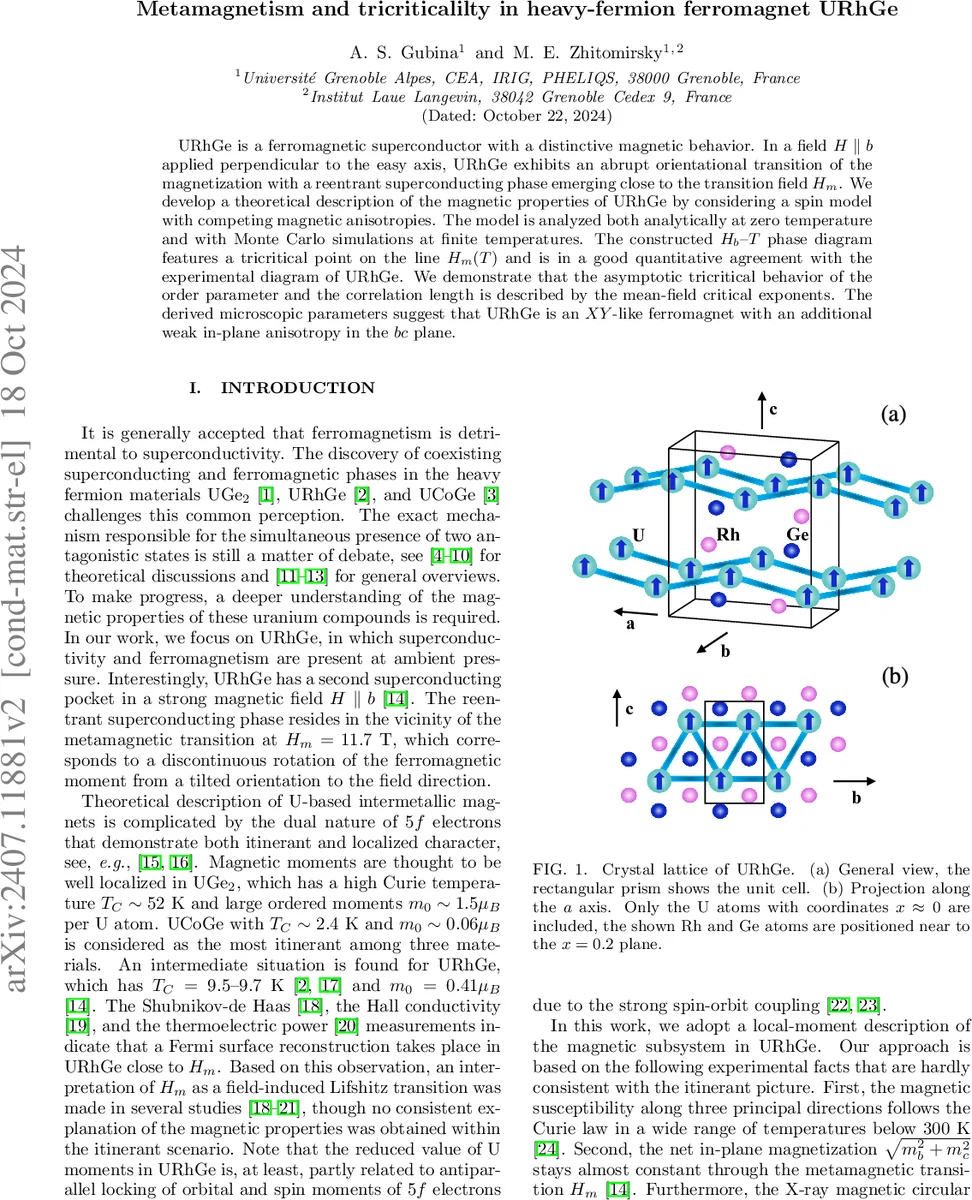
with the axes chosen as x‖a, y‖b, z‖c. The large D≫E>0 reproduces the hard a‑axis and easy c‑axis, while the quartic K‑term generates a sin 4θ contribution to the macroscopic anisotropy energy, essential for producing a first‑order metamagnetic transition.
At zero temperature the spins are confined to the y‑z plane. By parametrizing the net magnetization with an angle θ measured from the easy c‑axis, the energy per spin becomes
E(θ)/N = (2E+K) sin²θ – K sin⁴θ – H sin(θ+α),
where α is the angle between the applied field and the b‑axis. Analytic minimization shows that for K/E > 0.4 the energy develops a local maximum, and the system cannot rotate continuously from θ=0 to θ=π/2 as H increases. Instead, at a critical field H_m the magnetization jumps abruptly to full alignment, i.e., a first‑order metamagnetic transition. The condition K/E≈0.7 reproduces the experimentally observed magnetization jump ΔM/M_s≈0.3 and yields H_m≈2.82 E. Using the measured H_m=11.7 T and the ordered moment (≈0.41 µ_B) the authors extract E≈0.098 meV (≈1.14 K) and K≈0.07 meV.
When the field is tilted away from the b‑axis (α≠0), the first‑order line persists but the jump magnitude diminishes, vanishing at a critical angle α*≈2.3° (theoretical) compared with the experimental α*≈5°. The discrepancy is attributed to contributions from itinerant electrons to the total moment and to possible higher‑order anisotropy terms (e.g., sin 6θ) not included in the minimal model.
Finite‑temperature properties are explored via classical Monte Carlo simulations using the Metropolis algorithm with constrained spin updates to maintain reasonable acceptance rates. The simulations reproduce the H–T phase diagram: the first‑order line terminates at a tricritical point (T_tc, H_tc) where the transition changes from first‑ to second‑order. Near the tricritical point the order parameter and correlation length follow mean‑field critical exponents (β=½, ν=½), consistent with the three‑dimensional nature of the system. The model also captures the strong sensitivity of H_m to uniaxial stress σ_b: both E and K decrease under σ_b, lowering H_m while leaving the Curie temperature essentially unchanged, reflecting the restoration of isotropy in the bc‑plane.
Overall, the study demonstrates that a simple spin Hamiltonian with competing second‑ and fourth‑order anisotropies can quantitatively account for the metamagnetic transition, its field‑angle dependence, the location of the tricritical point, and the mean‑field critical behavior observed in URhGe. The extracted microscopic parameters (J, D, E, K) provide a concrete basis for future work that may incorporate itinerant electron effects or more detailed exchange pathways. By emphasizing the localized‑moment picture, the authors offer a complementary perspective to itinerant‑electron theories and clarify why the metamagnetic transition in URhGe is fundamentally driven by magnetic anisotropy rather than a Lifshitz electronic reconstruction.
Comments & Academic Discussion
Loading comments...
Leave a Comment