Exchange-Only Spin-Orbit Qubits in Silicon and Germanium
The strong spin-orbit interaction in silicon and germanium hole quantum dots enables all-electric microwave control of single spins but is unsuited for multi-spin exchange-only qubits that rely on scalable discrete signals to suppress cross-talk and heating effects in large quantum processors. Here, we propose an exchange-only spin-orbit qubit that utilizes spin-orbit interactions to implement qubit gates and keeps the beneficial properties of the original encoding. Our encoding is robust to significant local variability in hole spin properties and, because it operates with two degenerate states, it eliminates the need for the rotating frame, avoiding the technologically demanding constraints of fast clocks and precise signal calibration. Unlike current exchange-only qubits, which require complex multi-step sequences prone to leakage, our qubit design enables low-leakage two-qubit gates in a single step, addressing critical challenges in scaling spin qubits.
💡 Research Summary
This paper introduces a new “exchange‑only spin‑orbit” (XOSO) qubit architecture that leverages the strong spin‑orbit interaction (SOI) of hole spins in silicon and germanium quantum dots. Traditional exchange‑only (XO) qubits, built from electron spins, require many sequential exchange pulses to implement two‑qubit gates, leading to leakage into non‑computational states and demanding fast microwave clocks for rotating‑frame control. Hole spins, by contrast, can be driven purely electrically thanks to their large SOI, but the same SOI makes conventional XO encodings problematic because the exchange becomes highly anisotropic.
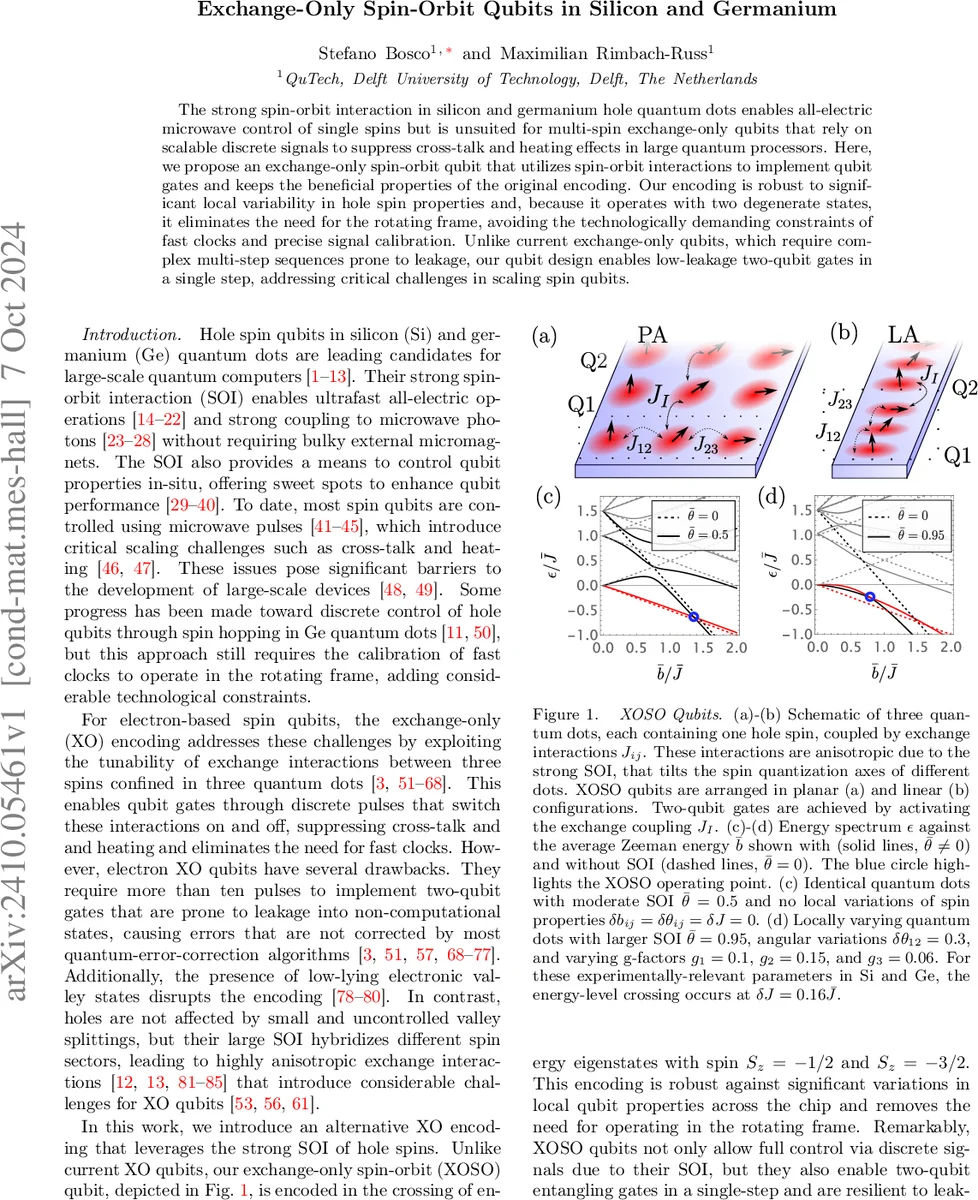
The authors consider three hole spins confined in three quantum dots arranged either linearly or in a planar geometry. The system Hamiltonian includes Zeeman terms (different g‑factors for each dot) and anisotropic exchange couplings J_ij that are rotated by angles θ_ij around the y‑axis, reflecting the SOI‑induced tilt of the local spin quantization axes. By defining average quantities (average Zeeman energy (\bar b), average exchange (\bar J), average SOI angle (\bar\theta)) and their differences, they analyse the energy spectrum. When the average Zeeman energy is increased, the S_z = –3/2 state (all spins down) descends and eventually crosses the S_z = –1/2 doublet. This crossing point, marked by a blue circle in Fig. 1, provides a pair of exactly degenerate states that can serve as the logical |0⟩ and |1⟩. Because the two states are degenerate, no rotating frame is required; the qubit is intrinsically static, eliminating the need for fast clocks and precise phase calibration.
Crucially, the crossing point is robust against local variations in g‑factors, SOI angles, and exchange strengths. The authors show analytically that any asymmetry (δb_ij, δθ_ij) can be compensated by adjusting the exchange asymmetry δJ, preserving the degeneracy. This automatic compensation makes the encoding tolerant to the inevitable device‑to‑device variability across a large chip.
The logical basis is approximately
|0⟩ ≈ |↓↓↓⟩,
|1⟩ ≈ (|↑↓↓⟩ + |↓↓↑⟩)/√6 – √(2/3)|↓↑↓⟩,
which can also be expressed in terms of singlet and triplet combinations of neighboring dots. Consequently, initialization and readout can be performed with Pauli spin blockade, a well‑established technique in spin‑qubit experiments.
Single‑qubit control is achieved with two independent exchange pulses: a global exchange deviation (\bar j(t)) that drives τ_z rotations, and a relative exchange deviation (\delta j(t)) that drives τ_x rotations. Expanding the full three‑spin Hamiltonian to third order in (\bar\theta) yields an effective qubit Hamiltonian
(H_{\text{XOSO}} = -\frac{3}{4}\bar j(t),\tau_z - \frac{\bar\theta}{2},\delta j(t),\tau_x).
Numerical simulations with realistic parameters (average exchange (\bar J/h ≈ 1) GHz, (\bar\theta ≈ 0.5) rad, pulse amplitudes of 20 MHz) show that X and Z rotations can be performed in tens of nanoseconds with leakage probabilities scaling as ((\delta j/\bar J)^2) or ((\bar j/\bar J)^2), i.e., well below 10⁻⁴.
Two‑qubit gates exploit a single exchange pulse between the central dots (planar geometry) or between the outer dots (linear geometry). The effective inter‑qubit Hamiltonian to lowest order in SOI is
(H_I = J_I(t)
Comments & Academic Discussion
Loading comments...
Leave a Comment