The Effects of Instrumental Deadtime on NICER Timing Products
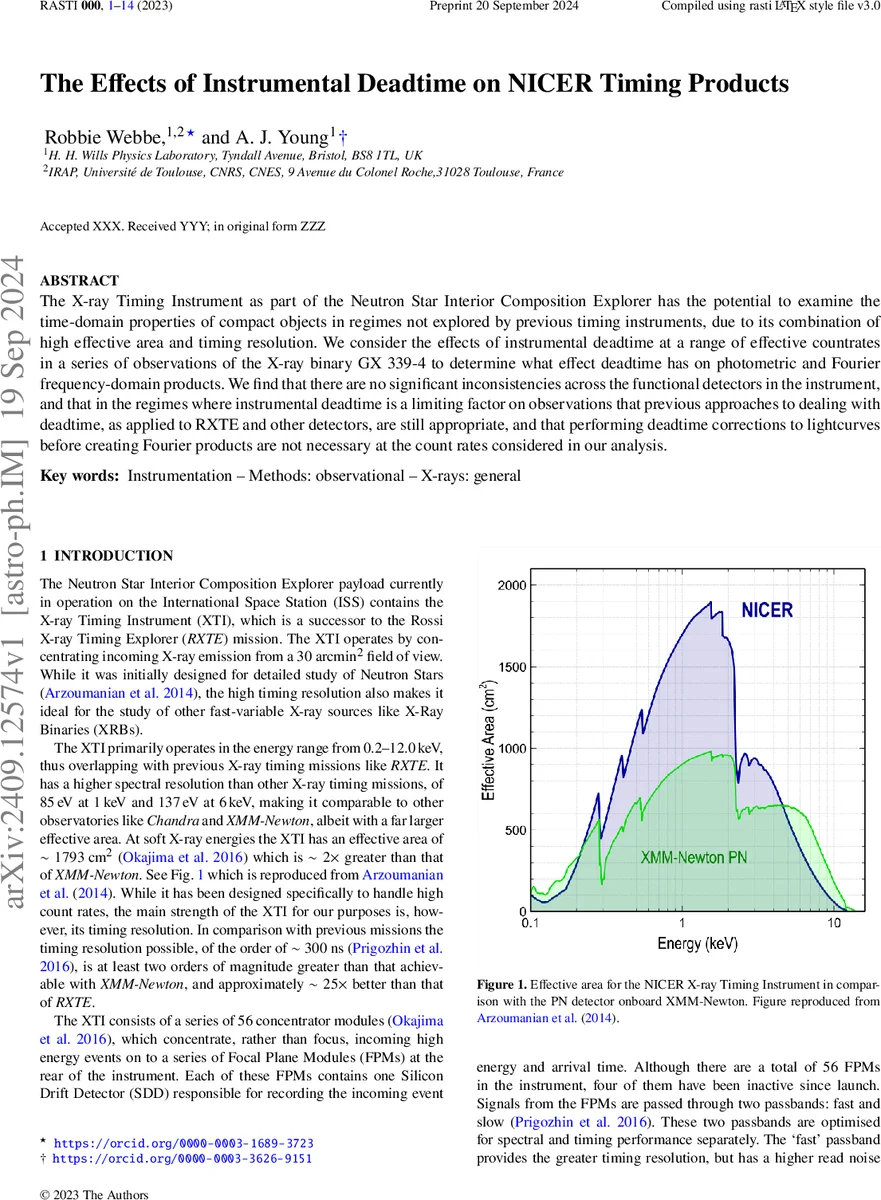
The X-ray Timing Instrument as part of the Neutron Star Interior Composition Explorer has the potential to examine the time-domain properties of compact objects in regimes not explored by previous timing instruments, due to its combination of high effective area and timing resolution. We consider the effects of instrumental deadtime at a range of effective countrates in a series of observations of the X-ray binary GX 339-4 to determine what effect deadtime has on photometric and Fourier frequency-domain products. We find that there are no significant inconsistencies across the functional detectors in the instrument, and that in the regimes where instrumental deadtime is a limiting factor on observations that previous approaches to dealing with deadtime, as applied to RXTE and other detectors, are still appropriate, and that performing deadtime corrections to lightcurves before creating Fourier products are not necessary at the count rates considered in our analysis.
💡 Research Summary
The paper investigates how instrumental deadtime in the Neutron Star Interior Composition Explorer (NICER) X‑ray Timing Instrument (XTI) influences both time‑domain (light curves) and frequency‑domain (power spectra, cross‑spectra) products. NICER consists of 56 Silicon Drift Detectors (FPMs) that record events through fast and slow readout chains. Two distinct deadtime mechanisms are identified: (1) detector deadtime, arising from the readout of individual events, and (2) telemetry deadtime, caused by buffer saturation that fragments Good Time Intervals (GTIs) at very high count rates. The study focuses exclusively on detector deadtime, deliberately excluding telemetry‑deadtime‑affected intervals to isolate the effect.
The authors adopt an event‑by‑event deadtime correction for light curves. For each time bin ΔT they sum the deadtime contributions of all events that start, end, or overlap the bin, obtaining a total deadtime τ_tot. The proportion of the bin lost to deadtime is τ_dead,prop = τ_tot / (ΔT × N_det), where N_det is the number of active detectors. The corrected count rate is then r_true = r_obs / (1 − τ_dead,prop). This approach assumes a constant count rate within each bin, allowing a straightforward extrapolation of the counts that would have been recorded during dead intervals.
For the frequency domain, the authors employ the classic deadtime correction formalism originally developed for the Rossi X‑ray Timing Explorer (RXTE). Specifically, they use the Zhang et al. (1995) modification of the van der Klis (1989) prescription, which subtracts a deadtime‑modified Poisson noise level from the normalized power spectrum. The correction term (Equation 5) incorporates the average total count rate r_e, the per‑detector count rate r_pe, the regular event deadtime τ_d, and a separate deadtime τ_vle for rare large‑energy events. This model predicts a frequency‑dependent suppression of power that can be analytically removed.
The empirical test case is the black‑hole X‑ray binary GX 339‑4. Nine NICER observations spanning low (≈30 cts s⁻¹), medium (≈750 cts s⁻¹), and high (≈7000 cts s⁻¹) count‑rate regimes were selected. All data were processed with the standard NICER pipeline, using a uniform energy band (0.2–15 keV) and stringent GTI filters: Earth limb elevation > 30°, bright Earth avoidance > 40°, undershoot event rate < 50 cts s⁻¹, and magnetic rigidity > 4.9 GV/c. Four detectors are permanently inactive; the remaining 52 are assumed to behave uniformly.
Key findings include:
- Uniform Detector Behaviour – The average deadtime per event shows no statistically significant variation among the active FPMs, confirming that the instrument behaves homogeneously across detectors.
- Low‑Count‑Rate Regime – For observations below ~100 cts s⁻¹, the deadtime fraction is < 0.5 %. Applying the deadtime correction to light curves yields negligible differences, indicating that raw NICER light curves are already reliable in this regime.
- Medium/High‑Count‑Rate Regime – At several hundred to a few thousand counts per second, the deadtime fraction rises to 2–5 %. Nevertheless, after applying the standard RXTE‑based deadtime correction to the power spectra, the Poisson noise level matches the theoretical expectation, and no residual systematic suppression is observed.
- Telemetry Deadtime Exclusion – Telemetry deadtime becomes relevant only above ~20 kcts s⁻¹, where GTIs become fragmented. By excluding such intervals, the study isolates pure detector deadtime effects, demonstrating that the existing correction methods remain valid even at the highest NICER count rates that are still free of telemetry saturation.
The authors conclude that NICER’s timing products can be analyzed with the same deadtime correction strategies that have been successfully applied to RXTE data. For count rates up to ~1 kcts s⁻¹, no explicit deadtime correction of the light curve is required; the standard frequency‑dependent Poisson noise subtraction suffices. Even at several thousand counts per second, the classic correction accurately restores the intrinsic variability power. Consequently, researchers can continue to use established NICER pipelines without additional deadtime‑specific preprocessing, provided that telemetry‑deadtime‑affected intervals are removed. This work offers a practical guideline for future NICER timing analyses, confirming that instrumental deadtime does not impose new limitations beyond those already accounted for in legacy X‑ray timing missions.
Comments & Academic Discussion
Loading comments...
Leave a Comment