(Un)buckling mechanics of epithelial monolayers under compression
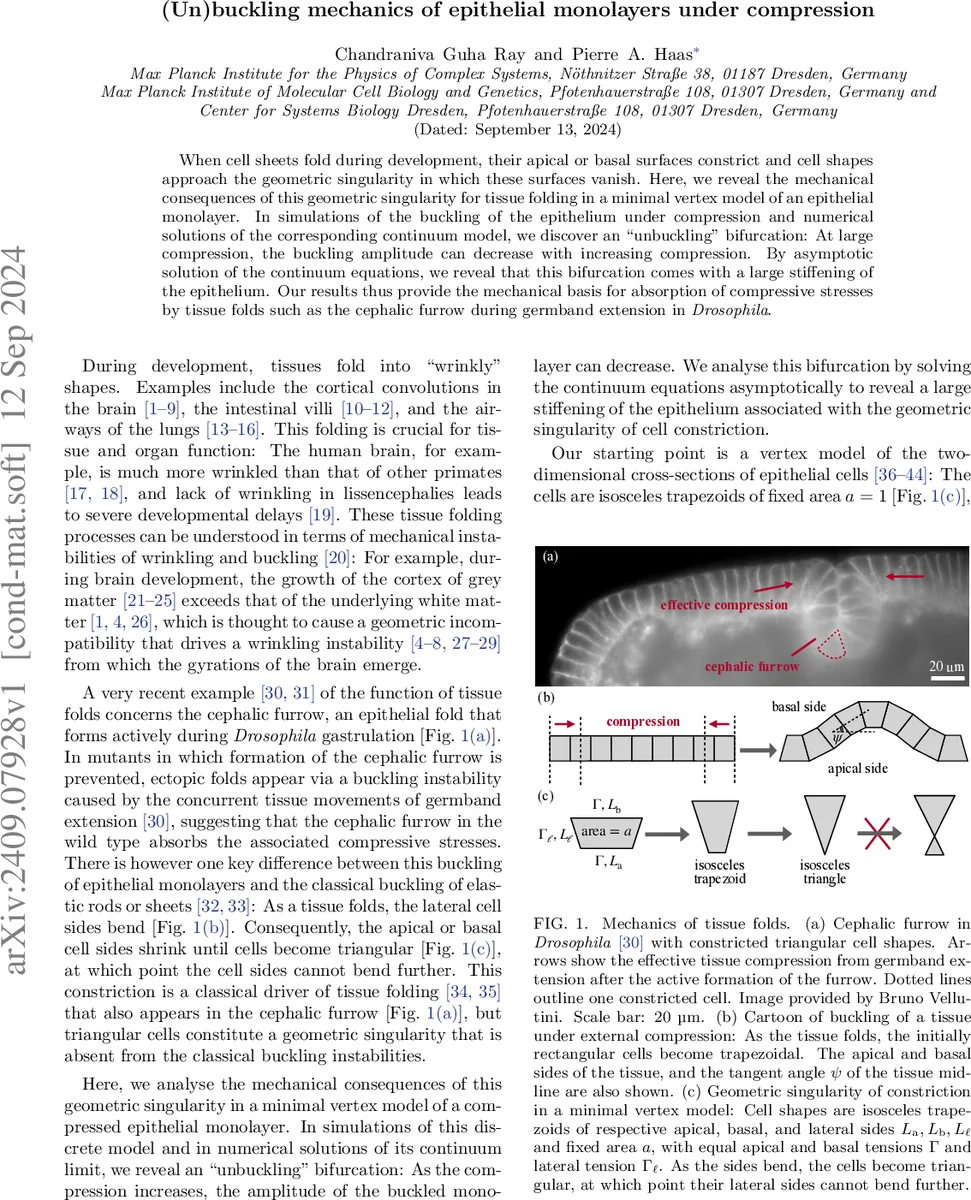
When cell sheets fold during development, their apical or basal surfaces constrict and cell shapes approach the geometric singularity in which these surfaces vanish. Here, we reveal the mechanical consequences of this geometric singularity for tissue folding in a minimal vertex model of an epithelial monolayer. In simulations of the buckling of the epithelium under compression and numerical solutions of the corresponding continuum model, we discover an “unbuckling” bifurcation: At large compression, the buckling amplitude can decrease with increasing compression. By asymptotic solution of the continuum equations, we reveal that this bifurcation comes with a large stiffening of the epithelium. Our results thus provide the mechanical basis for absorption of compressive stresses by tissue folds such as the cephalic furrow during germband extension in Drosophila.
💡 Research Summary
The paper investigates how a geometric singularity—cell apical or basal sides shrinking to zero, turning cells into triangles—affects the mechanical response of an epithelial monolayer under compression. Using a minimal vertex model, each cell is represented as an isosceles trapezoid (or triangle) of fixed area, with an energy e = Γ(L_a + L_b) + Γ_ℓ L_ℓ, where Γ and Γ_ℓ are the apicobasal and lateral tensions. Imposing a relative compression D through a Lagrange multiplier μ (compressive force) and minimizing the total energy yields a buckling instability at a critical compression D*. As compression increases to D△, cells at the crests and troughs become perfect triangles; further compression expands triangular “fans” outward from these points.
To connect the discrete model to a continuum description, the authors take the limit of a large number N of cells and derive an Euler–Lagrange equation for the tangent angle ψ(s) of the midline, together with constraints linking μ and the lateral side length Λ. Numerical solutions of the continuum equations reproduce the vertex‑model behavior, including the appearance of kinks that correspond to triangular cells.
The central discovery is an “unbuckling” bifurcation. Beyond a second critical compression D_bif, the buckling amplitude A does not always increase with D. If the initial aspect ratio r (N/2ℓ₀²) of the undeformed sheet is below a threshold r_bif, the amplitude actually decreases as compression grows—a phenomenon the authors term unbuckling. This occurs precisely when almost all cells have become triangular (fraction f ≈ 1). By analyzing the energy of a fully triangular configuration in terms of the semi‑angle ϕ of the triangular cells, they find that the energy landscape has a stationary point at ϕ_bif where both ∂E/∂ϕ and ∂D/∂ϕ vanish. For D just above D_bif two solutions exist: ϕ₁ < ϕ_bif corresponds to the decreasing‑amplitude (unbuckling) branch, while ϕ₂ > ϕ_bif gives the conventional increasing‑amplitude branch. The sign of ∂E/∂ϕ at ϕ_bif determines which branch is energetically favored.
Asymptotic analysis shows that in the limit of many cells (N ≫ 1) the critical values converge to D_bif → 0, r_bif → 1, and ϕ_bif → 0. Near the bifurcation the compressive force μ diverges dramatically, indicating a massive stiffening of the tissue. This stiffening is not due to the appearance of individual triangular cells (which only modestly increase stiffness at D△) but is a collective effect of the whole sheet becoming triangular. Steric interactions, which are absent from the continuum model, would only become relevant for D > D_bif and would further increase stiffness.
Biologically, the findings provide a mechanical explanation for how structures such as the Drosophila cephalic furrow absorb compressive stresses generated during germ‑band extension. When the furrow reaches the unbuckling regime, the tissue becomes extremely stiff, preventing further deformation. Conversely, if the aspect ratio is above the threshold, the fold deepens (buckling branch), which matches observations of ectopic folds in mutants lacking the furrow.
In summary, the authors combine discrete vertex simulations, continuum modeling, and asymptotic calculations to reveal a previously unrecognized mechanical transition—unbuckling—driven by the geometric singularity of cell constriction. This transition leads to a dramatic increase in tissue stiffness and offers a new perspective on how epithelial sheets manage compressive loads during development, with potential implications for tissue engineering and the study of morphogenetic instabilities.
Comments & Academic Discussion
Loading comments...
Leave a Comment