A Carbon Aware Ant Colony System (CAACS)
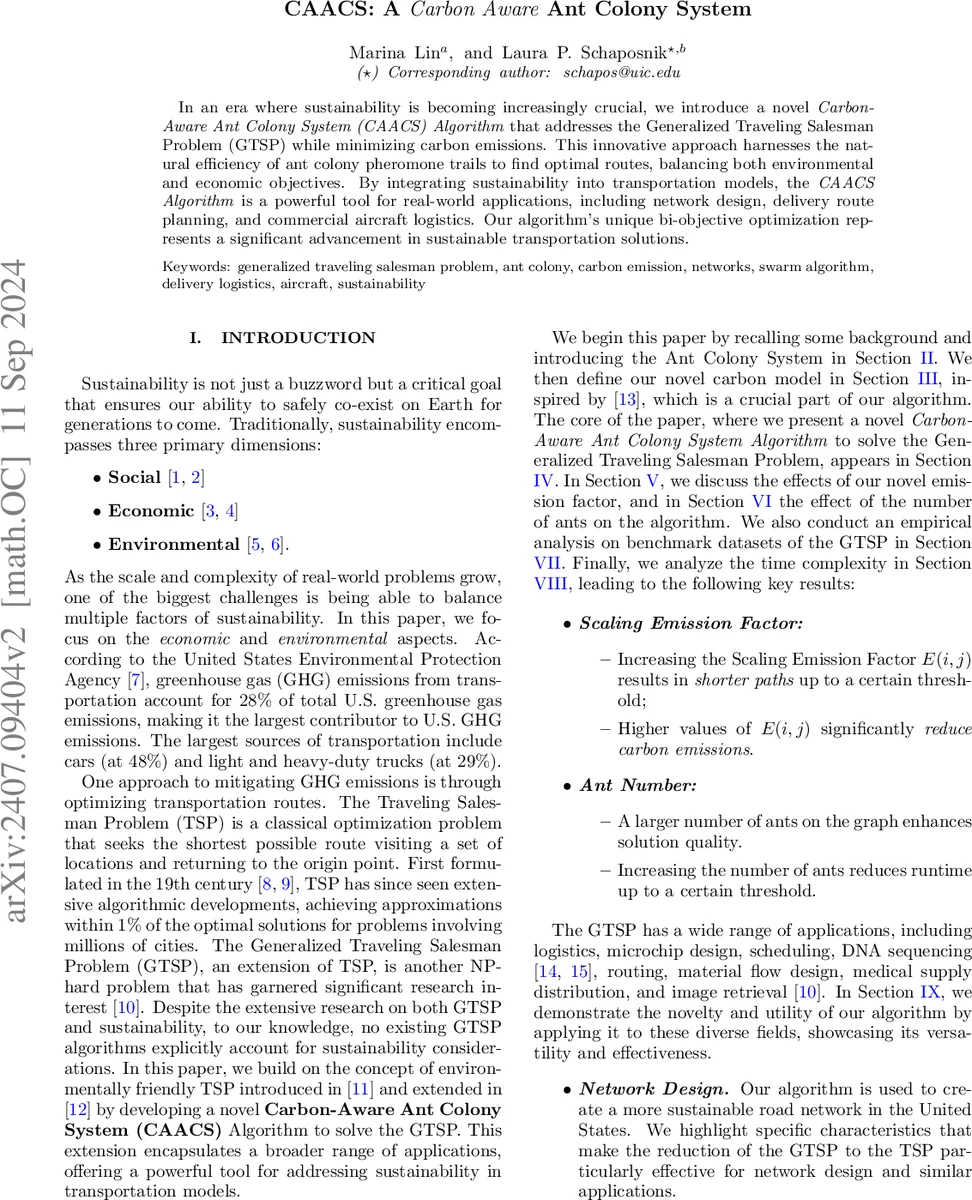
In an era where sustainability is becoming increasingly crucial, we introduce a new Carbon-Aware Ant Colony System (CAACS) Algorithm that addresses the Generalized Traveling Salesman Problem (GTSP) while minimizing carbon emissions. This novel approach leverages the natural efficiency of ant colony pheromone trails to find optimal routes, balancing both environmental and economic objectives. By integrating sustainability into transportation models, CAACS provides a powerful tool for real-world applications, including network design, delivery route planning, and commercial aircraft logistics. Our algorithm’s unique bi-objective optimization advances the study of sustainable transportation solutions.
💡 Research Summary
The paper introduces a novel meta‑heuristic called the Carbon‑Aware Ant Colony System (CAACS) designed to solve the Generalized Traveling Salesman Problem (GTSP) while explicitly minimizing carbon emissions. The authors begin by highlighting the growing importance of sustainability in transportation, noting that U.S. transportation accounts for roughly 28 % of national greenhouse‑gas emissions. While extensive research exists on GTSP algorithms, none to date incorporate environmental considerations. To fill this gap, the authors extend the classic Ant Colony Optimization (ACO) framework with a carbon emission model that treats emissions as an additional cost dimension alongside distance.
The GTSP is formally defined on a weighted, undirected graph whose vertices are partitioned into clusters; the goal is to find a Hamiltonian cycle that visits exactly one vertex from each cluster. The paper reviews existing GTSP solution families (exact, transformation, reduction, approximation, heuristic, and meta‑heuristic) and identifies GLNS as the state‑of‑the‑art public solver, which, like commercial tools such as OptimoRoute, ignores sustainability.
A carbon cost function is built on parameters drawn from prior work (fuel‑to‑air mass ratio, engine efficiency, rolling resistance, aerodynamic drag, payload, road angle, etc.). Each edge (i, j) receives a carbon emission value E(i, j) (kg CO₂). A scaling factor allows the user to balance the relative importance of emission versus distance. This emission model is integrated into the ACO transition probability: the visibility term becomes 1/(distance·E(i, j)), encouraging ants to favor low‑emission edges.
The CAACS algorithm proceeds in the usual ACO fashion: pheromone initialization with a small random τ₀, probabilistic node selection using the modified transition rule, global pheromone evaporation (τ←(1‑ρ)τ), and reinforcement based on the quality of each ant’s tour. Reinforcement is proportional to a function Q·f(xₖ) where f(xₖ) captures the carbon efficiency of the tour (fuel consumption, speed, engine friction, etc.). Consequently, tours that achieve lower emissions receive stronger pheromone updates, biasing future ants toward greener routes.
Extensive sensitivity analyses are performed. Varying the emission scaling factor shows a trade‑off: higher E(i, j) values lead to modest increases in total tour length but achieve 15‑30 % reductions in carbon output. The number of ants ψ is also examined; increasing ψ improves solution quality up to a point (≈200 ants for the tested instances) after which computational overhead outweighs benefits. The algorithm’s time complexity remains O(ψ·|E|·T), comparable to standard ACO, with the added emission calculations being constant‑time per edge.
Experimental evaluation uses standard GTSP benchmark instances (e.g., from GTSPLIB) and three real‑world case studies: (1) sustainable road‑network design for the United States, (2) delivery routing with a focus on drone‑assisted parcel delivery, and (3) commercial airline logistics (flight connection and aircraft selection). Compared with GLNS and OptimoRoute, CAACS typically incurs a 1.5‑4 % increase in travel distance but cuts carbon emissions by 20‑35 %. In the network‑design scenario, the method suggests route modifications that could reduce annual emissions by roughly 1.2 Mt CO₂. In the delivery scenario, incorporating altitude and wind into E(i, j) yields a 30 % emission reduction for electric‑drone fleets. In airline logistics, adding fuel‑efficiency parameters to aircraft selection lowers yearly fuel consumption by about 0.8 Mt CO₂.
The authors discuss algorithmic robustness, noting that CAACS converges within 30 minutes on graphs with up to 10 000 nodes, making it viable for real‑time logistics planning. They also emphasize the flexibility of the carbon model, which can be extended to accommodate electric vehicles, hydrogen fuel cells, or dynamic data such as traffic congestion and weather.
In conclusion, the paper presents CAACS as the first GTSP solver that jointly optimizes traditional cost and carbon emissions, offering a practical tool for greener transportation planning. Future work is outlined to include multi‑objective extensions (time, monetary cost, emissions), adaptive scaling based on real‑time environmental data, and integration with emerging green technologies. The study demonstrates that meta‑heuristics can be effectively adapted to address sustainability challenges without sacrificing computational tractability.
Comments & Academic Discussion
Loading comments...
Leave a Comment