Lightning declines over shipping lanes following regulation of fuel sulfur emissions
Abstract. Aerosol interactions with clouds represent a significant uncertainty in our understanding of the Earth system. Deep convective clouds may respond to aerosol perturbations in several ways that have proven difficult to elucidate with observations. Here, we leverage the two busiest maritime shipping lanes in the world, which emit aerosol particles and their precursors into an otherwise relatively clean tropical marine boundary layer, to make headway on the influence of aerosol on deep convective clouds. The recent 7-fold change in allowable fuel sulfur by the International Maritime Organization allows us to test the sensitivity of the lightning to changes in ship plume aerosol number-size distributions. We find that, across a range of atmospheric thermodynamic conditions, the previously documented enhancement of lightning over the shipping lanes has fallen by over 40 %. The enhancement is therefore at least partially aerosol-mediated, a conclusion that is supported by observations of droplet number at cloud base, which show a similar decline over the shipping lane. These results have fundamental implications for our understanding of aerosol–cloud interactions, suggesting that deep convective clouds are impacted by the aerosol number distribution in the remote marine environment.
💡 Research Summary
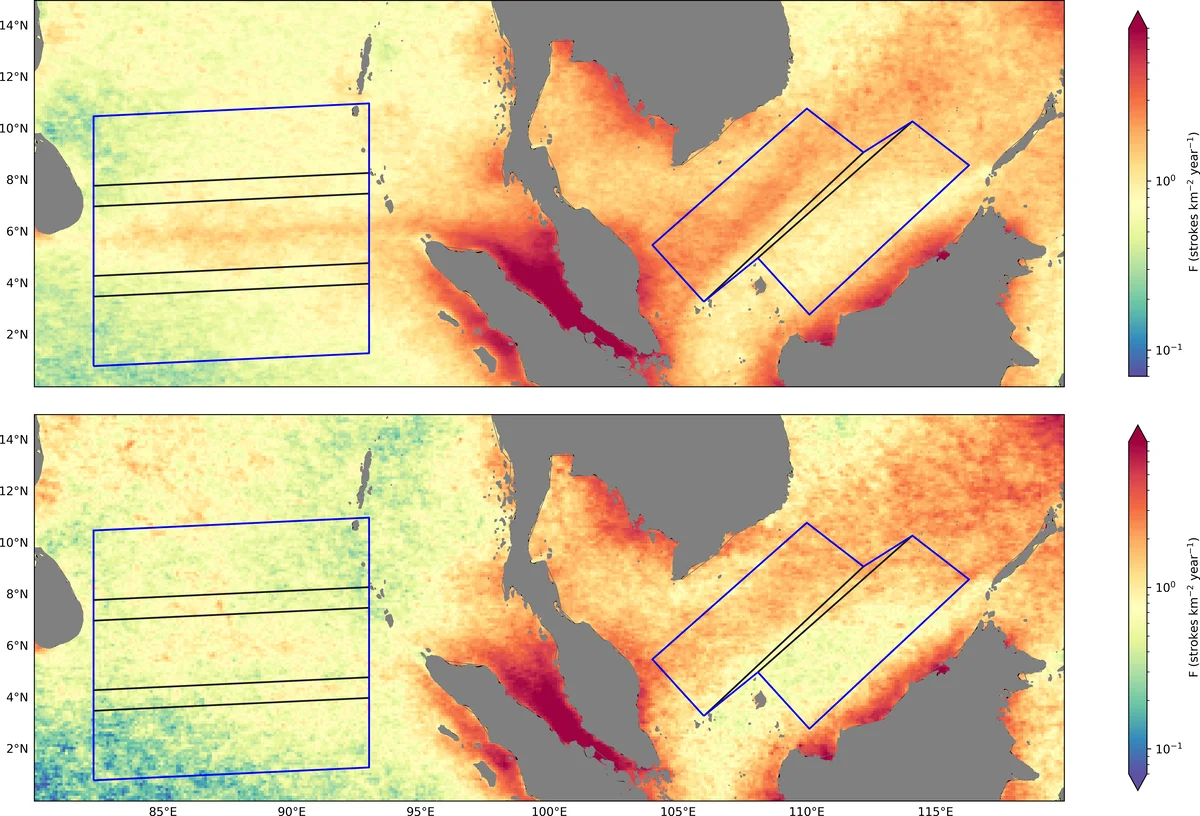
This paper investigates how the 2020 International Maritime Organization (IMO) regulation that reduced permissible sulfur content in ship fuel from 3.5 % to 0.5 %—a seven‑fold decrease—has altered aerosol emissions, cloud microphysics, and lightning activity over the two busiest global shipping corridors, the Indian Ocean and South China Sea lanes. Using World Wide Lightning Location Network (WWLLN) stroke density data spanning 2010‑2019 (pre‑regulation) and 2020‑2023 (post‑regulation), the authors first confirm that the shipping lanes exhibit a pronounced lightning enhancement of about 3.9 strokes km⁻² yr⁻¹ relative to adjacent oceanic regions before the regulation. After the sulfur cap, the enhancement drops to roughly 1.25 strokes km⁻² yr⁻¹, a reduction of more than 40 % and, after accounting for background meteorology, about 67 % of the original signal disappears.
To isolate the effect of changing emissions from natural variability, the study employs a multivariate regression that includes Convective Available Potential Energy (CAPE), precipitation rate, and the Oceanic Niño Index (ONI), together with latitude‑longitude terms. This model explains ~65 % of inter‑annual variance in lightning. Subtracting the regression‑predicted component yields a residual “lightning anomaly” that still shows a sharp step‑change coincident with the 2020 regulation, confirming that the decline is not merely due to altered storm frequency or intensity.
The authors further dissect the relationship by binning 3‑hourly observations of CAPE and precipitation into a two‑dimensional space and comparing lightning frequencies inside the shipping corridor with those in adjacent reference boxes. Before 2020, a positive lightning enhancement is evident across almost all CAPE‑precipitation regimes, especially in low‑CAPE environments where aerosol‑mediated microphysical processes are thought to be most effective. After the regulation, the enhancement collapses across the entire CAPE‑precipitation domain, with average reductions of 76 % (Indian Ocean) and 47 % (South China Sea). This systematic weakening across thermodynamic conditions strongly implicates aerosol number changes rather than dynamical shifts.
To test the aerosol hypothesis directly, the study examines MODIS‑derived cloud droplet number concentration (Nd) for shallow cumulus clouds over the Indian Ocean lane. Prior to the regulation, Nd is elevated by 10‑15 % above the surrounding ocean, consistent with an influx of ship‑derived cloud condensation nuclei (CCN). Post‑regulation, the Nd enhancement disappears; confidence intervals overlap with background values, indicating that the CCN supply from shipping plumes has been substantially curtailed.
Crucially, ship traffic metrics—Automatic Identification System (AIS) transponder counts and fuel sales at the Port of Singapore—show no significant decline after 2020; in fact, fuel sales have risen, suggesting that the observed atmospheric changes are driven by the sulfur content reduction rather than a decrease in vessel numbers.
The combined evidence leads the authors to conclude that the IMO sulfur cap has directly reduced aerosol number concentrations over these maritime corridors, which in turn has diminished cloud droplet number at cloud base and weakened the microphysical pathways that enhance lightning in deep convective clouds. The findings support theories that aerosol‑mediated changes in cloud droplet populations affect mixed‑phase processes, charge separation, and ultimately lightning frequency. Moreover, the work highlights that even remote marine environments are sensitive to anthropogenic aerosol perturbations, with implications for regional climate, precipitation patterns, and the representation of aerosol–cloud interactions in global climate models.
Comments & Academic Discussion
Loading comments...
Leave a Comment