Mechanics of poking a cyst
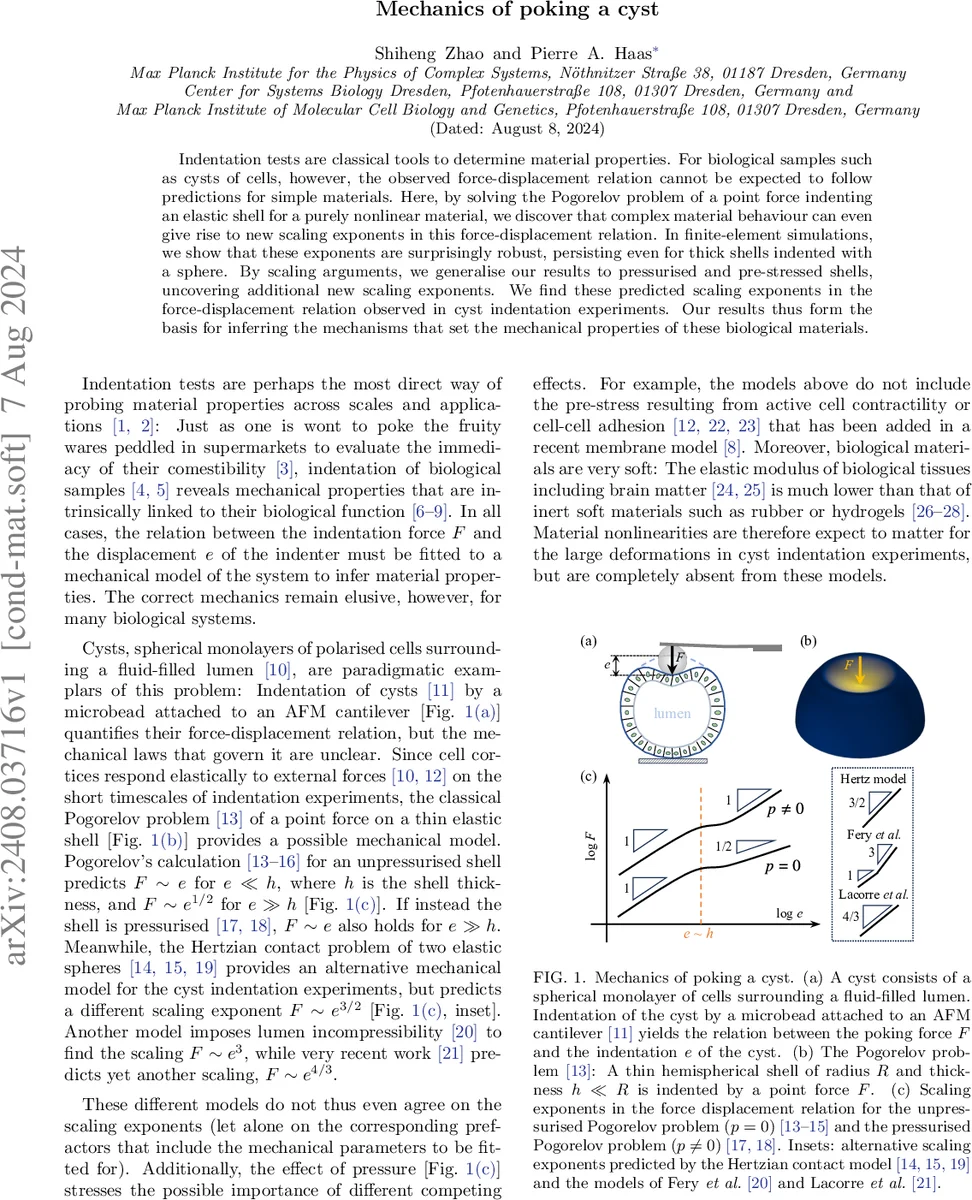
Indentation tests are classical tools to determine material properties. For biological samples such as cysts of cells, however, the observed force-displacement relation cannot be expected to follow predictions for simple materials. Here, by solving the Pogorelov problem of a point force indenting an elastic shell for a purely nonlinear material, we discover that complex material behaviour can even give rise to new scaling exponents in this force-displacement relation. In finite-element simulations, we show that these exponents are surprisingly robust, persisting even for thick shells indented with a sphere. By scaling arguments, we generalise our results to pressurised and pre-stressed shells, uncovering additional new scaling exponents. We find these predicted scaling exponents in the force-displacement relation observed in cyst indentation experiments. Our results thus form the basis for inferring the mechanisms that set the mechanical properties of these biological materials.
💡 Research Summary
This paper presents a comprehensive theoretical and computational study that redefines the mechanics of indenting biological shells, using cysts as a primary example. The authors address the longstanding confusion in interpreting force-displacement (F-e) data from cyst indentation experiments, where existing models like Hertzian contact or linear elastic shell theory predict conflicting scaling exponents and fail to capture the material’s complexity.
The core of the work lies in solving the classic Pogorelov problem—a point force indenting a spherical elastic shell—but for a material governed by purely nonlinear hyperelasticity. The hyperelastic strain energy density is separated into a linear part (governed by the linear shear modulus G1, as in Mooney-Rivlin materials) and a purely nonlinear part (governed by the nonlinear shear modulus G2, from second-order invariants). Through asymptotic scaling analysis for a thin shell, the authors derive groundbreaking results: for a purely nonlinear material (G1=0), the scaling laws become F ~ e³ for shallow indentations (e « h, where h is shell thickness) and F ~ e^(3/2) for deep indentations (e » h). This contrasts sharply with the classical linear elastic (G2=0) Pogorelov scalings of F ~ e and F ~ e^(1/2) for the same regimes, respectively.
The theoretical predictions are rigorously validated using finite element method (FEM) simulations. Simulations of a thin shell confirm not only the new scaling exponents but also the transitions between them based on the ratio g = G1/G2. Crucially, the simulations demonstrate the “robustness” of these scalings: they persist remarkably well even for thick shells (h/R = 0.2) indented by a point force, and more importantly, under the experimentally relevant condition of indentation by a sphere (of radius 0.4R). This robustness proves that large exponents like “3” are intrinsic signatures of material nonlinearity, not artifacts of shell geometry or contact area.
The study then generalizes these findings through scaling arguments to include two key biological factors: internal pressure (p) and pre-strain (E0) from cellular contractility or adhesion. Pressure introduces an energy term ~ p e² R. Pre-strain modifies the strain measures in the energy functional. The analysis reveals that even in the shallow indentation regime (e « h), three competing scaling exponents can emerge: 1/2, 1, and 3. Which exponent dominates depends on the relative magnitudes of g, the dimensionless pressure Π = p/G2, and the pre-strain E0. The paper systematically classifies four possible diagrams depicting sequences of scaling transitions, providing a complete “map” for interpreting experimental data. A key insight is that observing F ~ e^(1/2) at small indentations is a strong indicator of dominant pre-stress in the biological shell.
Finally, the authors reanalyze existing experimental force-displacement data from indentation of MDCK cell cysts. The data shows a local scaling exponent β that increases from approximately 0.5 to around 2 as indentation depth increases. The appearance of β ≈ 0.5 aligns with the pre-stress-dominated regime predicted by the theory. While the full transition to the predicted β = 3 (from purely nonlinear elasticity) is not observed within the experimental depth range, the observed strain-stiffening (β > 1) strongly suggests the onset of nonlinear elastic effects. The study concludes that the derived scaling laws and transition diagrams form a fundamental new basis for inferring the mechanical properties—encompassing linear elasticity, nonlinear elasticity, pre-stress, and pressure—of cysts and similar biological materials from indentation tests. Future work is needed to explore the effects of viscoelasticity and to derive these scalings from more microscopic cellular models.
Comments & Academic Discussion
Loading comments...
Leave a Comment