Dwyer-Kan homotopy theory of enriched categories
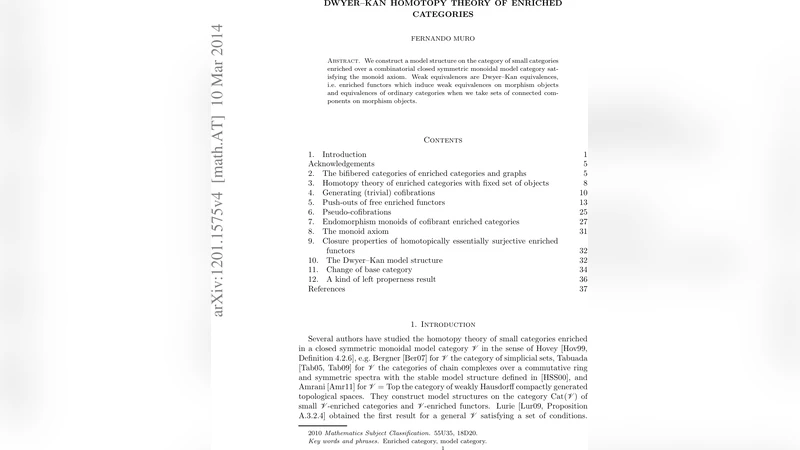
We construct a model structure on the category of small categories enriched over a combinatorial closed symmetric monoidal model category satisfying the monoid axiom. Weak equivalences are Dwyer-Kan equivalences, i.e. enriched functors which induce weak equivalences on morphism objects and equivalences of ordinary categories when we take sets of connected components on morphism objects.
💡 Research Summary
The paper establishes a Quillen model structure on the category Cat(𝓥) of small categories enriched over a combinatorial closed symmetric monoidal model category 𝓥 that satisfies the monoid axiom. The authors begin by recalling the basic notions of 𝓥‑enriched categories, enriched functors, and enriched natural transformations, emphasizing that the hom‑objects C(x, y) live in 𝓥 and inherit its model‑theoretic properties.
A central definition is that of a Dwyer‑Kan equivalence: an enriched functor F : C → D is a Dwyer‑Kan equivalence if (1) for every pair of objects (x, y) the induced map on hom‑objects C(x, y) → D(Fx, Fy) is a weak equivalence in 𝓥, and (2) after applying the connected‑component functor π₀ to each hom‑object, the resulting ordinary functor π₀C → π₀D is an equivalence of ordinary categories. This combines a homotopical condition on the enrichment with a categorical equivalence condition on the underlying ordinary categories.
The main technical achievement is the transfer of a model structure from a simpler category of 𝓥‑graphs to Cat(𝓥). The authors construct a free‑enriched‑category adjunction F ⊣ U, where F sends a 𝓥‑graph to the free 𝓥‑enriched category generated by it, and U forgets the composition. Because 𝓥 is combinatorial and satisfies the monoid axiom, the authors can apply the Schwede‑Shipley transfer theorem: F preserves cofibrations and trivial cofibrations, while U creates fibrations and trivial fibrations. Consequently, Cat(𝓥) inherits a cofibrantly generated model structure in which:
- Cofibrations are those enriched functors that are cofibrations on each hom‑object (via the free construction).
- Fibrations are enriched functors that are fibrations on each hom‑object and satisfy a lifting condition with respect to the enrichment.
- Weak equivalences are precisely the Dwyer‑Kan equivalences defined above.
To verify that the weak equivalences coincide with Dwyer‑Kan equivalences, the authors analyze derived mapping spaces. They show that a map that is a weak equivalence in the transferred model structure induces a weak equivalence on each hom‑object after fibrant replacement, and that the induced map on π₀‑categories is an equivalence. Conversely, any Dwyer‑Kan equivalence satisfies the lifting properties required of a weak equivalence in the transferred structure.
The paper also proves that the resulting model structure is left proper and right proper. Left properness follows from the fact that pushouts of cofibrations along weak equivalences preserve the Dwyer‑Kan condition, while right properness is a consequence of pullbacks of fibrations preserving weak equivalences. These properness results guarantee that homotopy colimits and limits behave as expected in the enriched setting.
Finally, the authors compare their construction with known cases. When 𝓥 = sSet (the category of simplicial sets) the model structure recovers the classical Dwyer‑Kan model structure on simplicially enriched categories. When 𝓥 is the category of chain complexes over a ring, or a stable model category of spectra, the same framework yields a homotopy theory of dg‑categories or spectral categories, respectively. Thus the work provides a unified, highly flexible homotopical foundation for enriched categories across a broad spectrum of algebraic and topological contexts.
Comments & Academic Discussion
Loading comments...
Leave a Comment