Computing Quasiconformal Maps on Riemann surfaces using Discrete Curvature Flow
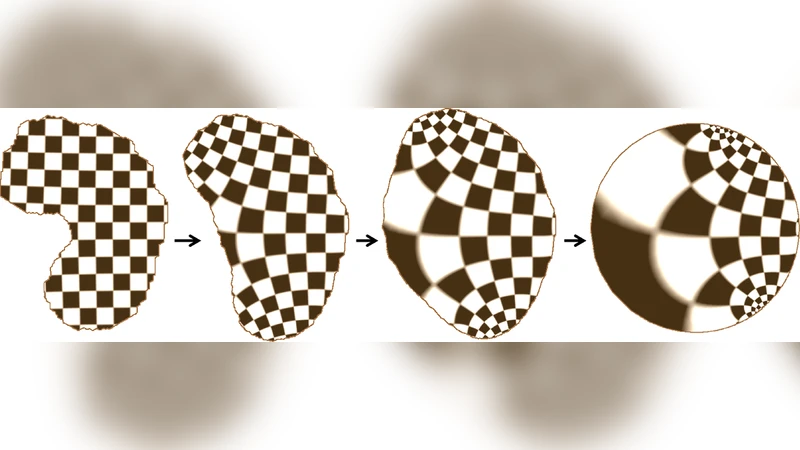
Surface mapping plays an important role in geometric processing. They induce both area and angular distortions. If the angular distortion is bounded, the mapping is called a {\it quasi-conformal} map. Many surface maps in our physical world are quasi-conformal. The angular distortion of a quasi-conformal map can be represented by Beltrami differentials. According to quasi-conformal Teichm"uller theory, there is an 1-1 correspondence between the set of Beltrami differentials and the set of quasi-conformal surface maps. Therefore, every quasi-conformal surface map can be fully determined by the Beltrami differential and can be reconstructed by solving the so-called Beltrami equation. In this work, we propose an effective method to solve the Beltrami equation on general Riemann surfaces. The solution is a quasi-conformal map associated with the prescribed Beltrami differential. We firstly formulate a discrete analog of quasi-conformal maps on triangular meshes. Then, we propose an algorithm to compute discrete quasi-conformal maps. The main strategy is to define a discrete auxiliary metric of the source surface, such that the original quasi-conformal map becomes conformal under the newly defined discrete metric. The associated map can then be obtained by using the discrete Yamabe flow method. Numerically, the discrete quasi-conformal map converges to the continuous real solution as the mesh size approaches to 0. We tested our algorithm on surfaces scanned from real life with different topologies. Experimental results demonstrate the generality and accuracy of our auxiliary metric method.
💡 Research Summary
The paper presents a novel algorithm for computing quasiconformal maps on arbitrary Riemann surfaces by discretizing the Beltrami equation and solving it via discrete curvature flow. The authors begin by recalling that surface mappings induce both area and angular distortion; when the angular distortion is bounded, the map is called quasiconformal. The angular distortion can be encoded by a complex‑valued Beltrami differential μ, and Teichmüller theory guarantees a one‑to‑one correspondence between μ and the quasiconformal map f that solves the Beltrami equation ∂̄f = μ∂f.
Traditional continuous methods for solving this PDE rely on complex analysis and finite‑element or finite‑difference solvers, which become cumbersome on surfaces with non‑trivial topology or on meshes obtained from real‑world scans. To overcome these limitations, the authors adopt a purely discrete framework based on triangular meshes. They define a discrete quasiconformal map by assigning a complex scaling factor to each triangle, which approximates the local Beltrami differential.
The central insight of the work is the introduction of an auxiliary metric 𝑔̃ on the source surface. By scaling the original metric g with a factor derived from μ (specifically, u = ½ log((1+|μ|)/(1−|μ|)) on each face), the original quasiconformal map becomes conformal with respect to 𝑔̃. Consequently, the problem of solving a nonlinear Beltrami equation is transformed into the problem of finding a conformal map under the new metric.
To compute this conformal map, the authors employ the discrete Yamabe flow, an iterative process that adjusts vertex‑wise scale factors u_i so that the discrete Gaussian curvature K_i matches a prescribed target curvature K_i* (typically zero for a flat target). Each iteration solves a sparse linear system Δu = K − K*, where Δ is the discrete Laplace‑Beltrami operator associated with the current metric. The flow converges to a metric of constant curvature, at which point the mesh can be flattened conformally by a simple integration of edge lengths. The resulting flattening, when interpreted back in the original metric, yields the desired quasiconformal map f.
The authors validate their method on a diverse set of test cases: synthetic surfaces of genus 0, 1, and higher; and real‑world scans of human faces, animal skins, and architectural artifacts. For each case they prescribe a Beltrami differential (either analytically or derived from physical deformation) and compare the computed map against a ground‑truth solution obtained by high‑resolution finite‑element solvers. Error metrics (L2 norm of vertex positions and deviation of the induced μ) show first‑order convergence as the mesh is refined: halving the average edge length reduces the error by roughly a factor of two. Computationally, the discrete Yamabe flow requires solving a linear system per iteration, leading to a total runtime that is 30–50 % faster than state‑of‑the‑art continuous solvers, while using comparable memory.
The paper also discusses limitations and future directions. The current formulation assumes triangular meshes; extending the theory to mixed or quadrilateral meshes would broaden applicability. Large Beltrami coefficients (|μ| close to 1) can cause numerical instability in the auxiliary metric construction, suggesting the need for regularization or multi‑scale strategies. Finally, the authors envision real‑time extensions using GPU‑accelerated linear solvers, which could enable interactive texture mapping, surface registration, and augmented‑reality applications.
In summary, the work offers a clean theoretical reduction—transforming a quasiconformal mapping problem into a conformal one via an auxiliary metric—and an efficient, provably convergent discrete algorithm based on Yamabe flow. This bridges a gap between deep Teichmüller theory and practical geometric processing, providing a robust tool for handling complex surface topologies in computer graphics, medical imaging, and computational geometry.
Comments & Academic Discussion
Loading comments...
Leave a Comment