An alternative approach to Shnirelman's inequality
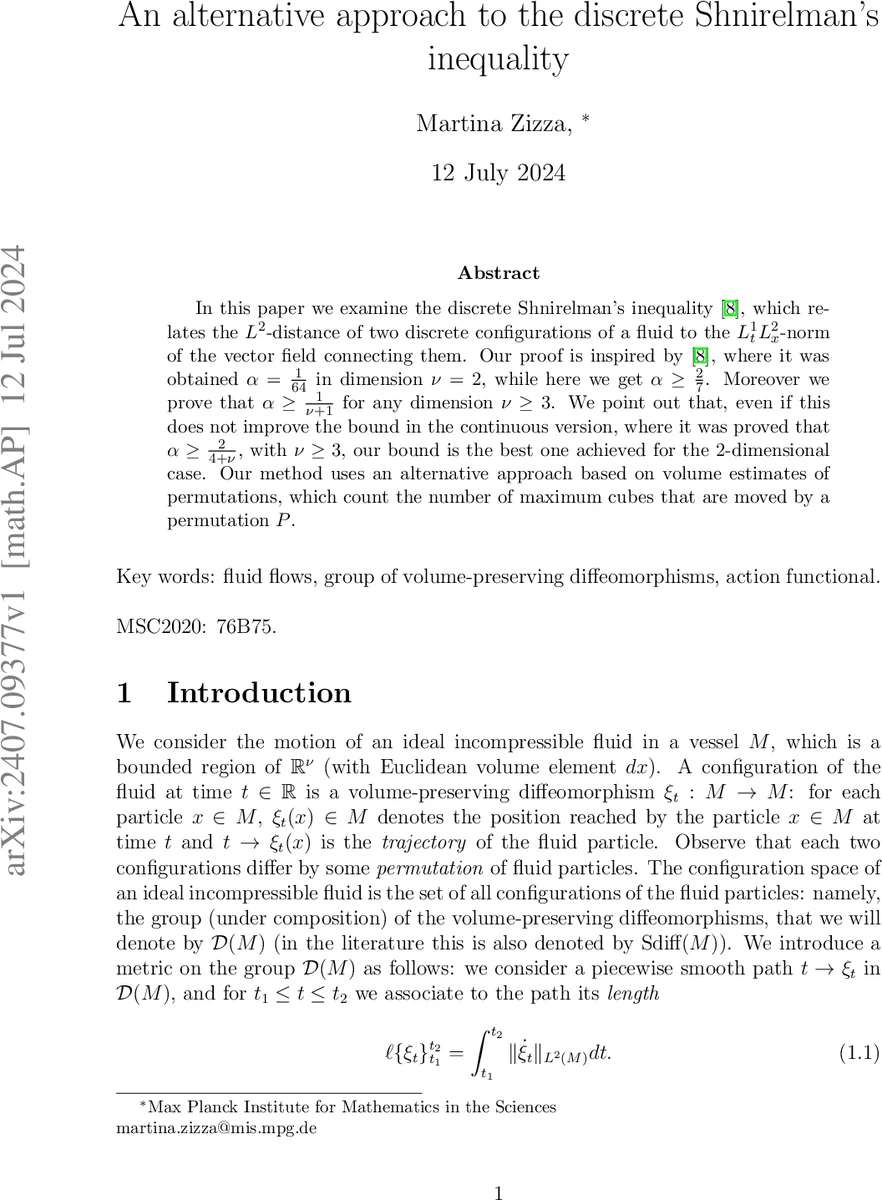
In this paper we examine the discrete Shnirelman’s inequality [Shnirelman A., 1985], which relates the $L^2$-distance of two discrete configurations of a fluid to the $L^1_tL^2_x$-norm of the vector field connecting them. Our proof is inspired by [Shnirelman A., 1985], where it was obtained $α=\frac{1}{64}$ in dimension $ν=2$, while here we get $α\geq\frac{2}{7}$. Moreover we prove that $α\geq\frac{1}{ν+1}$ for any dimension $ν\geq 3$. We point out that, even if this does not improve the bound in the continuous version, where it was proved that $α\geq\frac{2}{4+ν}$, with $ν\geq 3$, our bound is the best one achieved for the $2$-dimensional case. Our method uses an alternative approach based on volume estimates of permutations, which count the number of maximum cubes that are moved by a permutation $P$.
💡 Research Summary
The paper addresses the discrete version of Shnirelman’s inequality, which bounds the geodesic distance on the group of volume‑preserving diffeomorphisms (D(M)) by a power of the (L^{2})‑norm of the difference between two configurations. In the continuous setting, Shnirelman proved for dimensions (\nu\ge 3) that there exist constants (C>0) and (\alpha\ge 2/(\nu+4)) such that \
Comments & Academic Discussion
Loading comments...
Leave a Comment